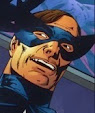

Grant Morrison's "season" writing Batman and Robin is drawing near to its end. The fifth and final three-issue arc of that run has begun, raising the stakes to their highest point. Given the spectacular conclusion that his run on Batman delivered for the final two issues of its main plot, there is every reason to expect lots of fireworks in the rest of the current arc and in the wrap-up issue, #16.
The Joker in Reverse?
The story is perhaps not a mystery in the classic sense (now that the Domino Killer and Oberon Sexton have had their mutual identity revealed as the Joker), but there are numerous substantial mysteries remaining. One of the biggest concerns the Joker himself. We got a clear reveal of the grinning face behind the Sexton mask. It's unclear, though, what is going on inside the Joker's mind. In captivity for all of his scenes in B&R #13, the Joker insists that he wants to assist Batman and Robin in their upcoming confrontation with the villain whom we know to be Doctor Hurt. No one in the story believes him: Dick and Damian are equally certain that the Joker is trying to gain their confidence merely to turn around and do evil. Probably, though, the heroes are wrong and the Joker's telling the truth.
It would certainly be more like history if Dick and Damian were correct, and the Joker were waiting for them to trust him before pulling an enormous treacherous joke on them. But Morrison said, very early on, that his plan for the Joker was to do something that he didn't think had been done before. But the Joker has pretended to be a good guy only to close a trap on Batman in the past -- it happened in The Brave and The Bold #111, and that story was collected in The Greatest Joker Stories Ever Told, so there's a good chance that Morrison is aware of it. Moreover, we have seen what Dick hasn't, that the Joker really was investigating Hurt and spiting him over the phone. And we have seen Hurt concur, as when he speaks with Senator Vine in #12, that the Joker really is working against him. Probably what the Joker said is on the level -- he is trying to stop Hurt. Intriguingly, the Joker knows more about Hurt's plan than we do. So when Dick turns his back on the Joker's offer to help, he seems to be letting the second to last chance to stop Doctor Hurt slip away. That is, the Joker could clue Dick in and give him the information he needs to neutralize Hurt's plan. If that's the second to last chance, then what is the last chance Dick has? Well, it's whatever Dick is actually going to do. Because he probably means what he says to Hurt through clenched teeth: "You're finished."
The Joker's motives still seem more complex than merely whether he is "good" or "bad". His overtures to the new Batman made repeated reference to Bruce Wayne. It becomes increasingly unlikely that the Joker has come out of RIP strangely unaware of his longtime foe's secret identity. The Joker has managed to track down and kill three members of the Black Glove. Does he honestly believe that Bruce Wayne is a member of the Black Glove? He shouldn't -- there was no one who looked like Bruce Wayne among the masked billionaires except for Batman himself. So when "Oberon Sexton" asks in #12 "Did Wayne have anything to say?" he's probably looking for information about his missing adversary. The obvious reason why would be because of their essential roles in one another's lives. But the intersection between his investigation and the Wayne cemetery's "garden of death" offers an additional, if unneeded explanation; the Joker may have learned enough about Hurt's goals to know that Wayne Manor is significant for reasons we know only partially.
In #13, Dick observes that the Joker's pattern on the map is a Mexican Train, domino-style. The post-RIP killings lead east to west: Arabia to Italy to the UK. (The sequence of the Russian general is unclear; but from Dick's comments, he doesn't consider it to break the pattern.) This is by design; the Joker could have killed them in any order, but he chose that sequence in order to point to Gotham. For a Batman to put the pattern of murders onto a map is something Damian does in Batman #666. Once the Black Glove killings stop (or pause) at Gotham, they branch off (which is what domino arrangements in Mexican Train do) to begin the marking of El Penitente's underlings: Toad is killed; then, Pyg, Santo, and Naberius receive planted dominoes. This is possibly just a message to the new Batman that El Penitente and the Black Glove are connected. Whatever the intent, Hurt sees it too: He says in #12 that the Joker is coming at the Black Glove "out of the east". Dick figured out that it was the Joker's work, but doesn't seem to have seen as of the time the Batmobile was shot down in #13 how it points to Doctor Hurt.
It's possible that the last chance is for Dick to give the Joker a chance to help. But things are not on that track. It is easy to miss the keening menace in Damian's speech to the Joker, just before he brings a crowbar into the discussion. Morrison is putting us back into the interrogation scene from The Dark Knight, when Heath Ledger's Joker giggled at Christian Bane's Batman and said, "You have nothing, nothing to threaten me with..." Morrison pens a retort in Damian's words. He does have something to threaten the Joker with, and it's not plain violence. He means to take the Joker's "brilliant mind" from him. He means to lobotomize the Joker with blunt force. He thinks he's found the one thing the Joker really does care about. And he's probably right, and the version of the Joker who might "join forces with your old enemy to turn the tables on these upstart newcomers" (Batman #680) is probably going to cease to be. The solicit for #14 mentions "two foes who almost destroyed the original Batman". While that could technically be fulfilled with Hurt and anyone else from Mr. Freeze to Killer Croc, the chances are that it means the exact same villain lineup from RIP: Hurt and the Joker, now both working against the new Batman. Dick and Damian are soon running out of chances to make mistakes in the showdown with Hurt. This may be the last.
Symbols and Signs
 We know from ROBW #4 that Alan Wayne deliberately drew a bat into the gardens around Wayne Manor in order to mark the location of the casket for when the man in black (Bruce Wayne, not Johnny Cash) returned. As the panel at right makes clear, he also built the outline of a bat into the Wayne Manor library, which is a room of great importance to the story. Various features of this room, such as the portrait of Thomas and Martha Wayne, have been in the background of several recent installments in this story, telling us that this is not only the room where Dick (in B&R #10) and Bruce (in Batman #701) press the three roses to enter the hidden room. It is also where Solomon Wayne posed for his portrait. More important, it is the location where Doctor Hurt will shoot Dick Grayson.

 Under the portrait of Bruce's parents, and just over the portal where one enters the secret passageways, is an art piece, the head of a horse. This seemingly requires no comment. But we should be looking for details: In an interview, Morrison called Andy Clarke's work (as in #10) part of a "Dan Brown thing" involving "attention to detail". And the same horsehead image appears also on the head and clothing of one of the 99 Fiends -- the very same one who picks up the casket in #12 and later springs Pyg from his cell in #13. It's seen, too, when Bruce approaches the passage in Batman #701. In all, three artists have now depicted the horsehead, although not one single word has called attention to it. What can a horsehead mean? A chess knight, recalling "the Dark Knight". A famous nebula in the sky just under Orion's Belt -- a trio of stars which has been mentioned several times in the story and is symbolized by the roses that appear in the very same location in the library. The horse Bruce rides in ROBW.

It is almost directly behind Dick's head in the panel depicting his shooting. Black fragments in the air may tell us something about the physics of the gunshot. In ROBW #4, Old Thomas Wayne refers to statues. We haven't seen plural statues of significance in the story yet -- just the one of Barbatos under the Manor. Is this horse figure another statue in the set to which OTW refers? It's not required that the horsehead will come to mean anything, or if so that its meaning would be more than a throwaway. But it certainly does keep surfacing.
Changing Faces
 During the run of RIP, I looked for clues in the original appearance of John Mayhew in World's Finest #89. Mayhew has very little dialogue in that issue, and what he does say is banal. What I found striking was how utterly his appearance had been transformed. In Mayhew's first appearance (almost exactly 50 years before his second), the great Curt Swan drew him as a man showing the gray hair of his age and some excess weight, not unlike Perry White. In Grant Morrison's "Club of Heroes" story, Mayhew looks much younger (though he's "almost sixty"). To the point, he looks near enough like Thomas Wayne. Probably more like Thomas Wayne than is coincidence. But why?
Even before Doctor Hurt told us that he had broken Bruce's mind with "carefully prepared scenarios", it seemed as though Mayhew's murderous attack on the Club of Heroes was designed, perhaps, not so much to succeed as to prey on Bruce's worries. He told Tim Drake that he decided to attend that reunion because he always wondered "what eccentric men who have everything do when they get bored." And knowing Hurt's larger scheme, we can ask, was Bruce's curiosity planted so that Mayhew, resembling Bruce's own father, supplied a completely repugnant answer: that men like Thomas Wayne can turn to murder and evil when they get bored. And with Morrison asking his artists to retool Mayhew into a Thomas Wayne lookalike, Mayhew becomes a plausible alternate version of Thomas Wayne, one whose activities were set up by Hurt in order to help split Bruce's mind with the thought that his good father, the parent whose death Bruce's mission is meant to avenge, was not a good man at all?
There are other lines throughout Morrison's run that support this conjecture, such as when Bruce describes Thomas to Damian as "a good man", "a doctor". But all of these lines are filled with many-way ambiguity. Bruce himself is an "eccentric man who has everything". And the equation between doctors and good men can also read as an ironic take on Hurt, maybe even explaining why Bruce trusted himself in Doctor Hurt's isolation experiment in the first place.
It's to the credit of Morrison's run that such ambiguity works and adds life to the reading even without point-by-point confirmation of any of these possibilities. But I raise this topic now, and explore some of its branching paths, to posit another reason for the "total makeover" of John Mayhew: Maybe the opening scenes of Batman and Robin #13 show John Mayhew and his wife Dorothy Lamarr and how he "had her killed" (Batman #669). Excepting that the part of the hair is on the other side, the "evil Thomas" is quite credibly Mayhew -- he looks like Mayhew and does something that we know Mayhew did. There is an important omission, though -- previous tellings of Mayhew's story have never included a son. And, there would have to be a villain of cosmic grandeur pulling the strings for Mayhew's family to have seen Zorro on the night of their "mugging" and for his son to have fenced at the air just as Bruce did. If such a boy existed, then he was a sort of alternate Bruce who was cut down in his youth.
There isn't enough to conclude that the "evil Thomas" we saw was actually Mayhew, but the commonalities run deep and are part of the larger "couples plot" that has continually resurfaced in alternate versions. One common element is that the man in the couple sees to the murder of his wife or lover. Count the instances of this, in truth and lies, in Morrison's Batman work:
1) The Joker planned to kill Harley Quinn in Batman #663
2) The "Bane Batman" Branca "killed his wife and kids" due to Hurt's manipulation
3) Flamingo killed his wife and children due to Hurt's manipulation
4) Mayhew killed his wife
5) Mangrove Pierce was framed for killing his lover, Mayhew's wife
6) According to the dossier and Hurt's lies, Bruce's father hired Chill to kill Martha
7) Oberon Sexton killed his wife
8) The "evil Thomas Wayne" seen in B&R #13 hired a man to kill his wife and son
9) Though it was for the purpose of saving her, Dick helped Batwoman overdose fatally in B&R #8-9
Why does this theme recur so often? Is it simply because it has high emotional charge, and needs no further explanation? Or is it something that Doctor Hurt is making to happen over and over again? Did, perhaps, Doctor Hurt's earlier incarnation as the older Thomas Wayne kill his wife? We may not get an answer. But as things turn back to the past in ROBW #5, it's useful to have the details of Mayhew's biography fresh in the memory.
Lady in Red
There's one other late character who has received a makeover. Martha Wayne has, perhaps, lighter hair in the portrait seen over the secret passageway than we've seen on her in the past. This is within the realm of colorists' variation (and Morrison's stories include a lot of unnatural hues... scenes that look as though they were lit by a strongly colored light). Martha's hair looked brown back in Batman #673. It was black in Batman #682. Maybe this isn't even Morrison's decision-making at work. But it is intriguing that Martha and Thomas may be, respectively, in red and black, as they did in the masquerade ball story in Detective #235. Old themes circle round again.
Hurt's Last Move
Doctor Hurt is yet to star in two or three upcoming issues of Batman and Robin, one issue of Batman, and one or two issues of Return of Bruce Wayne. The solicit for B&R #15 promises "the final confrontation with Doctor Hurt". Whether or not this tremendous character, perhaps Grant Morrison's greatest invention, is to be killed off, his motives and plans, and perhaps his origin, will be the prime focus of the three titles that Morrison is writing over the next several weeks.
My next post will be about this character in the context of the current story. We might re-ask the top question in comics from 2008 now and expect to see a different answer: Who is the Black Glove? On Thursday, I'll post on Doctor Hurt and his latest -- perhaps final -- plan.
It would certainly be more like history if Dick and Damian were correct, and the Joker were waiting for them to trust him before pulling an enormous treacherous joke on them. But Morrison said, very early on, that his plan for the Joker was to do something that he didn't think had been done before. But the Joker has pretended to be a good guy only to close a trap on Batman in the past -- it happened in The Brave and The Bold #111, and that story was collected in The Greatest Joker Stories Ever Told, so there's a good chance that Morrison is aware of it. Moreover, we have seen what Dick hasn't, that the Joker really was investigating Hurt and spiting him over the phone. And we have seen Hurt concur, as when he speaks with Senator Vine in #12, that the Joker really is working against him. Probably what the Joker said is on the level -- he is trying to stop Hurt. Intriguingly, the Joker knows more about Hurt's plan than we do. So when Dick turns his back on the Joker's offer to help, he seems to be letting the second to last chance to stop Doctor Hurt slip away. That is, the Joker could clue Dick in and give him the information he needs to neutralize Hurt's plan. If that's the second to last chance, then what is the last chance Dick has? Well, it's whatever Dick is actually going to do. Because he probably means what he says to Hurt through clenched teeth: "You're finished."
The Joker's motives still seem more complex than merely whether he is "good" or "bad". His overtures to the new Batman made repeated reference to Bruce Wayne. It becomes increasingly unlikely that the Joker has come out of RIP strangely unaware of his longtime foe's secret identity. The Joker has managed to track down and kill three members of the Black Glove. Does he honestly believe that Bruce Wayne is a member of the Black Glove? He shouldn't -- there was no one who looked like Bruce Wayne among the masked billionaires except for Batman himself. So when "Oberon Sexton" asks in #12 "Did Wayne have anything to say?" he's probably looking for information about his missing adversary. The obvious reason why would be because of their essential roles in one another's lives. But the intersection between his investigation and the Wayne cemetery's "garden of death" offers an additional, if unneeded explanation; the Joker may have learned enough about Hurt's goals to know that Wayne Manor is significant for reasons we know only partially.
In #13, Dick observes that the Joker's pattern on the map is a Mexican Train, domino-style. The post-RIP killings lead east to west: Arabia to Italy to the UK. (The sequence of the Russian general is unclear; but from Dick's comments, he doesn't consider it to break the pattern.) This is by design; the Joker could have killed them in any order, but he chose that sequence in order to point to Gotham. For a Batman to put the pattern of murders onto a map is something Damian does in Batman #666. Once the Black Glove killings stop (or pause) at Gotham, they branch off (which is what domino arrangements in Mexican Train do) to begin the marking of El Penitente's underlings: Toad is killed; then, Pyg, Santo, and Naberius receive planted dominoes. This is possibly just a message to the new Batman that El Penitente and the Black Glove are connected. Whatever the intent, Hurt sees it too: He says in #12 that the Joker is coming at the Black Glove "out of the east". Dick figured out that it was the Joker's work, but doesn't seem to have seen as of the time the Batmobile was shot down in #13 how it points to Doctor Hurt.
It's possible that the last chance is for Dick to give the Joker a chance to help. But things are not on that track. It is easy to miss the keening menace in Damian's speech to the Joker, just before he brings a crowbar into the discussion. Morrison is putting us back into the interrogation scene from The Dark Knight, when Heath Ledger's Joker giggled at Christian Bane's Batman and said, "You have nothing, nothing to threaten me with..." Morrison pens a retort in Damian's words. He does have something to threaten the Joker with, and it's not plain violence. He means to take the Joker's "brilliant mind" from him. He means to lobotomize the Joker with blunt force. He thinks he's found the one thing the Joker really does care about. And he's probably right, and the version of the Joker who might "join forces with your old enemy to turn the tables on these upstart newcomers" (Batman #680) is probably going to cease to be. The solicit for #14 mentions "two foes who almost destroyed the original Batman". While that could technically be fulfilled with Hurt and anyone else from Mr. Freeze to Killer Croc, the chances are that it means the exact same villain lineup from RIP: Hurt and the Joker, now both working against the new Batman. Dick and Damian are soon running out of chances to make mistakes in the showdown with Hurt. This may be the last.
Symbols and Signs


 Under the portrait of Bruce's parents, and just over the portal where one enters the secret passageways, is an art piece, the head of a horse. This seemingly requires no comment. But we should be looking for details: In an interview, Morrison called Andy Clarke's work (as in #10) part of a "Dan Brown thing" involving "attention to detail". And the same horsehead image appears also on the head and clothing of one of the 99 Fiends -- the very same one who picks up the casket in #12 and later springs Pyg from his cell in #13. It's seen, too, when Bruce approaches the passage in Batman #701. In all, three artists have now depicted the horsehead, although not one single word has called attention to it. What can a horsehead mean? A chess knight, recalling "the Dark Knight". A famous nebula in the sky just under Orion's Belt -- a trio of stars which has been mentioned several times in the story and is symbolized by the roses that appear in the very same location in the library. The horse Bruce rides in ROBW.
It is almost directly behind Dick's head in the panel depicting his shooting. Black fragments in the air may tell us something about the physics of the gunshot. In ROBW #4, Old Thomas Wayne refers to statues. We haven't seen plural statues of significance in the story yet -- just the one of Barbatos under the Manor. Is this horse figure another statue in the set to which OTW refers? It's not required that the horsehead will come to mean anything, or if so that its meaning would be more than a throwaway. But it certainly does keep surfacing.
Changing Faces

Even before Doctor Hurt told us that he had broken Bruce's mind with "carefully prepared scenarios", it seemed as though Mayhew's murderous attack on the Club of Heroes was designed, perhaps, not so much to succeed as to prey on Bruce's worries. He told Tim Drake that he decided to attend that reunion because he always wondered "what eccentric men who have everything do when they get bored." And knowing Hurt's larger scheme, we can ask, was Bruce's curiosity planted so that Mayhew, resembling Bruce's own father, supplied a completely repugnant answer: that men like Thomas Wayne can turn to murder and evil when they get bored. And with Morrison asking his artists to retool Mayhew into a Thomas Wayne lookalike, Mayhew becomes a plausible alternate version of Thomas Wayne, one whose activities were set up by Hurt in order to help split Bruce's mind with the thought that his good father, the parent whose death Bruce's mission is meant to avenge, was not a good man at all?
There are other lines throughout Morrison's run that support this conjecture, such as when Bruce describes Thomas to Damian as "a good man", "a doctor". But all of these lines are filled with many-way ambiguity. Bruce himself is an "eccentric man who has everything". And the equation between doctors and good men can also read as an ironic take on Hurt, maybe even explaining why Bruce trusted himself in Doctor Hurt's isolation experiment in the first place.
It's to the credit of Morrison's run that such ambiguity works and adds life to the reading even without point-by-point confirmation of any of these possibilities. But I raise this topic now, and explore some of its branching paths, to posit another reason for the "total makeover" of John Mayhew: Maybe the opening scenes of Batman and Robin #13 show John Mayhew and his wife Dorothy Lamarr and how he "had her killed" (Batman #669). Excepting that the part of the hair is on the other side, the "evil Thomas" is quite credibly Mayhew -- he looks like Mayhew and does something that we know Mayhew did. There is an important omission, though -- previous tellings of Mayhew's story have never included a son. And, there would have to be a villain of cosmic grandeur pulling the strings for Mayhew's family to have seen Zorro on the night of their "mugging" and for his son to have fenced at the air just as Bruce did. If such a boy existed, then he was a sort of alternate Bruce who was cut down in his youth.
There isn't enough to conclude that the "evil Thomas" we saw was actually Mayhew, but the commonalities run deep and are part of the larger "couples plot" that has continually resurfaced in alternate versions. One common element is that the man in the couple sees to the murder of his wife or lover. Count the instances of this, in truth and lies, in Morrison's Batman work:
1) The Joker planned to kill Harley Quinn in Batman #663
2) The "Bane Batman" Branca "killed his wife and kids" due to Hurt's manipulation
3) Flamingo killed his wife and children due to Hurt's manipulation
4) Mayhew killed his wife
5) Mangrove Pierce was framed for killing his lover, Mayhew's wife
6) According to the dossier and Hurt's lies, Bruce's father hired Chill to kill Martha
7) Oberon Sexton killed his wife
8) The "evil Thomas Wayne" seen in B&R #13 hired a man to kill his wife and son
9) Though it was for the purpose of saving her, Dick helped Batwoman overdose fatally in B&R #8-9
Why does this theme recur so often? Is it simply because it has high emotional charge, and needs no further explanation? Or is it something that Doctor Hurt is making to happen over and over again? Did, perhaps, Doctor Hurt's earlier incarnation as the older Thomas Wayne kill his wife? We may not get an answer. But as things turn back to the past in ROBW #5, it's useful to have the details of Mayhew's biography fresh in the memory.
Lady in Red
There's one other late character who has received a makeover. Martha Wayne has, perhaps, lighter hair in the portrait seen over the secret passageway than we've seen on her in the past. This is within the realm of colorists' variation (and Morrison's stories include a lot of unnatural hues... scenes that look as though they were lit by a strongly colored light). Martha's hair looked brown back in Batman #673. It was black in Batman #682. Maybe this isn't even Morrison's decision-making at work. But it is intriguing that Martha and Thomas may be, respectively, in red and black, as they did in the masquerade ball story in Detective #235. Old themes circle round again.
Hurt's Last Move
Doctor Hurt is yet to star in two or three upcoming issues of Batman and Robin, one issue of Batman, and one or two issues of Return of Bruce Wayne. The solicit for B&R #15 promises "the final confrontation with Doctor Hurt". Whether or not this tremendous character, perhaps Grant Morrison's greatest invention, is to be killed off, his motives and plans, and perhaps his origin, will be the prime focus of the three titles that Morrison is writing over the next several weeks.
My next post will be about this character in the context of the current story. We might re-ask the top question in comics from 2008 now and expect to see a different answer: Who is the Black Glove? On Thursday, I'll post on Doctor Hurt and his latest -- perhaps final -- plan.


