First as tragedy, then as farce. The pivotal battle of Dick Grayson's tenure as Bruce Wayne's replacement is here. The next issue is almost three weeks away, but a web-released preview gives us indications of where the battle and the larger story are going.
First, we see Alfred in the Wayne Manor library, whose portal to the hidden evil Batcave has been illustrated in multiple recent issues. Once again, we see the portrait of Thomas and Martha and the horsehead. Alfred appears to enter a different portal, first passing on foot, then manipulating the hands of a clock. The clock entrance has been displayed in many accounts of the Batcave architecture over the years; in Batman #676, Alfred and Tim Drake appear to enter the Batcave in this way, but no attention is given to the mechanism that opens the clock-portal. In Legends of the Dark Knight #6, Morrison shows Bruce seated in a very similarly-rendered library or den, with attention to a window that allows the sun to shine through, and a clock drawn by Klaus Janson that resembles the one Tony Daniel drew in RIP. This is similar to the clock drawn now by Frazier Irving. In "Gothic", Bruce sits in a room of stopped clocks, each turned to 8:25, presumably the hour of his parents' deaths. In Batman and Robin #14, Alfred turns the clock to 9:46 or 9:47. In Batman #701, when Alfred observes that what is likely the same clock has stopped (unbeknownst to him, at the time of the helicopter crash), it is stopped at 1:15. What is the relationship between these times? Did Morrison substitute, arbitrarily, a different death time for the Waynes? Or is there a second event that has some meaning? Or is it all arbitrary? Does it all break down into symbolism and hints and clues, or is that just Wikipedia?
Even if Alfred is going to the normal Batcave, then there is some significance to the scene or it wouldn't be shown to us. But even more so if he's going somewhere else. In #701, Bruce believes that Hurt got into the hidden evil Batcave. It's not clear how he knows that, but it's reasonable to assume that he has some sort of silent alarm. Suppose it wasn't Hurt who entered the room but Alfred. Given the reveals that are coming about the backstory, we can suspect that Alfred's been in that room before, when Thomas and Martha were. I.e., Alfred knows something that Bruce doesn't. As the Black Glove prepares to strike again, is Alfred going to the scene of a Black Glove event that he attended, one with great importance to the history of the Waynes?
The other event in this unlettered preview is the twist in the "interrogation room" encounter between Damian and the Joker. Having pleaded his (relative) innocence and desire to help, the Joker passively turns the beating into a victory. Damian stiffens, grins, and collapses. Apparently, the Joker has "tainted, sour blood" (something the Bat Clone says, in a different context, in B&R #9). This hearkens back to "The Clown at Midnight", when the Joker kills two Arkham guards with his own saliva, with the text explaining that his body has been dosed with so many toxins over the years that he is immune to that which easily kills others. The scene reads as a deliberate counterattack on the Joker's part, but it remains possible that the Joker didn't intend to win this way. Possible, but the man with the permanently frozen grin certainly seems pleased by the prospect.
First as tragedy, then as farce. The Alex Ross cover to Batman #680 showed Batman and Robin (Bruce and Tim) facing the Club of Villains in battle. Nothing very much like this scene actually happened. The villains who were taken down were beaten by the Club of Heroes and Nightwing. So the similar cover to B&R #14 may also illustrate a theme rather than a coming fistfight. The key parallel is that the Club of Villains were Hurt's muscle, and in the new cover, this is also true of the individually mediocre-looking but numerically awesome 99 Fiends. Naberius told us way back that the 99 Fiends have no master. Maybe not, maybe they are a "pandemonium" of which Hurt is a part, but this cover shows us, as did B&R #10-12, that they are doing Hurt's bidding.
Robin has been brought down (even if not deliberately) by the Joker, and whatever did so is sure to erode a path through the policemen guarding him, and the Joker will escape. The 99 Fiends have brought down Dick Grayson and Jim Gordon where Dollotrons are waiting to swarm them. Dick Grayson's capture is imminent, if not in the moment where we last saw him, then in the three days to come. This preview shows us that the Wayne Manor library remains the focal point of what's coming. And as a link to the past, Alfred may be showing us, with Return of Bruce Wayne #5 to show more, that it is also the key focal point in the story's past: Thomas and Martha, "Gotham's Hurt", a masquerade party, a cowl, and the Black Glove. The pivotal events in Batman's past, coming to light now.
Friday, August 20, 2010
Monday, August 16, 2010
Mad Men 404: The Rejected
Youth will be served, but not right away. As the decade moves closer to its appointment with revolution and upheaval, the generation that brought change faced many obstacles along the way. Youth and innovation were the subject of more than one of this episode's title reference, "The Rejected."
That begins with photos rejected from LIFE magazine because the boss hates nudes. The photographer's show is raided by the police. Soon enough, Clearasil (a face cream for teenagers) is rejected in favor of Ponds (a face cream for aging women). Allison loses her job as Don's secretary to someone perhaps too old to be her grandmother. The new ideas of Doctor Faye Miller are predictably rejected by Don just as the youth and vigor of Ken Cosgrove have been wasted at the two firms that he's worked for since Sterling Cooper. Along the way, Pete Campbell's child is forgotten when Pete assumes that Peggy's congratulated are work-related. We even find out that Trudy's mother had her uterus removed. The older generation really doesn't allow up-and-comers a break in this episode. Least of all Malcolm X, who is shot.
The rejected strike back. The photographer insults Peggy's entire commercial existence ("Why would I ever do that?"), just a moment after his friend assumes that when she says that she's a writer, that she must mean something besides a copy writer. (Peggy kisses him in thanks for the insult. Or, more to the point, for being part of the generation she chooses when she leaves the white-haired men in suits on the other side of the glass door at the end.) Pete forcefully gets Clearasil to oust Pond's from the firm's business. Allison throws a decoration at Don. Faye once again lashes back at Don when he rejects the very axioms of her approach. And in the episode's final shot, Don closes a heavy wooden door on the old couple arguing with mind-numbing lethargy over pears. If the very old and their ways have no use for the young, the reverse is equally true. And when the sparks are done flying, doors close to separate them. The door that Peggy closes on the older admen could be right out of The Graduate, itself a movie about two generations turning their backs on one another.
Symbols of intergenerational strife are worn to death in studies of the Sixties. Fortunately, "Mad Men" builds these scenarios on the back of rock-solid characterization. When we first see the older-than-Moses secretary now serving Don, we don't need to see Joan Holloway's face to know what sort of misbehavior on Don's part she was insuring against.
When Pete Campbell unleashes a torrent of bile in the direction of his never less than pleasant father-in-law, we react first with the uncomfortable reminder of how thoroughly amoral he is; then with the memory that he is also impeccably pragmatic, wonder not if but how, in his calculation, the vicious attack must be in his best interests. He's not just venting steam ("Every time you jump to conclusions, Tom, you make me respect you less"); he scores the career-boosting business victory that he was angling for, and it only cost him the goodwill of a key member of his family.
And in the process of using the characters, well-defined over seasons past, to execute repetitions on a basic theme, this episode scored one of the best nuanced moments in dramatic television. When Allison's emotional disarray from the quickie with Don threaten to spill over into the focus group, and in so doing shame Don publicly, Don squirms, and a lesser payoff would have been to let the scene erupt noisily, with the largest audience possible. Such are soap operas. But Allison's comments, when she does voice them, end up with just the right audience of one. Her lachrymose outburst is not coherent to the typical mind, but Peggy knows exactly what Allison is saying. She knows that Don has taken advantage of Allison, and that Allison assumes that Peggy must have achieved her career success by giving in to Don's carnal impulses, too. The implied loss of prestige immediately kills Peggy's sympathy. And as we think that Peggy's above that, that Allison has it wrong, we remember that Peggy had thrown herself at Don and it was she who was rejected and how that -- and her momentary fling with Pete -- has to bruise her self image. Allison's not the enemy, just the messenger. The tension helps push Peggy, who was gazing at her engagement ring just before this upheaval, to choose the far side of the glass door at the episode's end.
Don and "Who is Don Draper?" were less focal in this episode than in the last three. But between his distracted approach (what we'd call "multitasking" today) in the call with Lucky Strike, the bottle that was empty because he'd drunk it all, and his squirming during the focus group, we see a Don Draper still in decline. The man who makes his livelihood knowing what people want to hear doesn't know that the woman who kept sidling up to him after their one-minute stand didn't want to have to write her own compliments as her send-off. And Don, philosophically channeling David Hume and Nicholas Nassim Taleb, is technically correct when he tells Faye "You can't tell how people are going to behave based on how they have behaved." But Faye's scientific form of determinism is just another noose he's trying to slip out of. Don, we can tell exactly how you're going to behave based on how you have behaved.
He should accept Faye. She belongs aside the admen. She so adeptly makes up for losing her planned ruse (a misspelled nametag) with another (a "lost" nametag). It's like she went to the same school where Don learned to make up fires to get out of calls he doesn't want to be in. And everything about Pete that Ken Cosgrove is referring to when he says with a brutal lack of conviction, "Another Campbell. That's just what the world needs."
Thursday, August 12, 2010
Doctor Hurt
Be assured. The Black Glove is a seal of absolute quality and ruthlessness. With those words, Grant Morrison began to present to us the mind of a new villain. In a sense, Hurt had appeared before, with Grant Morrison using the general likeness and a few direct quotes of a nameless doctor from the far earlier Batman #156, "Robin Dies at Dawn". It would be fascinating to get the reaction of the creators from 1963 upon their learning that a minor throwaway character from one story had become the primary villain in Batman stories from 2007 through 2010. They would have to laugh at that idea. They would probably stop laughing when they saw him shoot Dick Grayson in the head. If they hadn't stopped long before that.
Doctor Hurt has been the force behind the scenes driving most threats to both Batmen in all of Grant Morrison's run for the last four years. Applying the foremost rule in suspense, Morrison has kept Hurt a mystery right up to the present, with clues to his nature and identity shown to us one at a time, in a striptease that seemed to conclude when Bruce Wayne beat him once, but was completely reset when Hurt somehow reemerged to send wave after wave of attacks towards the new Batman, Dick Grayson.
Who is Doctor Hurt?
He's literally the biblical Devil. He's probably the 18th Century's Thomas Wayne. He's gone by the names Doctor Simon Hurt, the Black Glove, and El Penitente. He's claimed to be Bruce's father Thomas. But all of those identities, sometimes utterly different in their activities and language, exist under a cloud of uncertainty; it seems almost more appropriate to refer to Hurt as "they" rather than "him". They, in chronological order, (and varying levels of certainty) have been:
3) Doctor Thomas Wayne, a 150-year-old casino/brothel owner around 1880; the shame of the Waynes for unnamed crimes (ROBW #4)
4) Possibly Jack the Ripper (ROBW #4)
5) A prominent Gothamite named Hurt who went missing in 1978 (Batman #678)
6) The titular head of the Black Glove club starting twenty or [much?] more years ago (Batman #681)
7) A research psychologist working for the U.S. Army about 10 years ago (Batman #674)
8) Still a psychologist working for the Gotham police about 8 years ago (Batman #674)
9) The head of the Black Glove directing attacks on Batman (Batman #665-681)
10) The Devil (Batman #681, #666, #701)
11) El Penitente, a drug lord in Mexico staging a massive attack on Gotham (B&R #4-11)
12) A man posing as Thomas Wayne, returning to Gotham to reclaim that identity (B&R #13)
That is a bizarre patchwork quilt of aliases and activities. It is further complicated by the fact that Doctor Hurt lies and speaks cryptically. He has referred to himself as "the hole in things... the piece that can never fit, there since the beginning", "the double you", "the shadow", "the dark twin". Aside from the many suspected lies he has told, he claimed, with Alfred as his only audience, that he is the recent Thomas Wayne; that he sees Alfred as a betrayer and Bruce's biological father, Martha as unfaithful, and Bruce as an usurper. He has called Gotham "home" and before he takes on the identity of a surprisingly alive Thomas Wayne, he says that he about to reclaim what has always been rightfully his, "for so many years."
There is moreover the mysterious and ever-ambiguous suggestion that he has supernatural powers, but none have been demonstrated up-front. The power he seems most often to demonstrate is immortality, but in any given scene, this is only suggested -- we have never seen him experience any definite trauma, and it is only indirect testimony saying that he over 150 years old by the time of ROBW #4. The devil in the story has given those powers also to Lane and to Damian in Batman #666. Moreover, the priest in B&R #11 asks Hurt for protection from gunfire, indicating a belief that such protection is within his means. Hurt gives specific details regarding the victim of Le Bossu in the first pages of RIP, and it is never explained how he could know such things. Finally, and most important to the story, Hurt places a curse on Bruce to wear the cape and cowl only one more time. This is not proven to be real instead of a bluff, but Bruce writes in his casebook that the curse is a "deathtrap".
At the core of all of this are facts that, if chosen selectively, suggest a rather straightforward explanation: That Doctor Hurt is the older Thomas Wayne, granted some sort of supernatural powers during a rite of demonic worship, was driven off by the scandal of his bloodletting, and is ever in wait to return, having made bids to unseat the reigning male of the Wayne family once and perhaps more times.
But this explanation leaves a lot of additional information unaccounted for, and the other information is hard to square away. Why does Hurt claim when Alfred is the only audience that he is the younger Thomas Wayne? If he wants to live the life of a wealthy man in Gotham, why is he undertaking actions to destroy it? If his goals are driven by self-interest, why doesn't he just kill Bruce and get on with it?
Character Development
Roughly speaking, we have seen Doctor Hurt (or those who might be him) in five distinct stories: As the voice whose face is never seen in the "Club of Heroes" story, as the Evil Psychologist running experiments on people, as the leader of the plan in RIP, the shadowy El Penitente / Doctor Hurt in Batman and Robin, and as Old Thomas Wayne (OTW) in ROBW. His appearance changes from c. 1880 to the present, as he appears to be 10 years older than Alan Wayne then, and passes for about sixty to pose as Thomas Wayne in the present. This could be explained as a great slowing, but not halt, of the aging process.
More meaningfully, his language and attitude changes. This is a natural consequence of changing circumstances... people at the zoo talk about animals. But in Hurt's case, it is more than that. OTW is needful and desperate. He has not procured immortality and is consumed by the pursuit of it. He speaks of Barbatos in the third person and is not, as some earlier conjectures had put it, Barbatos in possession of a human body from the time of the devil worship that had already taken place over 100 years earlier. OTW is angry, jumps into action, and never seems at ease. His singleminded pursuit of having the box opened highlights an anxiety that "Doctor Hurt" never shows except when the helicopter is about to crash.
In the present, Doctor Hurt is almost overpoweringly relaxed and smug. His poses look relaxed, he drinks champagne, and he's as often as not smirking. He speaks in terms of good and evil and universals. I performed a statistical breakdown of the word frequencies in his language during each story: In RIP, phrases such as "ultimate" and "noble spirit" are repeated, while "good" and "evil" dominate his language across all of his present-day appearances. Evil for the sake of evil has become his goal.
Is it possible that Hurt is simply like the Devil and has acquired immortality but must, in return, corrupt noble souls for the sheer sake of corruption? Could his actions as the evil influence on the world's wealthiest individuals a sort of payment that this man is making with the Devil as his boss, a separate entity? Then Hurt is not the Devil, but is a man working for the Devil. And to be clear, this is the villain whose identity was wrapped up as a secret that was eventually revealed to be the Devil.
The actual explanation is probably complex. Neither Hurt's actions nor his personality are consistent with the simple account of a 250-year-old man who just wants the family fortune back. It seems that neither simple explanation works: He's not the Devil even when he's 150 years old. But he's still obsessed with the Wayne fortune and getting back what's his when he's supposedly the ultimate evil being in the world. In fact, the latter impulse increases over time: In RIP, he uses the second person far more often than the first person singular, and uses the first person plural almost as often as the first person singular. In B&R, there is no "team", and his dominant pronoun use has switched to the first person singular. Emphasis on "my" and "mine". He wants what's his, and it seems to be utterly material. What does the Devil care with a nice house? Why would he call Gotham City his home? We cannot decide if Hurt is a man, OTW, or the Devil, because he plainly isn't either of them alone in any straightforward manner.
Twin Peaks
Morrison has made repeated references to the television show "Twin Peaks", both in the comics themselves, and in interviews. It's useful to consider the answer to the central mystery of "Twin Peaks" as a possible template for the Doctor Hurt story.
In "Twin Peaks", a girl named Laura Palmer is killed. This mystery became probably the most-talked about mystery on television since "Who Shot J.R.?" and until "The X-Files". Who killed Laura Palmer? A mortal man possessed by an evil spirit. The mortal man happened to be her father. The spirit, BOB, was not referred to as a demon, but filled the definition well enough to be considered one.
Leland Palmer was born an ordinary child. As a boy, he encountered BOB (who may or may not have been possessing some previous host), and somehow made the decision to allow BOB into him. From that time on, Leland was the host of BOB, but only thought, spoke, and acted as BOB part of the time. Usually, he was Leland. At times, BOB would take over and commit acts of unspeakable evil. When Leland was once again in control, he had no memory of what BOB had done. He wasn't even aware that BOB took turns controlling him. He either never had access to such knowledge or repressed it. And so the man/demon continued until he was finally caught for his crimes. BOB would have remained captive along with Leland had he not taken control and then suicidally injured Leland. Upon Leland's death, BOB floated free, until the final moments of the final episode, when he found a new host.
Morrison works in patterns. His seemingly standalone story in Batman #700 had numerous points of similarity to his larger Batman run as a whole. And one element in that story was Two Face Two, a character who had two personalities that split time controlling the body. When the big, handsome face wakes up, he asks, "What has he done this time? The bad little face? I'm so sorry I fell asleep." The two faces of Two Face Two work just like Leland and BOB. If Morrison is absorbing that pattern into his Batman run, it is plausibly a pattern that also explains the two-faced nature of Doctor Hurt. Old Thomas Wayne calls Gotham home and demands to possess again what is rightfully his. He abruptly snaps in Batman #679 and rants that he is the younger Thomas Wayne and calls Bruce the usurper of what is his. At other times, as the Devil, he smirks and speaks of inevitable victory. The body of Old Thomas Wayne. Sometimes the mind of Old Thomas Wayne. Sometimes the mind of the Devil.
And so he calls himself "the double you".
Gothic, The Sequel?
As noted above, we know that Morrison repeats story elements from one story to another. His JLA story "Rock of Ages" reads in some ways like an early draft of Final Crisis, even down to Darkseid hitting Bruce with his eye beams in the moments before Darkseid's defeat. It's clear that much of Morrison's long run with Batman duplicates features of the first story he ever wrote for a Batman monthly: 1990's Legends of the Dark Knight #6-10, "Gothic". Morrison has said that "Gothic" came from asking himself if a man could cheat the Devil and he decided that he couldn't. But he went on to say that RIP is the story of how Batman does cheat the Devil.
The number of known similarities between "Gothic" and the ongoing saga of Doctor Hurt is rather incredible. There are times when similarities are probably not meaningful, and arise by coincidence, being common to this genre in general or Morrison's works specifically. But the great number of alignments between the two stories is far beyond coincidence. A book could be filled with the details; for the sake of brevity, I will list in elliptical form story elements common to both "Gothic" and Morrison's post-Infinite Crisis Batman work. The length of this summary illustrates why I am not including more detailed citations.
A story opens with a man hanging upside-down at the mercy of his captor. The story features quotes from Paradise Lost. The villain's plan is centuries old. There is a countdown in days to an event in Gotham that seems harmless but is reputed to bring an apocalypse. Villains use the bat-signal to summon Batman. Villains use an upside-down symbol as a perversion of the regular form. The stories involve architecture. The stories involve roses as an instrument of death. Death is set against the ironic backdrop of children's rhymes. The villain knows Batman's identity. A woman is burned at the stake. Someone in the story is skeptical of the supernatural, but the story is supernatural. A villain is cited who kills seven victims but the eighth victim-to-be saves himself. The villain has an association with Bruce's father. An instrument of destruction is inside a box referred to within the story as a casket. The villain stands over a captive Batman and talks to him as to a child, psychoanalyzing him as a weak victim of past trauma. The villain's plan is to culminate at the stroke of midnight. Someone needs to "cheat the Devil". The villain takes a ship to England. The villain has supernaturally-derived longevity and is shown at work in the 1760s. The villain plans to unleash a plague in Gotham City. Batman arrives in a place contaminated with plague germs already wearing a gas mask. A villain attacks Batman's left arm. The villain seeks an extension of his already prolonged life, from mere centuries to all eternity. The villain is required to shed innocent blood to procure his life extension. Longevity does not entail invulnerability, and people with devilish life extension respond with an understated "Ow" when subjected to severe trauma, including being raked with gunfire. The exact vocabularies of the stories align, with "rites", "atrocious" / "atrocities", and the biblical phrase "good and faithful servant". A villain kills five crime bosses. Bruce survives an attack and then calls Alfred, asking him to bring Band-Aids.
Given this rather enormous list of coincidences, it is reasonable to wonder, when the case of Doctor Hurt features some unknowns, if the answer may be found in "Gothic". This could explain the "double you".
DCMB poster and standout Batman historian jgiannantoni05 suggests that Doctor Hurt began like "Gothic"'s villain, a man -- Old Thomas Wayne -- who made a deal with the Devil, but like Manfred, a man nonetheless. Sometime between ROBW #4 and the present, having lost his bargain, OTW forfeited his soul and the Devil came into possession of the body. To quote the villain himself, "Wayne became Hurt". If so, I would add per the earlier discussion that Hurt still is likely sometimes OTW, and probably switching personalities at times before our very eyes. As when he somewhat abruptly assaults Alfred in Batman #679. An assault that begins, perhaps not coincidentally, with the words "Wake up."
Endgame: Doctor Hurt's Attack
Whoever Doctor Hurt is, we have seen him put into motion what the solicit for B&R #15 calls his "final confrontation"with our heroes. What's coming?
Given what we absolutely know, what is hinted at by #666, and what the parallels with "Gothic" suggest, most of the details seem to be in front of us. Doctor Hurt may be seen as a single entity, but the "double you" analysis makes more sense: Doctor Hurt wants to take on the identity of Young Thomas Wayne, which seems like a logical priority for OTW, and living that life in that mansion doesn't necessarily work for or against the goals of the Devil.
There's a new Black Glove in town. As Senator Vine asks Hurt for protection in #12, we see five businessmen in domino masks waiting at the station. The Black Glove has room for five fingers, no more. Senator Vine isn't going to fit. He can count his remaining lifespan in heartbeats.
The Devil wants to settle a score with "Batman". To do so, he will try to kill Bruce Wayne's protege and most beloved companion Dick Grayson, corrupt Bruce's son Damian, and inflict mass casualties on Gotham City.
Kill the people of Gotham? That wasn't the deal that Hurt's underling Santos pitched to Gotham's mob bosses back in B&R #4. He proposed addicting the population of Gotham to drugs that they sold. That would be enormously profitable. Killing everyone in the city isn't profitable at all. That's not the plan of a mobster -- it's the plan of a devil.
But it is what is coming. Phosphorus Rex said so in B&R #3 ("They'll kill us all"), the Joker said so in #13 ("It looks like everybody dies"). And it matches the pattern of "Gothic". Manfred planned to save his own soul from the end of his 300-year deal by offering the souls of millions of dead Gothamites in his stead. He would do so by unleashing a plague from the Gotham cathedral whose construction he began. This would be set into motion by a lunar alignment that would allow light to enter through a rose window, at which time gear wheels would turn and place a phial containing the plague virus into the path of a bell which would be smashed the glass at midnight, releasing the epidemic in the heart of the city. The same addiction that could be used for profit may be lethal if the victims are not given their fix.
We already know that Hurt's plan crucially depends upon germs and upon a rare alignment of the Moon -- on the day of a solar eclipse, he refers to the "black sun" shining soon. He says this in the Wayne Manor library, a room whose importance has been foreshadowed heavily. The room has a large window which allows moonlight to enter in B&R #10. The Sun and the Moon follow nearly the same path through the sky -- any window that allows moonlight to enter will allow sunlight to enter during the day. When the eclipse happens, it will be observable from that window. This is somehow, by cosmic or mechanical necessity, essential for Hurt's corruption of Damian. Maybe he wants a more youthful body than the one of an older man he now has. Maybe an eclipse is cosmically empowering for acts of possession and soul jumping. Damian will be tempted to deal with the Devil (who "exists. I've met him") in order to save Dick Grayson and countless citizens of Gotham. Dick sees that the city could be held for ransom. But Hurt probably doesn't want money. He has money. He wants souls, bodies, death. That's the threat. That's the setup.
The solicit for the next issue says that if Dick and Damian "can't truly bond as a team, they're dead!" Right now, Dick has been shot down on one side of the city while Damian is making a big mistake beating the Joker on the other. They lose that round: Three days later, Dick is lying near death, and Damian is in captivity, asked to make a pact with the Devil. Bruce Wayne beat Manfred in "Gothic" and Doctor Hurt in RIP. If Dick's not as good as Bruce was, everybody dies.
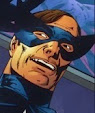
Doctor Hurt has been the force behind the scenes driving most threats to both Batmen in all of Grant Morrison's run for the last four years. Applying the foremost rule in suspense, Morrison has kept Hurt a mystery right up to the present, with clues to his nature and identity shown to us one at a time, in a striptease that seemed to conclude when Bruce Wayne beat him once, but was completely reset when Hurt somehow reemerged to send wave after wave of attacks towards the new Batman, Dick Grayson.
Who is Doctor Hurt?
He's literally the biblical Devil. He's probably the 18th Century's Thomas Wayne. He's gone by the names Doctor Simon Hurt, the Black Glove, and El Penitente. He's claimed to be Bruce's father Thomas. But all of those identities, sometimes utterly different in their activities and language, exist under a cloud of uncertainty; it seems almost more appropriate to refer to Hurt as "they" rather than "him". They, in chronological order, (and varying levels of certainty) have been:
1) Possibly "the Devil" in Gotham sometime around 1650 (ROBW #2)
2) Thomas Wayne, a devil worshipper in 1765 (B&R #10)3) Doctor Thomas Wayne, a 150-year-old casino/brothel owner around 1880; the shame of the Waynes for unnamed crimes (ROBW #4)
4) Possibly Jack the Ripper (ROBW #4)
5) A prominent Gothamite named Hurt who went missing in 1978 (Batman #678)
6) The titular head of the Black Glove club starting twenty or [much?] more years ago (Batman #681)
7) A research psychologist working for the U.S. Army about 10 years ago (Batman #674)
8) Still a psychologist working for the Gotham police about 8 years ago (Batman #674)
9) The head of the Black Glove directing attacks on Batman (Batman #665-681)
10) The Devil (Batman #681, #666, #701)
11) El Penitente, a drug lord in Mexico staging a massive attack on Gotham (B&R #4-11)
12) A man posing as Thomas Wayne, returning to Gotham to reclaim that identity (B&R #13)
That is a bizarre patchwork quilt of aliases and activities. It is further complicated by the fact that Doctor Hurt lies and speaks cryptically. He has referred to himself as "the hole in things... the piece that can never fit, there since the beginning", "the double you", "the shadow", "the dark twin". Aside from the many suspected lies he has told, he claimed, with Alfred as his only audience, that he is the recent Thomas Wayne; that he sees Alfred as a betrayer and Bruce's biological father, Martha as unfaithful, and Bruce as an usurper. He has called Gotham "home" and before he takes on the identity of a surprisingly alive Thomas Wayne, he says that he about to reclaim what has always been rightfully his, "for so many years."
There is moreover the mysterious and ever-ambiguous suggestion that he has supernatural powers, but none have been demonstrated up-front. The power he seems most often to demonstrate is immortality, but in any given scene, this is only suggested -- we have never seen him experience any definite trauma, and it is only indirect testimony saying that he over 150 years old by the time of ROBW #4. The devil in the story has given those powers also to Lane and to Damian in Batman #666. Moreover, the priest in B&R #11 asks Hurt for protection from gunfire, indicating a belief that such protection is within his means. Hurt gives specific details regarding the victim of Le Bossu in the first pages of RIP, and it is never explained how he could know such things. Finally, and most important to the story, Hurt places a curse on Bruce to wear the cape and cowl only one more time. This is not proven to be real instead of a bluff, but Bruce writes in his casebook that the curse is a "deathtrap".
At the core of all of this are facts that, if chosen selectively, suggest a rather straightforward explanation: That Doctor Hurt is the older Thomas Wayne, granted some sort of supernatural powers during a rite of demonic worship, was driven off by the scandal of his bloodletting, and is ever in wait to return, having made bids to unseat the reigning male of the Wayne family once and perhaps more times.
But this explanation leaves a lot of additional information unaccounted for, and the other information is hard to square away. Why does Hurt claim when Alfred is the only audience that he is the younger Thomas Wayne? If he wants to live the life of a wealthy man in Gotham, why is he undertaking actions to destroy it? If his goals are driven by self-interest, why doesn't he just kill Bruce and get on with it?
Character Development
Roughly speaking, we have seen Doctor Hurt (or those who might be him) in five distinct stories: As the voice whose face is never seen in the "Club of Heroes" story, as the Evil Psychologist running experiments on people, as the leader of the plan in RIP, the shadowy El Penitente / Doctor Hurt in Batman and Robin, and as Old Thomas Wayne (OTW) in ROBW. His appearance changes from c. 1880 to the present, as he appears to be 10 years older than Alan Wayne then, and passes for about sixty to pose as Thomas Wayne in the present. This could be explained as a great slowing, but not halt, of the aging process.
More meaningfully, his language and attitude changes. This is a natural consequence of changing circumstances... people at the zoo talk about animals. But in Hurt's case, it is more than that. OTW is needful and desperate. He has not procured immortality and is consumed by the pursuit of it. He speaks of Barbatos in the third person and is not, as some earlier conjectures had put it, Barbatos in possession of a human body from the time of the devil worship that had already taken place over 100 years earlier. OTW is angry, jumps into action, and never seems at ease. His singleminded pursuit of having the box opened highlights an anxiety that "Doctor Hurt" never shows except when the helicopter is about to crash.
In the present, Doctor Hurt is almost overpoweringly relaxed and smug. His poses look relaxed, he drinks champagne, and he's as often as not smirking. He speaks in terms of good and evil and universals. I performed a statistical breakdown of the word frequencies in his language during each story: In RIP, phrases such as "ultimate" and "noble spirit" are repeated, while "good" and "evil" dominate his language across all of his present-day appearances. Evil for the sake of evil has become his goal.
Is it possible that Hurt is simply like the Devil and has acquired immortality but must, in return, corrupt noble souls for the sheer sake of corruption? Could his actions as the evil influence on the world's wealthiest individuals a sort of payment that this man is making with the Devil as his boss, a separate entity? Then Hurt is not the Devil, but is a man working for the Devil. And to be clear, this is the villain whose identity was wrapped up as a secret that was eventually revealed to be the Devil.
The actual explanation is probably complex. Neither Hurt's actions nor his personality are consistent with the simple account of a 250-year-old man who just wants the family fortune back. It seems that neither simple explanation works: He's not the Devil even when he's 150 years old. But he's still obsessed with the Wayne fortune and getting back what's his when he's supposedly the ultimate evil being in the world. In fact, the latter impulse increases over time: In RIP, he uses the second person far more often than the first person singular, and uses the first person plural almost as often as the first person singular. In B&R, there is no "team", and his dominant pronoun use has switched to the first person singular. Emphasis on "my" and "mine". He wants what's his, and it seems to be utterly material. What does the Devil care with a nice house? Why would he call Gotham City his home? We cannot decide if Hurt is a man, OTW, or the Devil, because he plainly isn't either of them alone in any straightforward manner.
Twin Peaks
Morrison has made repeated references to the television show "Twin Peaks", both in the comics themselves, and in interviews. It's useful to consider the answer to the central mystery of "Twin Peaks" as a possible template for the Doctor Hurt story.
In "Twin Peaks", a girl named Laura Palmer is killed. This mystery became probably the most-talked about mystery on television since "Who Shot J.R.?" and until "The X-Files". Who killed Laura Palmer? A mortal man possessed by an evil spirit. The mortal man happened to be her father. The spirit, BOB, was not referred to as a demon, but filled the definition well enough to be considered one.
Leland Palmer was born an ordinary child. As a boy, he encountered BOB (who may or may not have been possessing some previous host), and somehow made the decision to allow BOB into him. From that time on, Leland was the host of BOB, but only thought, spoke, and acted as BOB part of the time. Usually, he was Leland. At times, BOB would take over and commit acts of unspeakable evil. When Leland was once again in control, he had no memory of what BOB had done. He wasn't even aware that BOB took turns controlling him. He either never had access to such knowledge or repressed it. And so the man/demon continued until he was finally caught for his crimes. BOB would have remained captive along with Leland had he not taken control and then suicidally injured Leland. Upon Leland's death, BOB floated free, until the final moments of the final episode, when he found a new host.
Morrison works in patterns. His seemingly standalone story in Batman #700 had numerous points of similarity to his larger Batman run as a whole. And one element in that story was Two Face Two, a character who had two personalities that split time controlling the body. When the big, handsome face wakes up, he asks, "What has he done this time? The bad little face? I'm so sorry I fell asleep." The two faces of Two Face Two work just like Leland and BOB. If Morrison is absorbing that pattern into his Batman run, it is plausibly a pattern that also explains the two-faced nature of Doctor Hurt. Old Thomas Wayne calls Gotham home and demands to possess again what is rightfully his. He abruptly snaps in Batman #679 and rants that he is the younger Thomas Wayne and calls Bruce the usurper of what is his. At other times, as the Devil, he smirks and speaks of inevitable victory. The body of Old Thomas Wayne. Sometimes the mind of Old Thomas Wayne. Sometimes the mind of the Devil.
And so he calls himself "the double you".
Gothic, The Sequel?
As noted above, we know that Morrison repeats story elements from one story to another. His JLA story "Rock of Ages" reads in some ways like an early draft of Final Crisis, even down to Darkseid hitting Bruce with his eye beams in the moments before Darkseid's defeat. It's clear that much of Morrison's long run with Batman duplicates features of the first story he ever wrote for a Batman monthly: 1990's Legends of the Dark Knight #6-10, "Gothic". Morrison has said that "Gothic" came from asking himself if a man could cheat the Devil and he decided that he couldn't. But he went on to say that RIP is the story of how Batman does cheat the Devil.
The number of known similarities between "Gothic" and the ongoing saga of Doctor Hurt is rather incredible. There are times when similarities are probably not meaningful, and arise by coincidence, being common to this genre in general or Morrison's works specifically. But the great number of alignments between the two stories is far beyond coincidence. A book could be filled with the details; for the sake of brevity, I will list in elliptical form story elements common to both "Gothic" and Morrison's post-Infinite Crisis Batman work. The length of this summary illustrates why I am not including more detailed citations.
A story opens with a man hanging upside-down at the mercy of his captor. The story features quotes from Paradise Lost. The villain's plan is centuries old. There is a countdown in days to an event in Gotham that seems harmless but is reputed to bring an apocalypse. Villains use the bat-signal to summon Batman. Villains use an upside-down symbol as a perversion of the regular form. The stories involve architecture. The stories involve roses as an instrument of death. Death is set against the ironic backdrop of children's rhymes. The villain knows Batman's identity. A woman is burned at the stake. Someone in the story is skeptical of the supernatural, but the story is supernatural. A villain is cited who kills seven victims but the eighth victim-to-be saves himself. The villain has an association with Bruce's father. An instrument of destruction is inside a box referred to within the story as a casket. The villain stands over a captive Batman and talks to him as to a child, psychoanalyzing him as a weak victim of past trauma. The villain's plan is to culminate at the stroke of midnight. Someone needs to "cheat the Devil". The villain takes a ship to England. The villain has supernaturally-derived longevity and is shown at work in the 1760s. The villain plans to unleash a plague in Gotham City. Batman arrives in a place contaminated with plague germs already wearing a gas mask. A villain attacks Batman's left arm. The villain seeks an extension of his already prolonged life, from mere centuries to all eternity. The villain is required to shed innocent blood to procure his life extension. Longevity does not entail invulnerability, and people with devilish life extension respond with an understated "Ow" when subjected to severe trauma, including being raked with gunfire. The exact vocabularies of the stories align, with "rites", "atrocious" / "atrocities", and the biblical phrase "good and faithful servant". A villain kills five crime bosses. Bruce survives an attack and then calls Alfred, asking him to bring Band-Aids.
Given this rather enormous list of coincidences, it is reasonable to wonder, when the case of Doctor Hurt features some unknowns, if the answer may be found in "Gothic". This could explain the "double you".
DCMB poster and standout Batman historian jgiannantoni05 suggests that Doctor Hurt began like "Gothic"'s villain, a man -- Old Thomas Wayne -- who made a deal with the Devil, but like Manfred, a man nonetheless. Sometime between ROBW #4 and the present, having lost his bargain, OTW forfeited his soul and the Devil came into possession of the body. To quote the villain himself, "Wayne became Hurt". If so, I would add per the earlier discussion that Hurt still is likely sometimes OTW, and probably switching personalities at times before our very eyes. As when he somewhat abruptly assaults Alfred in Batman #679. An assault that begins, perhaps not coincidentally, with the words "Wake up."
Endgame: Doctor Hurt's Attack
Whoever Doctor Hurt is, we have seen him put into motion what the solicit for B&R #15 calls his "final confrontation"with our heroes. What's coming?
Given what we absolutely know, what is hinted at by #666, and what the parallels with "Gothic" suggest, most of the details seem to be in front of us. Doctor Hurt may be seen as a single entity, but the "double you" analysis makes more sense: Doctor Hurt wants to take on the identity of Young Thomas Wayne, which seems like a logical priority for OTW, and living that life in that mansion doesn't necessarily work for or against the goals of the Devil.
There's a new Black Glove in town. As Senator Vine asks Hurt for protection in #12, we see five businessmen in domino masks waiting at the station. The Black Glove has room for five fingers, no more. Senator Vine isn't going to fit. He can count his remaining lifespan in heartbeats.The Devil wants to settle a score with "Batman". To do so, he will try to kill Bruce Wayne's protege and most beloved companion Dick Grayson, corrupt Bruce's son Damian, and inflict mass casualties on Gotham City.
Kill the people of Gotham? That wasn't the deal that Hurt's underling Santos pitched to Gotham's mob bosses back in B&R #4. He proposed addicting the population of Gotham to drugs that they sold. That would be enormously profitable. Killing everyone in the city isn't profitable at all. That's not the plan of a mobster -- it's the plan of a devil.
But it is what is coming. Phosphorus Rex said so in B&R #3 ("They'll kill us all"), the Joker said so in #13 ("It looks like everybody dies"). And it matches the pattern of "Gothic". Manfred planned to save his own soul from the end of his 300-year deal by offering the souls of millions of dead Gothamites in his stead. He would do so by unleashing a plague from the Gotham cathedral whose construction he began. This would be set into motion by a lunar alignment that would allow light to enter through a rose window, at which time gear wheels would turn and place a phial containing the plague virus into the path of a bell which would be smashed the glass at midnight, releasing the epidemic in the heart of the city. The same addiction that could be used for profit may be lethal if the victims are not given their fix.
We already know that Hurt's plan crucially depends upon germs and upon a rare alignment of the Moon -- on the day of a solar eclipse, he refers to the "black sun" shining soon. He says this in the Wayne Manor library, a room whose importance has been foreshadowed heavily. The room has a large window which allows moonlight to enter in B&R #10. The Sun and the Moon follow nearly the same path through the sky -- any window that allows moonlight to enter will allow sunlight to enter during the day. When the eclipse happens, it will be observable from that window. This is somehow, by cosmic or mechanical necessity, essential for Hurt's corruption of Damian. Maybe he wants a more youthful body than the one of an older man he now has. Maybe an eclipse is cosmically empowering for acts of possession and soul jumping. Damian will be tempted to deal with the Devil (who "exists. I've met him") in order to save Dick Grayson and countless citizens of Gotham. Dick sees that the city could be held for ransom. But Hurt probably doesn't want money. He has money. He wants souls, bodies, death. That's the threat. That's the setup.
The solicit for the next issue says that if Dick and Damian "can't truly bond as a team, they're dead!" Right now, Dick has been shot down on one side of the city while Damian is making a big mistake beating the Joker on the other. They lose that round: Three days later, Dick is lying near death, and Damian is in captivity, asked to make a pact with the Devil. Bruce Wayne beat Manfred in "Gothic" and Doctor Hurt in RIP. If Dick's not as good as Bruce was, everybody dies.
Labels:
batman,
batman and robin,
batman rip,
doctor hurt,
grant morrison
Subscribe to:
Posts (Atom)


