"I was blind. And now I see." Miss Blankenship is referring to her cataract surgery. Don has found some Amazing Grace of his own, and perhaps it is enough to save a wretch like him. This is old Don Draper. Bruised a bit and making some risky bets (like eavesdropping and two-timing). But he's not an adulterer anymore, and he's set aside serious alcohol abuse in favor of the existential woes that used to be conveyed with a grimace and now come forth in graceful, penetrating and -- for writers Lisa Albert, Janet Leahy, and Matthew Weiner -- triumphant prose.
Don's career has made him a sprinter among wordsmiths, the mind behind clever slogans half the length of a haiku. Don's journal shows him to be gifted in introspection, at least now that saving himself has proven to be necessary and worthwhile. When we first hear the words of his monologue, it sounds like one end of a conversation with a therapist, but we see that it's just Don, alone with his brilliant mind and his newfound -- or newly revealed -- self-awareness. It's an exercise in salvation. The optimism of the last episode has been borne out, thus far: The best idea does win. At least, a much better idea than waking up badly hungover with the waitress he left his one-night-stand for, and in so doing standing up his own children. Don's arc of personal improvement is obvious at every turn -- he wins an impromptu swimming race at episode's end, and wins the battle with the usurper in his home just by showing up. As another testament to his turnaround, he is invited to more sex than he accepts, and makes his model ex-wife feel insecure upon glimpsing his new life. It's telling that he sends Miss Blankenship away with the alcohol she brought -- the amount that she expected him to consume.
While the B plot brought the series to its full potential as a fraternity movie, the A plot -- Don's plot -- was resplendent, beginning with the long corridor of the swimming lane symbolizing the difficult route ahead. We later see Don submerged like Benjamin Braddock in The Graduate, in much the same state of disillusionment. But this is an improving Don Draper, who looks a lot like the Don Draper of seasons one and two, standing outside the health club, watching a market basket of 1965's people and styles go by as the Rolling Stones remind us that Don's trade tells us how white our shirts can be and that a man's not a man if he doesn't smoke the same cigarettes as he.
Particularly when last season's episode "Seven Twenty Three" showed Don as perhaps the first member of his generation to be knocked down -- literally -- by a member of antiwar counterculture, we knew that the series has always had the option of a larger historical metaphor, with Don symbolizing the end of Eisenhower America as it slides into decay with the changing times, as season upon season slowly undoes him. But Don came apart quickly and has soon been -- for the most part -- put back together. He's on the rise precisely as the war in Vietnam begins to hold a combat role for U.S. troops. Don may yet see worse than he has seen, but his arc will not rise and fall precisely with historical trends that we already know.
Broadly speaking, "control" underlies all of the episode's interactions, but that is such a general concept that it is either unintended, or is a throwaway. It is true that Peggy and Joan both try to get control of Joey and Stan, and when Peggy succeeds, Joan diminishes her victory as a way of finding the control that she has lost in her home life as well as in her marriage. To chastise the boyish men of the writing staff, she uses the threat of the war as a form of control -- and destruction -- at which they can't and don't laugh. But this is nakedly a compensation for the loss of control that she feels, worried even that her husband has to come in proximity to ammunition at boot camp and leave her without a confidante. In a still more peripheral plots, there was the battle between the vending machine and everyone who tried to use it.
But these parallels are weak and beside the point. Perhaps the meticulously-constructed parallel plots that have appeared in previous episodes this season were beside the point, or a kind of stunt. (In this episode, the most obviously parallel scenes are Don's two steamy cab rides with blondes.) Perhaps Don's rise from the abyss is itself the story arc of a self-help book or an after-school special. But the readings in the journal, and how the accompanying imagery is filmed by director Phil Abraham, delivers the depth and impact of this episode. There is Don, in bed alone, the way he has always wanted to be: Comfortable, rolling to the cool spots, feeling like a skydiver. When he says it so clearly -- and beautifully -- it isn't so hard to see who is Don Draper. Significantly, Don does not derive any particular empowerment in this episode from further openness with Peggy. What bridges the two episodes is that Don has found a voice with which to speak his feelings -- something that Joan also says she needs. We perhaps best understand Don Draper when we see that he prefers to direct his openness to one and the same person who is his bed partner -- nobody else at all.
Monday, September 13, 2010
Thursday, September 9, 2010
Batman and Robin 14
With bazookas, poison makeup, drug addiction, slaves, and a crowbar, so begins a three-sided war. The hallucinatory, nightmarish, David Lynch-inspired quality of Batman and Robin #14 is as intense and disorienting as anywhere else in Grant Morrison's sixteen-issue "first season" of the title. It is a carnival of death, debasement, victimization, and not infrequently, of comedy. Nearly nothing goes well for the heroes, at least not on-panel.
The three-headed nature of the struggle means attacks come from every direction. Robin beats, and is beaten by, the Joker, who uses the devices from the utility belt against the police. Dick and Jim Gordon are swarmed by Dollotrons. The Joker blackmails Dick into working with him. Doctor Hurt is caught off-guard by a chemical attack by the Joker at the same time that Batman swoops in, once again forced to fight a swarm of enemies who are dangerous due to sheer numbers. Then an enslaved Jim Gordon hits Dick from behind, showing the total control that Pyg's contagious addiction exerts on its victims. Finally, the Joker plans to use Damian as a weapon against Hurt.
That's a lot of action -- none of it terribly unexpected, at least given the preview that showed the Joker's escape in progress. The story is rich, however, in themes and tone, with a few lines carrying particularly important implications for where the story is going.
The horse/knight theme I mentioned earlier has crept out of the artwork and into the dialogue. The first image in the story is the horsehead in the Wayne Manor library, seen when Alfred goes either to check on Dick or to perform some other important chore in the Batcave. The final words of the issue are the title of #15 -- "The Knight, Death, and The Devil", with the words cleverly laid over the characters they represent: Dick, the Joker, and Doctor Hurt. In between, we see Hurt yell to his adversary, in a chess metaphor, that his knights have been beaten. But who is the audience for that line -- Dick or the Joker? Given that Dick is a knight, the Joker may be the one Hurt is addressing, even though his mouth is close to Dick's ear. It remains unclear if the horsehead on the mantle is a mere symbol or has some real power. Alfred may be looking at it as he passes by. Soon enough, it will be a silent witness to Hurt's gunshot aimed at Dick.
Hurt is getting a lot of practice for that shot. He fires at a pumpkin for no clear purpose early on, and later, we cut to a shot of him holding the smoking gun as a series of watermelons have received similar shootings. This is an intensely odd display of Hurt's behavior, seemingly for no purpose other than to enjoy in anticipation the shooting of Dick Grayson. He's chosen fruits that are roughly the size and shape of a head. That he seems to expect to undertake that specific manner of execution suggests some sort of ritualistic significance, either to fulfill some mystic requirement or because he will derive pleasure from it. It is a divergence from the otherwise stolid behavior we've seen him conduct as he goes about his business, and together with the wearing of the old bat-cowl and hitting Alfred with the champagne bottle, tells us more about Hurt's personality than all of his evil hand-wringing.
There is, however, plenty of that. In describing Pyg, Hurt tells us once again, that he enjoys corruption for its own sake. He describes with "might makes right" a vision of Gotham that matches the vision Lane has in Batman #666, with Lane "praying for a world where the strong are free to exploit and abuse the weak". Speaking to criminals, he celebrates crime, and plans to act on his contempt for the incorruptible, describing it with Hitler's term for a "new order" much as Lane, the Devil's messiah -- at least in his own mind -- dreamt of his version of a "better world". His vision is well underway, with the Mayor, who was shown to be working for Hurt in Morrison's Batman run, in attendance along with criminals and the media.
Other details in this issue point to #666. We see Batman fighting Dollotrons and Professor Pyg hanging upside down in a human inverted crucifix. Hurt's ceremony takes place in Crime Alley, which is apparently the scene of one Batman's death in #666, "the crossroads" where Damian chooses to deal with the Devil. The promised interaction between this story and the potential future of #666 is drawing near, and it is likely that the places where the details don't match (e.g., Damian is now ten, but fourteen when he makes the deal in #666) are to be considered dust swept under the carpet. This probably isn't a dress rehearsal for the real meeting between Damian and the Devil four years from now, but the in-continuity version of those events with, probably, a different outcome when it comes to whether or not Damian agrees to deal.
The ceremony itself, with Jim Gordon as a hostage, resembles the classic Joker story "Dreadful Birthday, Dear Joker!" from Batman #321. But this time the Joker is, if not a hero, an enemy of the villain. Senator Vine, whom Hurt seems earnestly to try to protect, gets Jokerized by a "golden domino" in a reference to Charlie and the Chocolate Factory, one of many references to children's literature in the run to date. Vine's earlier concern that Hurt told him that he would keep the Senator "outta harm's way" echoes the lines Black Glove members spoke when things went sour for them in Batman, R.I.P. Meanwhile, that Hurt uses drug addiction to flip Jim Gordon to his side is reminiscent of the very first page of Morrison's run, with a Jokerized Commissioner Gordon falling through the air, and also makes good on Lane's information in Batman #674 that Doctor Hurt makes slaves of good men. And for Jim Gordon, in an act of betrayal that at once suggests Odysseus and the sirens and Jezebel's betrayal in RIP, to succumb shows that virtually no man is too good to escape his grasp.
We get almost total assurance from Hurt's quest for the casket -- and chagrin that opening it will destroy the contents -- that Hurt is, basically, the same entity we saw as old Doctor Thomas Wayne in ROBW #4, and he uses now as then, the line "in the end". Back then, he wanted it to provide him with true immortality -- the mere centuries of life prolongation that Doctor Hurt has already enjoyed may be something short of eternal life. We know from Alan Wayne's estimate of OTW's appearance that Hurt has aged in appearance since c. 1880, so he may be aging at some reduced rate, but still on a path to die eventually. The key point is that his continued quest for the casket is a very important piece of information about Hurt's nature. While it had been surmised earlier that Hurt may have achieved immortality and true devilish nature between the events of ROBW #4 and RIP, the fact that he has the same goal now as then -- along with his aging -- suggests that he is not so very different, experience aside, than he was 130 years ago. It may explain why he exclaimed "Not like this!" at the time of the helicopter crash -- not that the crash itself would kill him, but that it might keep him from finding the casket and thus doom him to an eventual death of old age, or when his Manfred-like deal with the devil ran due.
Meanwhile, as much as those implications make Hurt seem more like an evil man with a dose of immortality than the Devil himself, Pyg bestows the devilish label of a "goat" in Gotham upon Hurt, suggesting Baphomet, a character associated with Satan. Pyg's rants reinforce that he was broken, like an animal in the experiments of Harry Harlow, to become a more perfect servant to Doctor Hurt, as part of a larger pattern (along with Flamingo and the three replacement Batmen from the GCPD experiment) to enslave good men to do evil. Pyg, eager for a PCP fix and to destroy reason, rambles on about his captivity, mentioning the rats in "Rockville" as a possible turn of the fictional asylum Rockland referenced in Allen Ginsberg's poem "Howl".
Meanwhile, the choice of Crime Alley as Hurt's chosen location resonates with the Wayne Murder itself, an event whose centrality to the Batman mythos cannot be overstated. Clearly Hurt knows about this event. Quite likely, he ordered it. But with Bruce Wayne absent, it hints at a larger agenda for Hurt to stage an event here, the same location where the event/fantasy that opened B&R #13 took place.
While Hurt goes about his plan, the Joker plans to strike at Hurt, even though the Joker is convinced that he cannot stop the dominoes from falling. The mystery of why dominoes were name-checked by Hurt and used by the Joker continues, although it seems that the Joker is using dominoes to mock Hurt, for whom dominoes seems to have some other role, larger than the plague already sweeping Gotham, which shouldn't bother the Joker all that much, save that he doesn't get to carry it out, since it is similar to his own vision of mass casualties. The Joker's first casualty in this story is Damian, who falls prey to toxins on the Joker's eyelids and/or fingernails, and has his turn interrogating the Joker go terribly sour. Damian ends the issue upside down, much like Pyg, but with his arms at his sides, with an ironic smile painted onto the tape across his mouth. At issue's end, the Joker plans to use Damian as a weapon against Hurt. Clearly, Robin will not resist that idea, although the Joker will have to distance himself from the freed Damian. Later, the Joker uses toxins to attack Hurt's audience, using popcorn (the "catering" he referred to in his call with Dick) as the delivery vehicle.
If there is a single line in the issue that packs more meaning than it seems to, it is Alfred telling Dick that he has prepared the mansion and the cave as Dick had requested. This has enormous implications. Whatever those preparations are, it means that Dick expects the confrontation to move from Crime Alley to Wayne Manor and even down into the Batcave. As we saw in the flash-forward last time, he is of course right. When he hisses to Hurt "You don't get it do you? You're finished." Dick is speaking of those preparations. That line, in reduced lettering that suggests a whisper, is Alfred telling us that Dick, for all his affinity for timing is going to end this scheme with no more help from Bruce Wayne than in having taught his friend that victory lies in the preparation.
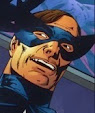
The three-headed nature of the struggle means attacks come from every direction. Robin beats, and is beaten by, the Joker, who uses the devices from the utility belt against the police. Dick and Jim Gordon are swarmed by Dollotrons. The Joker blackmails Dick into working with him. Doctor Hurt is caught off-guard by a chemical attack by the Joker at the same time that Batman swoops in, once again forced to fight a swarm of enemies who are dangerous due to sheer numbers. Then an enslaved Jim Gordon hits Dick from behind, showing the total control that Pyg's contagious addiction exerts on its victims. Finally, the Joker plans to use Damian as a weapon against Hurt.
That's a lot of action -- none of it terribly unexpected, at least given the preview that showed the Joker's escape in progress. The story is rich, however, in themes and tone, with a few lines carrying particularly important implications for where the story is going.
The horse/knight theme I mentioned earlier has crept out of the artwork and into the dialogue. The first image in the story is the horsehead in the Wayne Manor library, seen when Alfred goes either to check on Dick or to perform some other important chore in the Batcave. The final words of the issue are the title of #15 -- "The Knight, Death, and The Devil", with the words cleverly laid over the characters they represent: Dick, the Joker, and Doctor Hurt. In between, we see Hurt yell to his adversary, in a chess metaphor, that his knights have been beaten. But who is the audience for that line -- Dick or the Joker? Given that Dick is a knight, the Joker may be the one Hurt is addressing, even though his mouth is close to Dick's ear. It remains unclear if the horsehead on the mantle is a mere symbol or has some real power. Alfred may be looking at it as he passes by. Soon enough, it will be a silent witness to Hurt's gunshot aimed at Dick.
Hurt is getting a lot of practice for that shot. He fires at a pumpkin for no clear purpose early on, and later, we cut to a shot of him holding the smoking gun as a series of watermelons have received similar shootings. This is an intensely odd display of Hurt's behavior, seemingly for no purpose other than to enjoy in anticipation the shooting of Dick Grayson. He's chosen fruits that are roughly the size and shape of a head. That he seems to expect to undertake that specific manner of execution suggests some sort of ritualistic significance, either to fulfill some mystic requirement or because he will derive pleasure from it. It is a divergence from the otherwise stolid behavior we've seen him conduct as he goes about his business, and together with the wearing of the old bat-cowl and hitting Alfred with the champagne bottle, tells us more about Hurt's personality than all of his evil hand-wringing.
There is, however, plenty of that. In describing Pyg, Hurt tells us once again, that he enjoys corruption for its own sake. He describes with "might makes right" a vision of Gotham that matches the vision Lane has in Batman #666, with Lane "praying for a world where the strong are free to exploit and abuse the weak". Speaking to criminals, he celebrates crime, and plans to act on his contempt for the incorruptible, describing it with Hitler's term for a "new order" much as Lane, the Devil's messiah -- at least in his own mind -- dreamt of his version of a "better world". His vision is well underway, with the Mayor, who was shown to be working for Hurt in Morrison's Batman run, in attendance along with criminals and the media.
Other details in this issue point to #666. We see Batman fighting Dollotrons and Professor Pyg hanging upside down in a human inverted crucifix. Hurt's ceremony takes place in Crime Alley, which is apparently the scene of one Batman's death in #666, "the crossroads" where Damian chooses to deal with the Devil. The promised interaction between this story and the potential future of #666 is drawing near, and it is likely that the places where the details don't match (e.g., Damian is now ten, but fourteen when he makes the deal in #666) are to be considered dust swept under the carpet. This probably isn't a dress rehearsal for the real meeting between Damian and the Devil four years from now, but the in-continuity version of those events with, probably, a different outcome when it comes to whether or not Damian agrees to deal.
The ceremony itself, with Jim Gordon as a hostage, resembles the classic Joker story "Dreadful Birthday, Dear Joker!" from Batman #321. But this time the Joker is, if not a hero, an enemy of the villain. Senator Vine, whom Hurt seems earnestly to try to protect, gets Jokerized by a "golden domino" in a reference to Charlie and the Chocolate Factory, one of many references to children's literature in the run to date. Vine's earlier concern that Hurt told him that he would keep the Senator "outta harm's way" echoes the lines Black Glove members spoke when things went sour for them in Batman, R.I.P. Meanwhile, that Hurt uses drug addiction to flip Jim Gordon to his side is reminiscent of the very first page of Morrison's run, with a Jokerized Commissioner Gordon falling through the air, and also makes good on Lane's information in Batman #674 that Doctor Hurt makes slaves of good men. And for Jim Gordon, in an act of betrayal that at once suggests Odysseus and the sirens and Jezebel's betrayal in RIP, to succumb shows that virtually no man is too good to escape his grasp.
We get almost total assurance from Hurt's quest for the casket -- and chagrin that opening it will destroy the contents -- that Hurt is, basically, the same entity we saw as old Doctor Thomas Wayne in ROBW #4, and he uses now as then, the line "in the end". Back then, he wanted it to provide him with true immortality -- the mere centuries of life prolongation that Doctor Hurt has already enjoyed may be something short of eternal life. We know from Alan Wayne's estimate of OTW's appearance that Hurt has aged in appearance since c. 1880, so he may be aging at some reduced rate, but still on a path to die eventually. The key point is that his continued quest for the casket is a very important piece of information about Hurt's nature. While it had been surmised earlier that Hurt may have achieved immortality and true devilish nature between the events of ROBW #4 and RIP, the fact that he has the same goal now as then -- along with his aging -- suggests that he is not so very different, experience aside, than he was 130 years ago. It may explain why he exclaimed "Not like this!" at the time of the helicopter crash -- not that the crash itself would kill him, but that it might keep him from finding the casket and thus doom him to an eventual death of old age, or when his Manfred-like deal with the devil ran due.
Meanwhile, as much as those implications make Hurt seem more like an evil man with a dose of immortality than the Devil himself, Pyg bestows the devilish label of a "goat" in Gotham upon Hurt, suggesting Baphomet, a character associated with Satan. Pyg's rants reinforce that he was broken, like an animal in the experiments of Harry Harlow, to become a more perfect servant to Doctor Hurt, as part of a larger pattern (along with Flamingo and the three replacement Batmen from the GCPD experiment) to enslave good men to do evil. Pyg, eager for a PCP fix and to destroy reason, rambles on about his captivity, mentioning the rats in "Rockville" as a possible turn of the fictional asylum Rockland referenced in Allen Ginsberg's poem "Howl".
Meanwhile, the choice of Crime Alley as Hurt's chosen location resonates with the Wayne Murder itself, an event whose centrality to the Batman mythos cannot be overstated. Clearly Hurt knows about this event. Quite likely, he ordered it. But with Bruce Wayne absent, it hints at a larger agenda for Hurt to stage an event here, the same location where the event/fantasy that opened B&R #13 took place.
While Hurt goes about his plan, the Joker plans to strike at Hurt, even though the Joker is convinced that he cannot stop the dominoes from falling. The mystery of why dominoes were name-checked by Hurt and used by the Joker continues, although it seems that the Joker is using dominoes to mock Hurt, for whom dominoes seems to have some other role, larger than the plague already sweeping Gotham, which shouldn't bother the Joker all that much, save that he doesn't get to carry it out, since it is similar to his own vision of mass casualties. The Joker's first casualty in this story is Damian, who falls prey to toxins on the Joker's eyelids and/or fingernails, and has his turn interrogating the Joker go terribly sour. Damian ends the issue upside down, much like Pyg, but with his arms at his sides, with an ironic smile painted onto the tape across his mouth. At issue's end, the Joker plans to use Damian as a weapon against Hurt. Clearly, Robin will not resist that idea, although the Joker will have to distance himself from the freed Damian. Later, the Joker uses toxins to attack Hurt's audience, using popcorn (the "catering" he referred to in his call with Dick) as the delivery vehicle.
If there is a single line in the issue that packs more meaning than it seems to, it is Alfred telling Dick that he has prepared the mansion and the cave as Dick had requested. This has enormous implications. Whatever those preparations are, it means that Dick expects the confrontation to move from Crime Alley to Wayne Manor and even down into the Batcave. As we saw in the flash-forward last time, he is of course right. When he hisses to Hurt "You don't get it do you? You're finished." Dick is speaking of those preparations. That line, in reduced lettering that suggests a whisper, is Alfred telling us that Dick, for all his affinity for timing is going to end this scheme with no more help from Bruce Wayne than in having taught his friend that victory lies in the preparation.
Labels:
batman,
batman and robin,
black glove,
doctor hurt,
grant morrison,
joker
Tuesday, September 7, 2010
Mad Men 407
As has been the case all season, the episode has a single theme driving the beat, and this time it was toughness. The client case, Samsonite, featured the only luggage of the day that strove for durability. The current event de jour was the Ali-Liston fight that marked the coronation of the then-23-year-old boxer, known for his toughness in taking punches, though in this fight, he won early by giving one. The distinction between giving a punch and taking one is useful to consider in the episode's main plots involving Don and Peggy. From the pitched football commercial and the bad news that both Don and Peggy suffer to the state of Don's and Duck's respective livers, the protagonists in the episode take punches instead of giving them. That holds true when Don throws a punch and fails to connect. But he takes punches very well episode-long, and is likely in a far better situation by the end than at the beginning. Because in cultivating Peggy as a confidante, Don has done himself the first favor we've seen in a long time. He may even have hit bottom and rebounded towards a happier future, although this is far from certain.
The counterpoint of toughness, (male) weakness, was inevitably on display. Peggy's uncompelling beau, Mark, fasting without his upwardly-mobile woman to the ironically-chosen tune of La donna รจ mobile, was in both senses of the word pitiful in turning the shame of being stood up into a noncommittal breakup. Don wept openly in front of Peggy and bemoaned his life in ways beyond the day's signature tragedy. The alcoholics' vulnerability was a token of amusement for Roger, just as Roger's unintended exposure in the form of the found audiotape was a token of amusement for Don and Peggy. The loss of male power was most literally brought to bear in the form of Bert Cooper's unnecessary orchiectomy, a revelation that explains the previously obscure reference from two episodes ago to "Lyle Evans, M.D." that Roger made when explaining to Cooper the eternal animosity he felt regarding the Japanese race. The weakness of the weaker man was also on overt display in the two lost fistfights of the episode: Ali's knockout of Sonny Liston (still rumored to be a fix with Liston having taken, allegedly, an intentional dive) and Don's laying out by Duck (likely fixed more by alcohol than by Duck's war experience).
The point of this episode's theme was not to show several men (and articles of luggage) swapping physical injuries. It is to peel back the characters, primarily that of Don Draper, to reveal their inner core. We didn't see or care to see if Don ended up with physical bruises. We saw instead the evidence of the deeper injuries -- the best answer yet to "Who is Don Draper?" Injured by the loss of his sole confidante Anna (a loss whose impact on himself he notes; the tragedy in terms of Anna herself, he omits), Don hurriedly replaces her with Peggy. This is a turn of events so beneficial to Don that we might surmise that he forced her into the late night of work precisely to help bring about that end. It is noteworthy that of all of Don's many secrets, only a small number of them are still withheld from Peggy by the end of this: Principally, the occupation of his mother; and, the great ruse of switching identities with the first Don Draper (and the latter fact, remember, is already known to half the partners at the firm). It would be a comparatively small matter now for Don to complete the act of coming clean and make Peggy every bit the insider that Anna was. She's a good choice: smart enough to understand him; moreover, he already knows one of her secrets -- the what, but not the who of her pregnancy. Moreover, we see Peggy suffer in the face of numerous gibes, from Trudy, her mother, and Mark, that she is not as young and pretty as a woman in search of a husband could be.
Running the "toughness" angle between the different subplots gets to the core decision facing Don. He sees the boxing matchup as a same battle between approaches to manliness. He hates "Clay" not because he is threatened by African-American masculinity, as Peggy's father was by Nat King Cole's. He hates him because "He's got a big mouth. 'I'm the greatest.' Not if you have to say it. Liston just goes about his business. Works methodically." Liston, as Don encapsulates him, is what Don chose to be in the interview that began this season -- the interview that didn't work because the firm needed Don to be a visible star. The interview that ended the season premiere had Don selling himself like Ali. But this was a put-on. Don still hates having a big mouth to the point that he hides himself, destructively, from the contact that he obviously needs. He opened up a bit to Faye last week, and much more so to Peggy this time.
It's a tribute to the high quality of the series that this episode can offer, spread across Don and Peggy's several conversations, possibly the most open discussion of the creative process that we've seen, and that that seems like the sidebar to the real interest -- what is going on with this particular bunch of fictional characters. And that it matters less that we see the great adman and adwoman trying to find the right pitch for a product than that we see Don working on a more important item: himself, the self that has been edited and tweaked countless times to arrive at this obviously inadequate, all-too-often drunken man on the verge of collapse.
Roger deftly makes fun of the Alcoholics Anonymous members in comments to Don, who sorely needs that advice. Don may chuckle at Roger's comments, but just going about one's business of vomiting in the work bathroom is losing, not winning. Duck shows us, in a collapse that plays out in seconds over a phone call (and later over Roger's carpet), how much a man with his -- and Don's -- problem with alcohol can disintegrate when he tries to be tougher than his problems. Duck shows us a man who is in his professional and social life like Liston laid out before Ali. Don was on the way there last episode, and he's on the path to this outcome midway through this one.
Don is working out the problem of his life all episode long. He's unintentionally speaking of himself when he says, earlier in the long night, "I'm not so sure about it. I mean, every time we get into this, we abandon the toughness element. Maybe there's something to the elephant." The strong, solitary figure, silently trying to resist all that's outside -- Don is the elephant. And as the night wears down, and Don's weaknesses are exposed, he draws more and more strength from turning to Peggy, eventually giving up everything and placing his head in her lap, not as a sexual overture, but out of need for comfort.
If there is hope for Don Draper it is that as he considers holding onto toughness, in the ad and in himself, that he says "The best idea always wins and you know it when you see it and then it happens." After turning to Peggy, he is the Don Draper of Season One again, mystically fresh, with the winning idea. Whatever their clasped hands mean, Don has gotten closer to the best idea about what he needs to be when Peggy asks, about his door, "Open or closed?" and he answers, about a new self who has a confidante by his side, "Open."
The counterpoint of toughness, (male) weakness, was inevitably on display. Peggy's uncompelling beau, Mark, fasting without his upwardly-mobile woman to the ironically-chosen tune of La donna รจ mobile, was in both senses of the word pitiful in turning the shame of being stood up into a noncommittal breakup. Don wept openly in front of Peggy and bemoaned his life in ways beyond the day's signature tragedy. The alcoholics' vulnerability was a token of amusement for Roger, just as Roger's unintended exposure in the form of the found audiotape was a token of amusement for Don and Peggy. The loss of male power was most literally brought to bear in the form of Bert Cooper's unnecessary orchiectomy, a revelation that explains the previously obscure reference from two episodes ago to "Lyle Evans, M.D." that Roger made when explaining to Cooper the eternal animosity he felt regarding the Japanese race. The weakness of the weaker man was also on overt display in the two lost fistfights of the episode: Ali's knockout of Sonny Liston (still rumored to be a fix with Liston having taken, allegedly, an intentional dive) and Don's laying out by Duck (likely fixed more by alcohol than by Duck's war experience).
The point of this episode's theme was not to show several men (and articles of luggage) swapping physical injuries. It is to peel back the characters, primarily that of Don Draper, to reveal their inner core. We didn't see or care to see if Don ended up with physical bruises. We saw instead the evidence of the deeper injuries -- the best answer yet to "Who is Don Draper?" Injured by the loss of his sole confidante Anna (a loss whose impact on himself he notes; the tragedy in terms of Anna herself, he omits), Don hurriedly replaces her with Peggy. This is a turn of events so beneficial to Don that we might surmise that he forced her into the late night of work precisely to help bring about that end. It is noteworthy that of all of Don's many secrets, only a small number of them are still withheld from Peggy by the end of this: Principally, the occupation of his mother; and, the great ruse of switching identities with the first Don Draper (and the latter fact, remember, is already known to half the partners at the firm). It would be a comparatively small matter now for Don to complete the act of coming clean and make Peggy every bit the insider that Anna was. She's a good choice: smart enough to understand him; moreover, he already knows one of her secrets -- the what, but not the who of her pregnancy. Moreover, we see Peggy suffer in the face of numerous gibes, from Trudy, her mother, and Mark, that she is not as young and pretty as a woman in search of a husband could be.
Running the "toughness" angle between the different subplots gets to the core decision facing Don. He sees the boxing matchup as a same battle between approaches to manliness. He hates "Clay" not because he is threatened by African-American masculinity, as Peggy's father was by Nat King Cole's. He hates him because "He's got a big mouth. 'I'm the greatest.' Not if you have to say it. Liston just goes about his business. Works methodically." Liston, as Don encapsulates him, is what Don chose to be in the interview that began this season -- the interview that didn't work because the firm needed Don to be a visible star. The interview that ended the season premiere had Don selling himself like Ali. But this was a put-on. Don still hates having a big mouth to the point that he hides himself, destructively, from the contact that he obviously needs. He opened up a bit to Faye last week, and much more so to Peggy this time.
It's a tribute to the high quality of the series that this episode can offer, spread across Don and Peggy's several conversations, possibly the most open discussion of the creative process that we've seen, and that that seems like the sidebar to the real interest -- what is going on with this particular bunch of fictional characters. And that it matters less that we see the great adman and adwoman trying to find the right pitch for a product than that we see Don working on a more important item: himself, the self that has been edited and tweaked countless times to arrive at this obviously inadequate, all-too-often drunken man on the verge of collapse.
Roger deftly makes fun of the Alcoholics Anonymous members in comments to Don, who sorely needs that advice. Don may chuckle at Roger's comments, but just going about one's business of vomiting in the work bathroom is losing, not winning. Duck shows us, in a collapse that plays out in seconds over a phone call (and later over Roger's carpet), how much a man with his -- and Don's -- problem with alcohol can disintegrate when he tries to be tougher than his problems. Duck shows us a man who is in his professional and social life like Liston laid out before Ali. Don was on the way there last episode, and he's on the path to this outcome midway through this one.
Don is working out the problem of his life all episode long. He's unintentionally speaking of himself when he says, earlier in the long night, "I'm not so sure about it. I mean, every time we get into this, we abandon the toughness element. Maybe there's something to the elephant." The strong, solitary figure, silently trying to resist all that's outside -- Don is the elephant. And as the night wears down, and Don's weaknesses are exposed, he draws more and more strength from turning to Peggy, eventually giving up everything and placing his head in her lap, not as a sexual overture, but out of need for comfort.
If there is hope for Don Draper it is that as he considers holding onto toughness, in the ad and in himself, that he says "The best idea always wins and you know it when you see it and then it happens." After turning to Peggy, he is the Don Draper of Season One again, mystically fresh, with the winning idea. Whatever their clasped hands mean, Don has gotten closer to the best idea about what he needs to be when Peggy asks, about his door, "Open or closed?" and he answers, about a new self who has a confidante by his side, "Open."
Subscribe to:
Posts (Atom)


