Wednesday, July 28, 2010

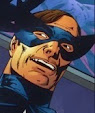
Return of Bruce Wayne 4

At the same time that Batman and Robin began to tell a story about the past of the Wayne family and the secrets of Wayne Manor, Return of Bruce Wayne started its story about the adventures of Bruce Wayne in the past, a past which is also being referred to by a two-part story in Batman #701-702. So Grant Morrison is weaving a story that skips around in time (both the narration and the characters) spanning three series, 24 issues, with at least two villains of absolutely godlike proportion. To this point, the connections between Bruce's adventures in time and the story in the present have interacted only weakly, with artifacts (especially portraits, hidden passages in Wayne Manor, and a casket with a bat symbol on it) bridging them. But in ROBW #4, the connections are much more direct.

Western heroes are known for their silence. Bruce Wayne says nothing in this issue -- not one word. The narrator of the story is Bruce's great-great grandfather Alan Wayne, whose name does not actually appear anywhere. The girl with the prophetic link to her Grandpa Jerome will become Alan's wife, the mother who dies in childbirth while delivering Bruce's great grandfather Kenneth. The family history is linked together by references to Alan's father, Judge Solomon Wayne. Furthermore, we get brief nods to the architects Van Derm (from earlier in Morrison's story) and Cyrus Pinkney, a religious fanatic from Alan Grant's 1992 story "Destroyer" who lived in the 1860s and believed that his buildings would ward off evil. Van Derm is the architect who began Wayne Manor under the direction of Darius Wayne. Pinkney continues the work, which is unfinished as of this issue, which is set sometime around 1870 to 1890, after the death of Solomon's brother, which has earlier been pegged to 1860. There is brief mention of Darius along with Revolutionary War hero "Mad Tony", who is a reference to a real Wayne -- "Mad" Anthony Wayne who followed up his accomplishments in the Revolution with campaigns against the Native Americans in what are now Ohio and Indiana. Geographical entities ranging from the city of Fort Wayne to the Mad River are named after him, and so is, by the admission of Bill Finger, the fictional character Bruce Wayne, because Finger wanted to link Batman's real name to the history of America. Things are really coming full circle.

For reasons that are not stated, but hang ominously over the story, Alan Wayne is headed to a bridge to commit suicide rather than face a family legacy that he considers "haunted". He mentions a rail terminal with a bleak ending, which at least symbolically calls to mind the rail line under Wayne Manor that should have been built and used in his lifetime, perhaps for a dark purpose making victims of those who tried to take the figurative historical Underground Railroad to freedom. On the bridge, he encounters his great-great grandson Bruce, his future wife, and a wagon "from Hell" carrying the story's master villains, Vandal Savage (the immortal, making his second appearance in this series) and... someone else.

As mysterious as Bruce is to the characters in the story, the casket remains to us. Bruce gets to look inside, because the girl, whose family owns the ancient necklace that belonged to Anthro's wife recognizes him as the figure that their family -- the remnants of the Miagani Bat-People -- has been waiting for and after the events of #4, waits for still. The family attacked in the opening pages is thus either Miagani or has been entrusted with their legacy and that of the Van Derms, who last had the casket. So, one reveal of this issue may be that Bruce is part Miagani, and therefore part of the line that awaits his own return.

We don't see what Bruce sees inside the casket, but he removes his book from the 1640s and perhaps some other papers. Something else is left inside, and as Bruce takes the book with him in his next time jump, the items of the casket are thus separated for now.

Of the story's two villains, one is anything but mysterious. Vandal Savage (Monsier Sauvage) has a memory that has lost some of its secrets due to the enormous amount of past he has to remember  -- an idea from Jorge Luis Borges' story El Inmortal. ("When the end approaches, memory contains no more images, only words.") He remembers encountering Bruce once before, in ROBW #1, and is much consumed with memories of a more recent encounter at the side of Napoleon a few decades earlier.

By far the most portentous figure in this story is the other villain, who shares Savage's gift of extended life, and is perhaps the reason why Alan Wayne looks so darkly upon his family legacy. The Thomas Wayne earlier referred to as a devil-worshipper, is here to confirm quite plainly the dark rumor. We also find out that this Thomas Wayne, like the later one, is a doctor. There is nothing really but the interpretation of comic book art (which is always difficult when comparing the work of two different artists, not to mention when the character undergoes the passage of a great deal of time) to tell us whether or not Old Thomas Wayne (henceforth, OTW; Bruce's father is YTW) is Doctor Hurt. He matches his demeanor, his diction, and his firm orientation towards evil. The hair color and hairline seem not to match. But it may not matter so much if the face or actual physical body match. We have already been told, as part of a different lie, "Wayne became Hurt". Seeing the older Wayne for the first time makes that seem increasingly likely to be true, at least for OTW, if not YTW. This is particularly reinforced by the line from Batman #701 about "sickness at the root of the family tree, a worm at the foundations". OTW appears to be the worm. This story affirms that he has been retroactively made into one of the devil worshippers from the 1990 story "Dark Knight, Dark City". We also know that he is an "old gambler" and is, as Hurt is known to be, linked to roulette. Hurt, as El Penitente, seems to have followed exactly Vandal Savage's suggestion to OTW to build an empire in Mexico as a base from which later to attack America (at that time, an infant nation by Savage's immortal standards). OTW also uses a Hurt tactic in destroying with dynamite the casino/brothel behind him... something like the destruction of Mayhew's house back in Batman #669 and his disregard for the house in Mexico he abandons in Batman and Robin #11, when his line "Let it all fall down" suggests dominoes as well as luxurious mansions.

OTW has been alive for 150 years (so, born around 1730 and very approximately 35 years old for the Barbatos ritual in 1765). He wants the casket, and Vandal Savage appears interested as well. It remains a bit of a mystery what he wants it for. He says it has the secret of life eternal, which is something that someone so far past the century mark with an appearance of youth might seem already to have. Maybe he has only procured, through evil means, a really long life, but not eternal, and he wants to get the infinite extension to that deal. He and the girl both have information on the casket, though they have completely contrasting goals. She says the box has bells (OTW refines that to "the bells of Barbatos") that a "dark god" (a phrase used in ROBW #2 to refer, apparently, to Darkseid) is opening his box and there's bells. When someone from Apokolips has a box that makes sounds, we have to wonder if it's a Mother Box. Did Anthro inherit such a thing from Metron? Is something in the rocket from Final Crisis the mysterious thing in the casket? It seemed that only Superman's cape was able to withstand the great passing of time. But Superman's cape wouldn't make a sound or scare Jack Valor so much when he saw it. Whatever the source of the bells, Grandpa Jerome knows that the box's "bells at the end summon another from the shadows, one who won't stop until the wicked are brought to account". He furthermore says through his granddaughter that the opening of the box will bring about the time when "all the days of the world is one day" (Vanishing Point?) "and he must be strong for us" (Bruce is always good for that).

OTW's words to Bruce are enigmatic but probably very important: "are you one too? I'll get you all in the end!" When he says "one" and "you all", does he mean Waynes? If so, the second person suggests that he is perhaps lying after all, and not a real Wayne but a pretender. If he is a biological Wayne or not, he certainly represents a darkness opposed to the good Waynes who've been part of the family line.

Jonah Hex has always been a winner in the DC canon. He shot and killed an evil version of Superman in Jeph Loeb's "Absolute Power" story, and helped beat a JLA/JSA team in a 1978 Gerry Conway story. He wins the duel with Bruce. And there part the members of this issue's cast. Hex takes, but then dumps, Napoleon's gold. Bruce jumps through time (perhaps an eclipse of the sun is taking place on the other side of the world?), once again through water. After being shot and hit by a truck, how will he survive? Maybe because he saw inside the casket?

Alan Wayne refers to his offspring Kenneth, Bruce's great grandfather to be, as "our dark son, delivered from a gaping tomb." Is this only because his birth killed his mother and Alan's wife, or is Kenneth another bad Wayne? His portrait shows him in a cemetery.

And OTW (whether or not he is a real Wayne; whether or nor he is Hurt) flees Gotham and America for England, with passage on the S.S. Orion (again, the name of the constellation as well as the New God) for Liverpool. Alan, who seems to know a lot about OTW, hints that he uses blood to achieve his longevity. Given the timing, I might speculate that OTW's activity in England could include a stint as Jack The Ripper, who was supposed to be a doctor, but that would take place off-camera.

The last time Morrison showed someone beating the Omega Effect, it was Shiloh Norman with the help of a Mother Box. Bruce saw inside the casket. He's sure to survive his injuries with the casket's help or not. The scene appears to be sometime around the "1978" seen on a newspaper in Batman #678 mentioning "Gotham's Hurt Missing". Possibly a bit later since the X-rated theaters around Bruce mention video. Bruce is thus a child in the same world where Bruce the adult has arrived. The next issue will show us the events leading up to the Wayne murders, and more about "Gotham's Hurt", who is probably in some form OTW with another century of life extension under his belt.

Monday, July 26, 2010

Mad Men 401: Public Relations

There is true audacity in beginning the fourth season of a television series asking a question that one might expect to have been answered long ago or not be worth answering ever. "Who is Don Draper?" When the episode begins, we don't know who's asking it, but know that the question is being asked not merely for the interrogator's benefit, but for ours as well. Long seconds tick by, allowing us to consider the significance of the question. He's a poor boy who stole another man's name and used his talent to become successful, really. Is that the question? No, the deep question is: What motivates this man? What makes him tick? What does he want?

Audacious. It asks us to forgive that the show has run so long and left this an enigma. And also, that it expects us to care. The pause after the question runs nine seconds before anyone speaks. If the viewer gets to the end of those nine seconds wondering, then the question, the episode, and the series thus far have been validated. If one gets to the end of those nine seconds still looking for an answer, then the first three seasons have succeeded. And when Don doesn't answer directly we can wonder if it's because he doesn't want to provide clues to his secret past, or because he's a Midwesterner who was taught not to talk about himself, or if it's because he really doesn't know.

A year has passed since the narration of the last season ended, and in that year, Don scored a signature success with a campaign for Glo-Coat Floor Wax, a product that is designed to coat a surface with an invisible shield that prevents it from picking up any marks while it is in use -- an apt metaphor for Don's impregnable "dignity of movement of an iceberg" demeanor. His behavior in the first three seasons has shown us only that he likes what one expects a man to like, and that he doesn't terribly like making choices that limit his future choices, which is to restate: He likes what one expects a man to like.

The viewer who cares about the answer to that question is in luck: This episode tells us more about Don Draper than the rest of the series up to this point. The events in this episode don't really illuminate the man's character by showing us how he responds to the professional debacle that results from his failure to answer the question. This is predictable, within bounds: He takes his anger out on his subordinates, his ex-wife, and unsympathetic clients; he works overtime even while his children and Ivy League football occupy the background; he overcompensates by giving a better answer in a follow-up interview. And in the interim, he spends Thanksgiving alone (having declined more conventional invitations) for an afternoon tryst with a prostitute; and, that his request of her is to slap him while he occupies the lower position during sex.

The slaps are borne of Don's request, not real anger. This is one act of many we see throughout the episode. Acting is the central theme in the episode, and how the acts fail to hold up. Don's date is an actress, but she only looks pretty and doesn't say anything. In real life, Bethany's pretty smart -- smart enough to know that Don's offer to walk her to her door is also an act.

Besides the prostitute, two other women take money to act: Pete and Peggy hire two actresses to fight over a ham as a backhanded means of boosting a client's sales, which they hope will be attributed to their ad campaign, not the stunt. The act turns too real when the actresses really feud and almost expose the act to the public. Peggy's friend Mark tries to cover her embarrassment by pretending to be her fiancé. Don sees through this act.

Relations in the office are full of artifice: Harry asks Joan not to reveal his good news. Don asks his secretary to get him out of a meeting by paging him with a phony call. And two repeated acts are used as laugh lines: Peggy and Joey's flirtatious recitation of Stan Freberg's two-word "lyrics" to his sly recording "John and Marsha". And, more deviously, covering up the spare budget of Sterling Cooper Draper Pryce is the cause of frequent references to a fictitious "second floor"; Bert Cooper and Don are both above making that false claim. Later, Don turns it into an in-joke hiding behind the slogan that Jantzen Swimwear rejects: "So well built, we can't show you the second floor."

And so, when Don is on the hot seat for the nearly disastrous consequences of his first interview, his reponse under pressure yields the most revealing moment of the episode, discounting the aforementioned moment in which no one is clothed: In a second interview that is scheduled to make up for the first, Don shows no hesitation in embracing every lie put before him, and in the episode's final words, he garrulously boasts of the fictional second floor.

For a series whose slogan was once "Where the truth lies", it is not a great overhaul of the earlier themes to show people acting and lying for the sake of a buck. This is why Don's mention of the second floor finishes a distant second for the episode's largest revelation. When Don asks the call girl to slap him, he's not motivated to make a buck or impress anyone outside the room. That's just him. That's the most information we've gotten yet about "Who is Don Draper?"

Wednesday, July 14, 2010

Batman 701


One day in Gotham City, a thug wearing a gargoyle mask stabbed Batman in an otherwise futile attack. The blade of the knife was coated with a chemical that made him susceptible to psychological attack. Visual exposure to the trigger phrase that was to bring on an attack on his mind had worn away at his well-being for months, but due to the influence of the drug, Bruce Wayne fell unconscious when he heard the trigger phrase aloud. As he lay on the floor, Bruce was injected with heroin and methamphetamine. Then a tracking device was surgically inserted under one of his teeth, and Bruce was dumped unconscious in a Gotham alley. After a day of wandering the city sick and amnesiac, Bruce managed to activate in himself the blunt, hyperactive Batman of Zur En Arrh personality. In this identity, Batman tracked down criminals, winning some tactical battles, until he had to fight his way through a large number of henchmen in Arkham Asylum. Upon sweeping the Joker aside, Batman had to break through glass, upon which, he was dosed with the Joker's lethal nerve gas. Surviving because he had administered himself an antidote, Bruce woke up in a coffin underground. Once he escaped from that and he tunneled to the surface, he fought another round of thugs, resisted more mental attacks from Doctor Hurt, and then entered the city harbor in a helicopter crash. Batman #701 begins the next moment, with Bruce underwater, needing to surface and swim out to survive.

Because we already knew that Bruce would talk with Alfred in the Batcave, then partake in the events of Final Crisis, the general trajectory that Bruce follows in this issue was largely what one would have expected. The added details are, however, very meaningful. Or, enigmatic, but indicative of something important, lacking only clarity as to what they mean.

One mystery is cleared up right away. At the end of RIP, it was a curiosity (in my mind) as to why Bruce would remove his cape and cowl during his face-off with Hurt. When he tells us that he was not aware that his cape and cowl were missing, we can conclude that he did this as a partial response to the mental command Hurt attempted to trigger by telling Bruce to "put away his Batman costume and retire from crime-fighting" (a line originally from Batman #156). Bruce doesn't remember taking his mask off because he didn't do it voluntarily: He began, as Hurt asked, to "put away his Batman costume", but his will was too strong for him to retire from crime-fighting. According to the RIP backstory, this command affected Bruce for "a couple of weeks" the first time Hurt employed it, back when Dick Grayson was Robin. This time, it hardly affected Bruce at all.

Bruce's swim is a kaleidoscope of minor, but intriguing details. We see in the form of charts showing the weather, the value of stocks, and the stars in the sky (Sagittarius -- no, this does not mean that Green Arrow is in the story), that the world continues to go on while Batman is submerged. The first person whom Bruce sees upon reaching land is Ellie, the former prostitute who was last in the story right around the time that "devil ears" and an "enemy as old as time and bigger than all of us" were invoked back in Batman #665. She has taken the job with Waynetech that Batman offered her back then; her return symbolizes things coming full circle as well as redemption.

Much of what we learn in this story concerns Bruce's reaction to and interpretation of the villain who had just made the past five days of his life a living hell. He at once tells himself that swimming away from the crash is, for anyone less than himself, impossible. Lane, one of the three people in the helicopter, is a serious athlete on the superhero level. Hurt has never proven any physical ability, and Bruce deems his escape impossible. But Hurt never surfaces. More than five minutes go by in addition to the time that it took Bruce to swim out. And yet, when he later checks the wreckage, there is no body. And so, Bruce cannot explain Hurt -- he remains for Bruce "a ghost" as well as a threat.

Alfred, paraphrasing the opinion that Morrison attributed to some readers, doesn't want to accept the supernatural explanation. We already have Morrison's reply to this, when he said "For me, this is the ultimate supernatural Batman story." Alfred gets another shadowy form of that reply when he sees that the clock in Wayne Manor had stopped at the precise moment of the helicopter crash.

Bruce himself expresses uncertainty when he says that Hurt "may or may not be some manifestation of the Devil, or my dead father." But he takes the curse absolutely seriously, calling it "a death trap".

Many of the small details in the issue reinforce, conveniently, details that we saw for the first time quite recently in Batman and Robin. Bruce goes to the Barbatos shrine under Wayne Manor. He knows that Hurt had been there, and he sees the paint that Dick Grayson told us was relatively fresh. We find out that Bruce's parents knew about the room, and it becomes increasingly likely that it was the scene of a Black Glove party. So we find out that Bruce knew about the things that Dick Grayson discovered so recently, but only partially. He knew that those things were there, but not why.

Bruce enters that room through the library in Wayne Manor, standing almost on the exact spot where Doctor Hurt shoots Dick Grayson. He looks at the paining of his parents that is to overlook Dick's shooting. Martha is again shown with lighter hair, so we know that it is Martha, because Bruce does not react in any unusual manner. There is a figure before them, an art piece whose strangeness -- a large knight from a chess board -- suggests that it has some special role. It, too, is to look down upon Dick's shooting.

The "three days" reference to Easter from Batman and Robin #13 also appears here. Bruce tells Alfred that if he sleeps for three days, not to wake him. Sleeping for three days then rising -- Bruce will be resurrected.

The most important symbol in this issue, though, is the one that represents Hurt. In his own words, a hole. Bruce ends the issue looking at a hole. But more important, he calls Hurt a hole. An empty space. An absence. Bruce has an empty space in his life -- maybe in that sense, an enemy who is an absence represents not Bruce's father but the hole in his life where his father should be. Bruce suspects that Hurt goes back in his own family tree. An anti-father. An anti-Bruce as well. As Bruce is the one who sleeps for three days then rises, an anti-Bruce is symbolically an anti-Christ.

The story ends with questions. Part two of this story within a story is yet to come.