There is no avoiding the comparison. 2013's Zero Year and 1987's Year One are consecutive tellings of the Batman origin. The latter has a name which twists the first's around cosmetically. They both follow DC's company-wide reboots, to re-pitch Batman as part of a general shuffle, tailoring some facts to suit the new continuity.
This is unfortunate context for Scott Snyder, who hasn't written a bad issue in two years on Batman. The dialogue flows, the action is vivid, and his Bruce/Batman has the combination of compulsion and humanity that all the best renditions of the character have had. But Frank Miller's Year One was nearly flawless, bringing Batman from a stiffer, shallower figure into a new era of deeper characterization seen across the comics universe. Year One portrayed a Batman who was – the word has to be taken with a grain of salt – realer than past version. He had weapons that a real crime fighter might have. His Rube Goldberg schemes sometimes failed, leaving him more than once on the verge of death in Gotham's streets and alleys. We imagined him learning to become the masked demigod that Batman would go on to be.
And Scott Snyder's Batman in Zero Year and the preceding twenty issues also has all of those qualities, but that's not new anymore. The effort is serviceable, providing one readable scene after another, but to what other end? If there's a contribution here, it's in the reordering of certain biographical facts. We see an uncle on the Kane side, but what, besides another small tragedy beside Bruce's two huge tragedies, does this add? We see, in the most striking alteration of the legend, a Gotham which is already beset by masked villains, instead of conventional Mafia-style gangs, when Bruce begins his war. That's different in fact than either film series, the previous continuity, or even the publishing history from 1939, although it remains to be seen if this drives some future intrigue.
The greatest potential contribution seems to be in elevating the Joker in primacy in Batman's universe, putting him right at a time of their mutual origin, which was an element, though handled very differently, of the 1989 movie. Coming as a sequel to the use of the Joker in Snyder's earlier Death of the Family arc, it may bookend the character's role in Batman's past and present. It nicely teases a specific identity for the Joker, then throws that promise away, making the Joker now as before, a mystery for Batman as well as for us.
Zero Year is better than most stories we've seen over the years. But in replacing Year One, it has a tough assignment, one that so far serves as a downgrade. It's good. But it leaves, so far, the former as the classic origin, even if this one defines current continuity.
Wednesday, October 9, 2013
Tuesday, August 6, 2013
Ouroboros
The central motif of Batman, Incorporated is the Ouroboros, the self-swallowing snake, a symbol that goes back to Egyptian antiquity. Beyond the visual imagery of a ring, the theme it represents is a cycle in time, things that occur in repetition, endlessly. A cycle is suggested at the moment the Batman, Inc story begins in the epilogue of Batman and Robin #16, when Bruce tells Damian, "Batman and Robin can never die" and it appears visually in the lower right corner of Inc #13's final panel, as shown here.
Cycles as a theme are a common motif in Morrison's stories. His Superman stories All Star Superman and Superman Beyond end with references to, respectively, a Superman 2 and "To be continued..."
The first panel of Batman, RIP shows Dick Grayson saying "Batman and Robin will never die" in a flash-forward which answers a comment made by Le Bossu in RIP's epilogue. Final Crisis has a platonic time-traveling bullet that goes back through time, then ends up in Darkseid's possession so he can fire it again. In like fashion, Bruce Wayne becomes part of his own inspiration when Darkseid fires him back in time.
Ouroboros as the "never-ending ring" is first mentioned explicitly in Inc vol 1 #3, when the Knight survives battle with Dedalus. This Knight is the second of three, with Morrison promoting one sidekick to replace the main hero in his earlier works, then promoting the sidekick's sidekick in this one. Things advance, but remain the same. A Knight followed by a Knight followed by a Knight.
We first see the Ouroboros later, a ring on Scorpiana's finger that Bruce Wayne steals while dancing with her. In this scene, Bruce Wayne performs super heroics, but he's not giving up his identity: Gaucho believes that it's Batman posing as Bruce Wayne, whereas unbeknownst to him it's actually Bruce Wayne posing as Batman posing as Bruce Wayne. This cycle of purpose and identity is immediately repeated in the Buenos Aires adventure that Batman and Gaucho undergo. They are given clues which lead them to a house. The situation seems to give away the criminal's location, to lead the heroes there. In reality, it's intended to lead them there, as a trap. But knowing it's a trap, they go anyway, confident they can prevail: A cycle of what the villain's plan seems to be, and what the heroes think of it, and what the heroes think of what the villain thinks of it.
It is here that Morrison's Argentina portion of Inc. becomes truly ingenious, if the complexity of a ring turning within a ring is not too dizzying for the reader. Batman and Gaucho realize that they are led to the house by a mystery resembling one in fiction, and Batman recounts a literary detective Espartaco Estraño who is led to his death by a similar trap. Espartaco, Batman recalls, was a fiction created by Jorge Luis Borges and other writers: A fictitious author created as a hoax by a real author, resulting in a real book, with a plot that resembled the one Batman and Gaucho were experiencing.
But there's another twist off the (comic book) page: The Espartaco hoax did not exist. Morrison has taken the plot of an actual Borges story, "La muerte y la brújula" (Death and the Compass), which is similar to the one that Morrison describes, and in that story, too, a fictional detective is led to a trap while working on the case of a serial murderer. Another twist? In that story, the fictional detective, Lönnrot, believes he finds a pattern in the murders committed by his nemesis, Red Scarlach. Actually, the pattern was coincidence, but Scarlach realizes that Lönnrot believes there is a pattern, so Scarlach sets a trap in the location he thinks Lönnrot will expect the next murder to occur.
It is almost painstaking to unwind the cycles that Morrison has built on top of Borges' original story. Borges' story itself is patterned on the dynamic: "he thought that I thought that he thought..." Morrison creates a fictional story, about Espartaco Estraño, that is almost the same as the original story, but is a hoax that exists only as a story. And this resembles the Batman-Gaucho adventure in Inc. The nested stories, in summary:
Story 1 - Writer: The actual Jorge Luis Borges. Detective: Lönnrot. Villain: Scarlach.
Story 2 - Writer: A fictional Jorge Luis Borges. Writer/Detective: Espartaco Extraño. Villain: Doctor Dedalus.
Story 3 - Writer: Grant Morrison. Detectives: Batman/Gaucho. Villain: Otto Netz using the alias Doctor Dedalus.
In each of these stories, the hero is led into a trap by the villain. But only in Story 3, does the detective, Batman, realize that it is a trap.
More twists: Daedalus, in Greek mythology, created the labyrinth the Minotaur occupied. Borges, in real life, wrote a story about a labyrinth called "El Jardín de senderos que se bifurcan" (The Garden of Forking Paths).
At this point, it is useful to note that Borges wrote a story called "El inmortal" (The Immortal) about a man who, as an immortal, finds that owing to his vast quantity of life experience, his memory is confused into a mixture of true and false recollections that he can no longer sort out. Back in Return of Bruce Wayne, Morrison has Vandal Savage, an immortal, say that this is also his experience, so that immortality becomes a kind of non-pathological senility.
This, too, surfaces in Inc. Otto Netz (very old, but not immortal) suffers from severe memory loss and, though brilliant, is confused and experiences things in sequence that may not be occurring. Later, in Leviathan Strikes, Netz uses a mind-control gas to defeat Batman by inducing the same condition in him, and a temporarily confused and addled Batman has his apparent victory over Netz turn to defeat and a humiliating realization that he has repeatedly, in a short space of time, believed that he's defeated Netz, then forgets both the victory and the defeat.
Once Batman and Gaucho arrive in the trap, they are required by Sombrero to fight to the death. Of course, Batman is no killer, and no loser, so he and Gaucho pretend to fight to the death while Batman works to rescue Sombrero's hostages. Yet, the false fight has some real punches thrown to hurt, because Batman is enraged when he learns of a past association between Gaucho and Batman's former lover, Kathy Kane. So, the Batman-Gaucho animosity is again: Reality within a fiction posing as the real thing.
Morrison's use of the works of Jorge Luis Borges as a story-within-a-story is perhaps his finest accomplishment in comics. Its almost horrifically complexity, and the paper trail through other fictional works (I almost cringe to note that Batman also references, in Inc vol 1 #3, another literary hoax by Thomas Chatterton) may leave few to appreciate it. In fact, I would suggest that virtually anyone who tries to decode this may find a bit of the same confusion creeping in that Otto Netz lives with and Batman suffers in Leviathan Strikes.
The Argentine subplot of Inc. thus introduces and brilliantly utilizes the Ouroboros idea which goes on to surface in other subplots.
In Inc. vol 1 #6, Batman helps cover his identity as Bruce Wayne by assuming an online identity of an amateur detective who argues that Bruce Wayne is Batman -- precisely the sort of inference that someone would make, incorrectly, if it were false. So that attempts to solve his secret identity is "lost in a blizzard of rumor, denial, and misinformation." The message board where this false chatter takes place resembles, probably not coincidentally, the forums where Morrison's stories are discussed online, and so yet another pattern encloses itself.
The Spyral plot with The Hood and Kathy Kane at its center is also full of reality within appearances seeming to be another reality. The Hood seems to join Inc, but has actually infiltrated it as a double agent, but must actually defeat his Spyral boss in order to serve Inc. As an ongoing bit of deception, Inc. stages the deaths of several agents, and we suspect that some of these deaths are real, but they actually hide the full strength of Inc's assets from Leviathan so to gain an advantage later. So early in volume 2, we see Damian's death faked. It turns out he is alive. But then later actually dies. Reality hidden in deception.
In Leviathan Strikes, Bruce and Lucius Fox discuss metamaterials, the substances which appear in the story as Talia's metabomb and the photonic crystal that Batman stole from Sivana. When shown the Ouroboros symbol, Fox notes that an exotic molecule with an interlocking ring structure might have remarkable properties. Here, Morrison references some impressively recent actual chemical research, working this, also into his pattern.
The Ouroboros pattern is visually apparent in the manner in which both Leviathan and Batman, Incorporated operate around the world, with the Earth's sphere creating a ring wherever Leviathan/Inc assets happen to approximate a great circle route around the globe. Netz refers to this as a "necklace of deadly meta-bombs places around the world like precious pearls." The location of these bombs becomes focal for the Leviathan/Inc war, and so a ring becomes a visual element in a literal circle. Of course, Netz' metaphor also recalls a circle of circles: a pearl necklace, only pages after we'd seen Batman hallucinate a broken pearl necklace on Professor Pyg's "mommy made of nails", two of many references Morrison has made to Martha Wayne's pearl necklace, a visual motif of profound importance for Batman's origin.
And it is in this respect that Ouroboros has its greatest relevance for Morrison's story, the payoff towards which this sprawling two-and-a-half-year, 25-issue, epic has endeavored. Morrison brings, eventually, his entire Batman plot back around to its beginning, and more importantly, brings the entire Batman plot back around to its beginning.
As we get closer to the end of Inc, Morrison brings back elements from early in his own run. The minor character Ellie has surfaced once before each season of Morrison's Batman epic has reached its climax. She was there when Batman was about to fight the Bane Batman, when he emerged from the Gotham River between RIP and Final Crisis, and appears late in Inc vol 2 before Damian meets his fate. Repeated patterns become ominous as Dick Grayson and Damian fight one last battle together, going into it cheerfully and with great mutual admiration, throwing their signature double-punch before the battle turns grim and deadly.
But the most important return to a previously-seen theme is the overarching one of Batman's whole legend. Inc began with a seemingly-unrelated story, a prologue to Batman: The Return that tells the story of the bat that flew into Wayne Manor's study one night to inspire Batman. Morrison almost whimsically makes drama of the bat's life, but why does he choose that occasion, in that issue, to tell that story? Batman, Inc., aside from its particular plot points of bombs and international spies, Inc is the story of Batman. Morrison includes such key details as the pearl necklace and the bat in the study because, just as RIP was Morrison's bid to tell the ultimate Batman story, Inc is Morrison's bid to create a recapitulation of Batman's entire story. The Return, tellingly, was published with a page of the script that provides a detail not in the illustrated story: That this was the same bat that frightened young Bruce decades earlier when he fell into the future Batcave. This seemingly random time to recall this event comes at the beginning of Inc because the entire series is a return to the making of Batman.
Jim Gordon has a central role in Batman, Inc #13 in order to close the circle of Morrison's run. Gordon is the first familiar character to appear in Morrison's run back in Batman #655. Like Ellie, he appears to recall a seven-year run by Morrison and bring it back to its beginning. But the issue as a whole serves to recall a seventy-year run by everyone from Finger and Kane to Christopher Nolan and Scott Snyder, and the details in #13 do so very deliberately.
The final five issues of Inc bring Batman back where he started. Bruce Wayne stands looking at two headstones, and he is overcome with grief, a sense of defeat. A family of three has lost two, and now Bruce stands alone, in sorrow. The connection between this graveside scene and the death of Bruce's parents is not obscure: It has been duly noted by most who have commented on the story. But it is also essential context for the grimness, or bleakness that some found off-putting. The seemingly invincible hero who arose triumphant from battles with the Devil and Darkseid was sunk into despair and defeat in #13... why? We may look at the character and psychoanalyze his grief and ask if it seems true to the character. We can ask what relationship Talia and Damian bore to him, certainly not a traditional wife or traditional son. We can weigh the steely, almost supernatural resolve that Batman has shown in earlier work, including Morrison's. But the bleakness and sense of defeat that Bruce feels in #13 is absolutely essential because that's what young Bruce Wayne felt when his parents died, and this story about the Ouroboros has to bring him back to that. Once again, Jim Gordon is there as he was at the beginning (in a detail borrowed from the Nolan films). Once again, Bruce is grieving, and for some limited time, he is not Batman. He is not ready to go on. And then, feeling once again what Morrison once called "a miracle in Crime Alley", he becomes Batman again. The Finger/Kane era is quickly brought up to the immediate reality of the summer of 2013 with a reference to the ongoing Zero Year story, much more a link to the immediate present than a dose of marketing schlock. And the Batman story is rebooted, reinvigorated with power. We see a villain whose very identity is, like that of Borges' character, immortal, and he's the perfect villain for this moment, more appropriate than, say, the Joker, because this is the moment that celebrates Batman's immortality.

Morrison's two aforementioned Superman stories ended, emphatically, on the note of continuation, that Superman is eternal, and inherently serial, and has a message of hope that will never end. He devoted only a panel or two each time to convey this message, boldly, and suddenly surprising the reader with it. His Batman run approaches a similar message through exquisitely more elaborate means, a story that comprises a not-negligible fraction of Batman's whole history. We see it all again. The bat from the cave, the moment in the study, the pearl necklace, the gun, all the past eras diced and sliced and respliced. Doctor Death, Axis Chemicals, Professor Milo, Batwoman, the International Club of Heroes, the Seventies and Ra's al-Ghul, the Eighties and the Killing Joke, the Wayne deaths, Joe Chill, Hugo Strange, Jason Todd, and everything. For it all to come back around, there had to be a moment of grief, a dark night of the soul in order to create a Dark Knight of the soul. It breaks Batman down and then rapidly, in a few panels, builds him back up. As the ring turns full circle it is, in some sense 2006 again, with Morrison's successors able to pick up where Morrison's predecessors left off, but with a character and fictional world greatly enriched by these past seven years.

Cycles as a theme are a common motif in Morrison's stories. His Superman stories All Star Superman and Superman Beyond end with references to, respectively, a Superman 2 and "To be continued..."
The first panel of Batman, RIP shows Dick Grayson saying "Batman and Robin will never die" in a flash-forward which answers a comment made by Le Bossu in RIP's epilogue. Final Crisis has a platonic time-traveling bullet that goes back through time, then ends up in Darkseid's possession so he can fire it again. In like fashion, Bruce Wayne becomes part of his own inspiration when Darkseid fires him back in time.
Ouroboros as the "never-ending ring" is first mentioned explicitly in Inc vol 1 #3, when the Knight survives battle with Dedalus. This Knight is the second of three, with Morrison promoting one sidekick to replace the main hero in his earlier works, then promoting the sidekick's sidekick in this one. Things advance, but remain the same. A Knight followed by a Knight followed by a Knight.
We first see the Ouroboros later, a ring on Scorpiana's finger that Bruce Wayne steals while dancing with her. In this scene, Bruce Wayne performs super heroics, but he's not giving up his identity: Gaucho believes that it's Batman posing as Bruce Wayne, whereas unbeknownst to him it's actually Bruce Wayne posing as Batman posing as Bruce Wayne. This cycle of purpose and identity is immediately repeated in the Buenos Aires adventure that Batman and Gaucho undergo. They are given clues which lead them to a house. The situation seems to give away the criminal's location, to lead the heroes there. In reality, it's intended to lead them there, as a trap. But knowing it's a trap, they go anyway, confident they can prevail: A cycle of what the villain's plan seems to be, and what the heroes think of it, and what the heroes think of what the villain thinks of it.
It is here that Morrison's Argentina portion of Inc. becomes truly ingenious, if the complexity of a ring turning within a ring is not too dizzying for the reader. Batman and Gaucho realize that they are led to the house by a mystery resembling one in fiction, and Batman recounts a literary detective Espartaco Estraño who is led to his death by a similar trap. Espartaco, Batman recalls, was a fiction created by Jorge Luis Borges and other writers: A fictitious author created as a hoax by a real author, resulting in a real book, with a plot that resembled the one Batman and Gaucho were experiencing.
But there's another twist off the (comic book) page: The Espartaco hoax did not exist. Morrison has taken the plot of an actual Borges story, "La muerte y la brújula" (Death and the Compass), which is similar to the one that Morrison describes, and in that story, too, a fictional detective is led to a trap while working on the case of a serial murderer. Another twist? In that story, the fictional detective, Lönnrot, believes he finds a pattern in the murders committed by his nemesis, Red Scarlach. Actually, the pattern was coincidence, but Scarlach realizes that Lönnrot believes there is a pattern, so Scarlach sets a trap in the location he thinks Lönnrot will expect the next murder to occur.
It is almost painstaking to unwind the cycles that Morrison has built on top of Borges' original story. Borges' story itself is patterned on the dynamic: "he thought that I thought that he thought..." Morrison creates a fictional story, about Espartaco Estraño, that is almost the same as the original story, but is a hoax that exists only as a story. And this resembles the Batman-Gaucho adventure in Inc. The nested stories, in summary:
Story 1 - Writer: The actual Jorge Luis Borges. Detective: Lönnrot. Villain: Scarlach.
Story 2 - Writer: A fictional Jorge Luis Borges. Writer/Detective: Espartaco Extraño. Villain: Doctor Dedalus.
Story 3 - Writer: Grant Morrison. Detectives: Batman/Gaucho. Villain: Otto Netz using the alias Doctor Dedalus.
In each of these stories, the hero is led into a trap by the villain. But only in Story 3, does the detective, Batman, realize that it is a trap.
More twists: Daedalus, in Greek mythology, created the labyrinth the Minotaur occupied. Borges, in real life, wrote a story about a labyrinth called "El Jardín de senderos que se bifurcan" (The Garden of Forking Paths).
At this point, it is useful to note that Borges wrote a story called "El inmortal" (The Immortal) about a man who, as an immortal, finds that owing to his vast quantity of life experience, his memory is confused into a mixture of true and false recollections that he can no longer sort out. Back in Return of Bruce Wayne, Morrison has Vandal Savage, an immortal, say that this is also his experience, so that immortality becomes a kind of non-pathological senility.
This, too, surfaces in Inc. Otto Netz (very old, but not immortal) suffers from severe memory loss and, though brilliant, is confused and experiences things in sequence that may not be occurring. Later, in Leviathan Strikes, Netz uses a mind-control gas to defeat Batman by inducing the same condition in him, and a temporarily confused and addled Batman has his apparent victory over Netz turn to defeat and a humiliating realization that he has repeatedly, in a short space of time, believed that he's defeated Netz, then forgets both the victory and the defeat.
Once Batman and Gaucho arrive in the trap, they are required by Sombrero to fight to the death. Of course, Batman is no killer, and no loser, so he and Gaucho pretend to fight to the death while Batman works to rescue Sombrero's hostages. Yet, the false fight has some real punches thrown to hurt, because Batman is enraged when he learns of a past association between Gaucho and Batman's former lover, Kathy Kane. So, the Batman-Gaucho animosity is again: Reality within a fiction posing as the real thing.
Morrison's use of the works of Jorge Luis Borges as a story-within-a-story is perhaps his finest accomplishment in comics. Its almost horrifically complexity, and the paper trail through other fictional works (I almost cringe to note that Batman also references, in Inc vol 1 #3, another literary hoax by Thomas Chatterton) may leave few to appreciate it. In fact, I would suggest that virtually anyone who tries to decode this may find a bit of the same confusion creeping in that Otto Netz lives with and Batman suffers in Leviathan Strikes.
The Argentine subplot of Inc. thus introduces and brilliantly utilizes the Ouroboros idea which goes on to surface in other subplots.
In Inc. vol 1 #6, Batman helps cover his identity as Bruce Wayne by assuming an online identity of an amateur detective who argues that Bruce Wayne is Batman -- precisely the sort of inference that someone would make, incorrectly, if it were false. So that attempts to solve his secret identity is "lost in a blizzard of rumor, denial, and misinformation." The message board where this false chatter takes place resembles, probably not coincidentally, the forums where Morrison's stories are discussed online, and so yet another pattern encloses itself.
The Spyral plot with The Hood and Kathy Kane at its center is also full of reality within appearances seeming to be another reality. The Hood seems to join Inc, but has actually infiltrated it as a double agent, but must actually defeat his Spyral boss in order to serve Inc. As an ongoing bit of deception, Inc. stages the deaths of several agents, and we suspect that some of these deaths are real, but they actually hide the full strength of Inc's assets from Leviathan so to gain an advantage later. So early in volume 2, we see Damian's death faked. It turns out he is alive. But then later actually dies. Reality hidden in deception.
In Leviathan Strikes, Bruce and Lucius Fox discuss metamaterials, the substances which appear in the story as Talia's metabomb and the photonic crystal that Batman stole from Sivana. When shown the Ouroboros symbol, Fox notes that an exotic molecule with an interlocking ring structure might have remarkable properties. Here, Morrison references some impressively recent actual chemical research, working this, also into his pattern.
The Ouroboros pattern is visually apparent in the manner in which both Leviathan and Batman, Incorporated operate around the world, with the Earth's sphere creating a ring wherever Leviathan/Inc assets happen to approximate a great circle route around the globe. Netz refers to this as a "necklace of deadly meta-bombs places around the world like precious pearls." The location of these bombs becomes focal for the Leviathan/Inc war, and so a ring becomes a visual element in a literal circle. Of course, Netz' metaphor also recalls a circle of circles: a pearl necklace, only pages after we'd seen Batman hallucinate a broken pearl necklace on Professor Pyg's "mommy made of nails", two of many references Morrison has made to Martha Wayne's pearl necklace, a visual motif of profound importance for Batman's origin.
And it is in this respect that Ouroboros has its greatest relevance for Morrison's story, the payoff towards which this sprawling two-and-a-half-year, 25-issue, epic has endeavored. Morrison brings, eventually, his entire Batman plot back around to its beginning, and more importantly, brings the entire Batman plot back around to its beginning.
As we get closer to the end of Inc, Morrison brings back elements from early in his own run. The minor character Ellie has surfaced once before each season of Morrison's Batman epic has reached its climax. She was there when Batman was about to fight the Bane Batman, when he emerged from the Gotham River between RIP and Final Crisis, and appears late in Inc vol 2 before Damian meets his fate. Repeated patterns become ominous as Dick Grayson and Damian fight one last battle together, going into it cheerfully and with great mutual admiration, throwing their signature double-punch before the battle turns grim and deadly.
But the most important return to a previously-seen theme is the overarching one of Batman's whole legend. Inc began with a seemingly-unrelated story, a prologue to Batman: The Return that tells the story of the bat that flew into Wayne Manor's study one night to inspire Batman. Morrison almost whimsically makes drama of the bat's life, but why does he choose that occasion, in that issue, to tell that story? Batman, Inc., aside from its particular plot points of bombs and international spies, Inc is the story of Batman. Morrison includes such key details as the pearl necklace and the bat in the study because, just as RIP was Morrison's bid to tell the ultimate Batman story, Inc is Morrison's bid to create a recapitulation of Batman's entire story. The Return, tellingly, was published with a page of the script that provides a detail not in the illustrated story: That this was the same bat that frightened young Bruce decades earlier when he fell into the future Batcave. This seemingly random time to recall this event comes at the beginning of Inc because the entire series is a return to the making of Batman.
Jim Gordon has a central role in Batman, Inc #13 in order to close the circle of Morrison's run. Gordon is the first familiar character to appear in Morrison's run back in Batman #655. Like Ellie, he appears to recall a seven-year run by Morrison and bring it back to its beginning. But the issue as a whole serves to recall a seventy-year run by everyone from Finger and Kane to Christopher Nolan and Scott Snyder, and the details in #13 do so very deliberately.
The final five issues of Inc bring Batman back where he started. Bruce Wayne stands looking at two headstones, and he is overcome with grief, a sense of defeat. A family of three has lost two, and now Bruce stands alone, in sorrow. The connection between this graveside scene and the death of Bruce's parents is not obscure: It has been duly noted by most who have commented on the story. But it is also essential context for the grimness, or bleakness that some found off-putting. The seemingly invincible hero who arose triumphant from battles with the Devil and Darkseid was sunk into despair and defeat in #13... why? We may look at the character and psychoanalyze his grief and ask if it seems true to the character. We can ask what relationship Talia and Damian bore to him, certainly not a traditional wife or traditional son. We can weigh the steely, almost supernatural resolve that Batman has shown in earlier work, including Morrison's. But the bleakness and sense of defeat that Bruce feels in #13 is absolutely essential because that's what young Bruce Wayne felt when his parents died, and this story about the Ouroboros has to bring him back to that. Once again, Jim Gordon is there as he was at the beginning (in a detail borrowed from the Nolan films). Once again, Bruce is grieving, and for some limited time, he is not Batman. He is not ready to go on. And then, feeling once again what Morrison once called "a miracle in Crime Alley", he becomes Batman again. The Finger/Kane era is quickly brought up to the immediate reality of the summer of 2013 with a reference to the ongoing Zero Year story, much more a link to the immediate present than a dose of marketing schlock. And the Batman story is rebooted, reinvigorated with power. We see a villain whose very identity is, like that of Borges' character, immortal, and he's the perfect villain for this moment, more appropriate than, say, the Joker, because this is the moment that celebrates Batman's immortality.

Morrison's two aforementioned Superman stories ended, emphatically, on the note of continuation, that Superman is eternal, and inherently serial, and has a message of hope that will never end. He devoted only a panel or two each time to convey this message, boldly, and suddenly surprising the reader with it. His Batman run approaches a similar message through exquisitely more elaborate means, a story that comprises a not-negligible fraction of Batman's whole history. We see it all again. The bat from the cave, the moment in the study, the pearl necklace, the gun, all the past eras diced and sliced and respliced. Doctor Death, Axis Chemicals, Professor Milo, Batwoman, the International Club of Heroes, the Seventies and Ra's al-Ghul, the Eighties and the Killing Joke, the Wayne deaths, Joe Chill, Hugo Strange, Jason Todd, and everything. For it all to come back around, there had to be a moment of grief, a dark night of the soul in order to create a Dark Knight of the soul. It breaks Batman down and then rapidly, in a few panels, builds him back up. As the ring turns full circle it is, in some sense 2006 again, with Morrison's successors able to pick up where Morrison's predecessors left off, but with a character and fictional world greatly enriched by these past seven years.
Wednesday, July 31, 2013
Batman Inc, #13
Batman and his allies square off against one of his oldest and deadliest nemeses, and this time, the battle almost destroys Batman. That's the story, as it was framed from early on, and that's how it ends. There is no swirling cosmic complexity added at the end, as we'd seen in Return of Bruce Wayne. The things we knew must happen happen, give or take a couple, and the artistry of the finale is largely in the soft touches, the feelings and how this battle staggered our hero and how he rises from it.
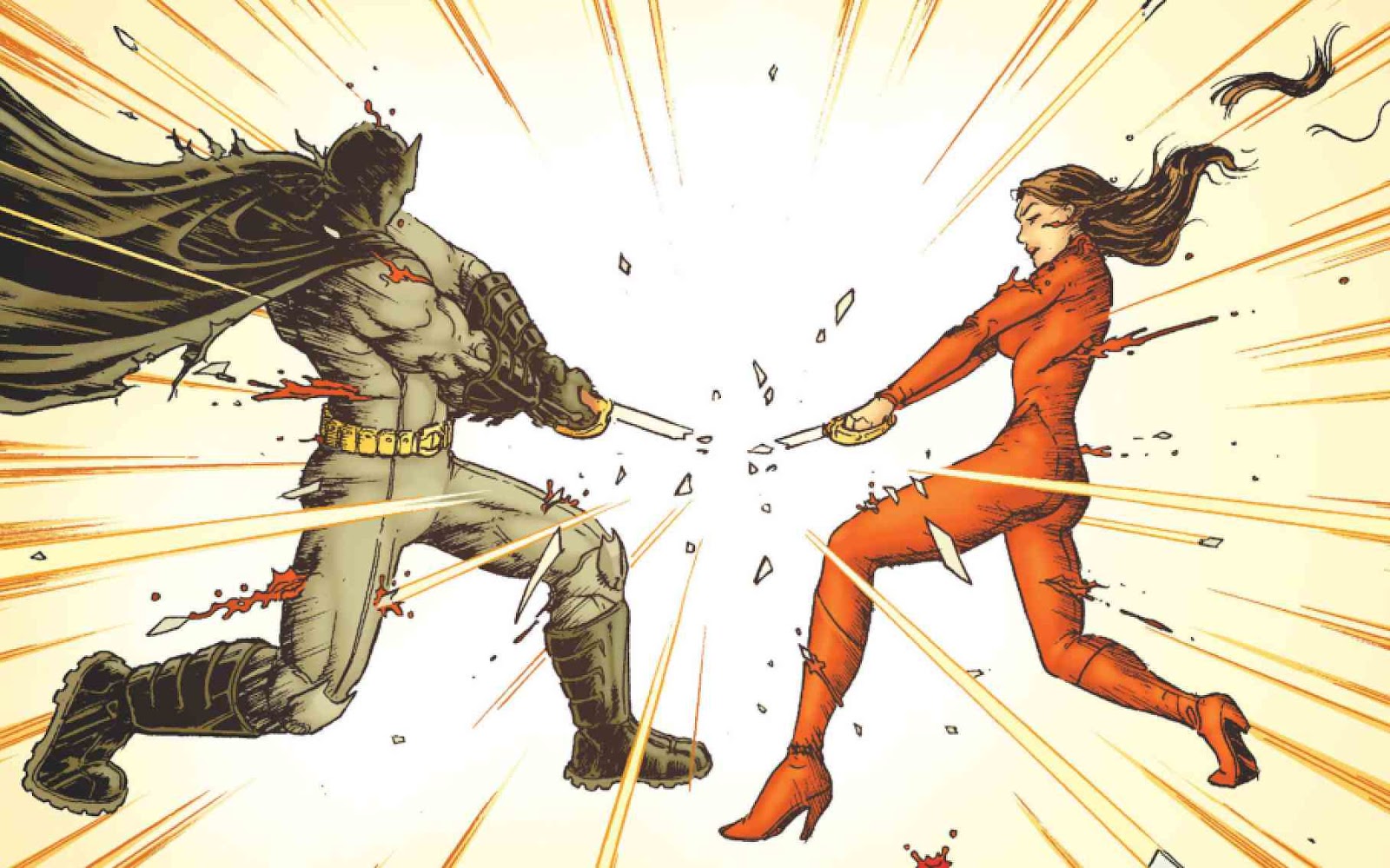
From the time Talia walks into the cave until Bruce walks out, needing stitches for the cuts on his face, probably minutes, only, elapse. Batman's allies are busiest as they go to work around the world neutralizing the threat of mass destruction, and Batman's allies come to his aid in the scenes that follow the end of his sword fight with Talia, one that she perhaps wins by cheating. Then two of Batman's allies enter the cave and cheat to save him. And then, intercut with all the action, Batman's fondest ally, Jim Gordon, helps to patch him up with words. And an extra surprise or two follows.
When Inc began, Batman and Selina Kyle stole a substance that Sivana had created, a meta-material that allowed him to turn invisible during his final battle with the Heretic. It also proved to have critical utility as an agent to neutralize Talia's ring of meta-bombs around the world, and in actions we see only in montage, the threat to the world at large is eliminated as Inc. agents make sure those seven bombs will never detonate. An old Morrison Batman principle at work: "The victory lies in the preparation."
But Batman loses the sword fight, succumbing to one or two poisons Talia snuck into the mix, and will die unless he begs for mercy. Just in time, Robin arrives. In this case, Jason Todd, who tricks Talia into giving Batman the antidote in return for the trigger to set off the metabombs. Talia accepts, but in vain, because with the metabombs neutralized, the trigger is worth nothing. And then, as she vows continuing revenge, Talia is abruptly taken down by a shot from the Headmistress, as expected, Kathy Kane, who briefly outlines her scope of operations in Spyral, and she departs leaving Talia dead and Bruce in a vacuum, the Leviathan threat at an end. But Batman is deeply shaken by the loss all around him. His child and the child's mother are laid to rest side by side, and he's unsure of continuing on.
This is the low point of Bruce Wayne in all of Morrison's run, the exact moment we saw in flashforward in Inc v2, #1, when Jim Gordon arrives to arrest Bruce Wayne, but in his interrogation of Bruce, Gordon plays the part of a sympathetic figure, a counselor, a priest. As Bruce talks through it, Gordon tries to understand the motives and how the madness was too large for him to control, and all throughout, Gordon knows that he might be speaking directly with Batman. And when it's over, he makes it clear that Batman is needed, and gives him the encouragement to suit up again, and return to his mission.
The events of #13 are full of mirrors to earlier stories. Bruce's lover enters the Batcave and belittles him, attacks him -- this is a key moment in RIP, with Talia serving a role now like Jezebel Jet did then. Morrison said that the image of a woman betraying Batman was the first thought he had for his run that began in 2006. Here, the same moment plays out, although the surprise of Talia's animosity has long been apparent. The sword fight itself is a mirror of one Bruce fought with Ra's in the desert in Batman #244.
Each of Morrison's long Batman arcs ends with a Robin coming to his aid. In RIP, Dick Grayson protects his blindside. In Return of Bruce Wayne, Tim Drake awakens the man inside the possessed Bruce-Hyper Adapter combination that returned from the future. And here, Jason Todd is the Robin who saves Batman, neatly giving each of the three Robins his turn. In fact, the coda of Inc's midpoint, in the Leviathan Strikes #1 special, gave Damian his turn to be the Robin who saves Batman, in a scene quite similar to this one, with Batman staggered and defeated at the feet of his enemy.
And so, in counterpoint to the grand message of RIP that the towering figure of Batman can defeat any enemy, rise above any menace, we have the grand message of Return of Bruce Wayne: Batman always had his allies; he was never alone. Inc #13 shores that up by showing Jim Gordon as the cop who comforted young Bruce Wayne on the night of his parents' deaths, a fact in Nolan's Batman films, but not -- previously -- in post-Infinite Crisis continuity. The appearance of a bat-themed woman ally who shoots the bad guy is also a key moment in Nolan's films, when Catwoman shoots Bane, remarking as Kathy Kane does here, that Batman's rule not to kill does not apply to her. And so the battle ends.
Bruce standing over two graves is a counterpoint to his childhood tragedy, he the only one left standing from a family of three. Jim Gordon's interview with Bruce Wayne is the counterpoint to whatever he gave young Bruce on the night of the Waynes' deaths (we may imagine it to be the same comfort we saw in the Nolan films). And we know from Gordon quoting it that Bruce saw all of this destruction as the "hole in things", Doctor Hurt's self-aggrandizing description, a void that nearly overwhelmed him until Gordon affirmed that Gotham needed Batman once more. So we see in montage that Batman does return, just as determined as before, and things really are much the same as before Morrison's run. Batman is Gotham's protector. Everything has come full circle. For Batman to rise again after having been taken down is how all of Morrison's runs have ended: Bruce returning from defeat while a narrator provides solemn acclamation is a fivefold Morrison ending/non-ending, something we saw in Batman #681, #683, #702, and Return of Bruce Wayne #6.
Kathy Kane, from the shadows, arranges for all charges against Bruce Wayne to be dropped. And then there is a surprise. As Ra's al-Ghul hinted in mocking comments he made to Talia in #10, he is the larger figure who will rise when she falls. Was he pulling the strings behind the Leviathan plot all along? No, but he saw opportunity lay on the other side of it. Ra's readies a continuation of his war against Batman and has the bodies of Talia and Damian as well as the lab and embryos to build an army of Damian clones he will control in the future. This opens the door for Talia to return, and in principle, Damian.
Inc was in its larger strokes more conventional than Morrison's other long Batman stories. The ambiguities and unreliable narration reached their peak in the middle, when Batman got lost in the traps and mind games of Otto Netz. The key distinction of Batman, Incorporated's war with Leviathan is in its scope. This story was 25 issues long, grander even than Morrison's long run up to RIP. It turned around the world and pivoted from literary references to Borges, to deep dives into Batman lore from the Fifties, Sixties, and Seventies, and it ended by renewing Batman in terms of his origin in the Thirties.
The power of this finale, unlucky #13, is in the extent that the reader shares the feeling that the sprawling epic which twice poisoned Bruce and left him waiting for a mortal blow at the feet of his enemy, succeeded in taking him to a dark place. Perhaps we're too certain by now of his ability to rebound to feel that it ever got so dark. Damian's death five issues ago and the mourning that followed were the psychological low point of the story, and for Bruce to rise from that surely indicated he could rise from this. After having seen Bruce face off against the Devil and Darkseid, to stand up after nearly dying in the past and in the future, we can't be surprised to see him rise again now. Perhaps what lingers longest from this finale is the clipped tone of his interview with Gordon, the caring Jim Gordon showed him, and the obvious sense that the two men were both shaken by all of the destruction this brought to Gotham. When Morrison was just seven issues into a run he didn't know would be anywhere near this long, he put Batman and Jim Gordon on a rooftop and let them share this kind of a moment when all the evils that awaited Batman in Morrison's run were just beginning to unfold. And with the same shared devotion, reverence, and mutual respect, they discussed the Replacement Batmen with Gordon asking, "Look at you, all beat up to Hell. Why did you have to choose an enemy that's as old as time and bigger than all of us, Batman?" And Batman answering, "Same reason you did, Jim. I figured I could take him. This isn't over." But now, for Morrison's glorious portion of the Batman legend, it is.
From the time Talia walks into the cave until Bruce walks out, needing stitches for the cuts on his face, probably minutes, only, elapse. Batman's allies are busiest as they go to work around the world neutralizing the threat of mass destruction, and Batman's allies come to his aid in the scenes that follow the end of his sword fight with Talia, one that she perhaps wins by cheating. Then two of Batman's allies enter the cave and cheat to save him. And then, intercut with all the action, Batman's fondest ally, Jim Gordon, helps to patch him up with words. And an extra surprise or two follows.
When Inc began, Batman and Selina Kyle stole a substance that Sivana had created, a meta-material that allowed him to turn invisible during his final battle with the Heretic. It also proved to have critical utility as an agent to neutralize Talia's ring of meta-bombs around the world, and in actions we see only in montage, the threat to the world at large is eliminated as Inc. agents make sure those seven bombs will never detonate. An old Morrison Batman principle at work: "The victory lies in the preparation."
But Batman loses the sword fight, succumbing to one or two poisons Talia snuck into the mix, and will die unless he begs for mercy. Just in time, Robin arrives. In this case, Jason Todd, who tricks Talia into giving Batman the antidote in return for the trigger to set off the metabombs. Talia accepts, but in vain, because with the metabombs neutralized, the trigger is worth nothing. And then, as she vows continuing revenge, Talia is abruptly taken down by a shot from the Headmistress, as expected, Kathy Kane, who briefly outlines her scope of operations in Spyral, and she departs leaving Talia dead and Bruce in a vacuum, the Leviathan threat at an end. But Batman is deeply shaken by the loss all around him. His child and the child's mother are laid to rest side by side, and he's unsure of continuing on.
This is the low point of Bruce Wayne in all of Morrison's run, the exact moment we saw in flashforward in Inc v2, #1, when Jim Gordon arrives to arrest Bruce Wayne, but in his interrogation of Bruce, Gordon plays the part of a sympathetic figure, a counselor, a priest. As Bruce talks through it, Gordon tries to understand the motives and how the madness was too large for him to control, and all throughout, Gordon knows that he might be speaking directly with Batman. And when it's over, he makes it clear that Batman is needed, and gives him the encouragement to suit up again, and return to his mission.
The events of #13 are full of mirrors to earlier stories. Bruce's lover enters the Batcave and belittles him, attacks him -- this is a key moment in RIP, with Talia serving a role now like Jezebel Jet did then. Morrison said that the image of a woman betraying Batman was the first thought he had for his run that began in 2006. Here, the same moment plays out, although the surprise of Talia's animosity has long been apparent. The sword fight itself is a mirror of one Bruce fought with Ra's in the desert in Batman #244.
Each of Morrison's long Batman arcs ends with a Robin coming to his aid. In RIP, Dick Grayson protects his blindside. In Return of Bruce Wayne, Tim Drake awakens the man inside the possessed Bruce-Hyper Adapter combination that returned from the future. And here, Jason Todd is the Robin who saves Batman, neatly giving each of the three Robins his turn. In fact, the coda of Inc's midpoint, in the Leviathan Strikes #1 special, gave Damian his turn to be the Robin who saves Batman, in a scene quite similar to this one, with Batman staggered and defeated at the feet of his enemy.
And so, in counterpoint to the grand message of RIP that the towering figure of Batman can defeat any enemy, rise above any menace, we have the grand message of Return of Bruce Wayne: Batman always had his allies; he was never alone. Inc #13 shores that up by showing Jim Gordon as the cop who comforted young Bruce Wayne on the night of his parents' deaths, a fact in Nolan's Batman films, but not -- previously -- in post-Infinite Crisis continuity. The appearance of a bat-themed woman ally who shoots the bad guy is also a key moment in Nolan's films, when Catwoman shoots Bane, remarking as Kathy Kane does here, that Batman's rule not to kill does not apply to her. And so the battle ends.
Bruce standing over two graves is a counterpoint to his childhood tragedy, he the only one left standing from a family of three. Jim Gordon's interview with Bruce Wayne is the counterpoint to whatever he gave young Bruce on the night of the Waynes' deaths (we may imagine it to be the same comfort we saw in the Nolan films). And we know from Gordon quoting it that Bruce saw all of this destruction as the "hole in things", Doctor Hurt's self-aggrandizing description, a void that nearly overwhelmed him until Gordon affirmed that Gotham needed Batman once more. So we see in montage that Batman does return, just as determined as before, and things really are much the same as before Morrison's run. Batman is Gotham's protector. Everything has come full circle. For Batman to rise again after having been taken down is how all of Morrison's runs have ended: Bruce returning from defeat while a narrator provides solemn acclamation is a fivefold Morrison ending/non-ending, something we saw in Batman #681, #683, #702, and Return of Bruce Wayne #6.
Kathy Kane, from the shadows, arranges for all charges against Bruce Wayne to be dropped. And then there is a surprise. As Ra's al-Ghul hinted in mocking comments he made to Talia in #10, he is the larger figure who will rise when she falls. Was he pulling the strings behind the Leviathan plot all along? No, but he saw opportunity lay on the other side of it. Ra's readies a continuation of his war against Batman and has the bodies of Talia and Damian as well as the lab and embryos to build an army of Damian clones he will control in the future. This opens the door for Talia to return, and in principle, Damian.
Inc was in its larger strokes more conventional than Morrison's other long Batman stories. The ambiguities and unreliable narration reached their peak in the middle, when Batman got lost in the traps and mind games of Otto Netz. The key distinction of Batman, Incorporated's war with Leviathan is in its scope. This story was 25 issues long, grander even than Morrison's long run up to RIP. It turned around the world and pivoted from literary references to Borges, to deep dives into Batman lore from the Fifties, Sixties, and Seventies, and it ended by renewing Batman in terms of his origin in the Thirties.
The power of this finale, unlucky #13, is in the extent that the reader shares the feeling that the sprawling epic which twice poisoned Bruce and left him waiting for a mortal blow at the feet of his enemy, succeeded in taking him to a dark place. Perhaps we're too certain by now of his ability to rebound to feel that it ever got so dark. Damian's death five issues ago and the mourning that followed were the psychological low point of the story, and for Bruce to rise from that surely indicated he could rise from this. After having seen Bruce face off against the Devil and Darkseid, to stand up after nearly dying in the past and in the future, we can't be surprised to see him rise again now. Perhaps what lingers longest from this finale is the clipped tone of his interview with Gordon, the caring Jim Gordon showed him, and the obvious sense that the two men were both shaken by all of the destruction this brought to Gotham. When Morrison was just seven issues into a run he didn't know would be anywhere near this long, he put Batman and Jim Gordon on a rooftop and let them share this kind of a moment when all the evils that awaited Batman in Morrison's run were just beginning to unfold. And with the same shared devotion, reverence, and mutual respect, they discussed the Replacement Batmen with Gordon asking, "Look at you, all beat up to Hell. Why did you have to choose an enemy that's as old as time and bigger than all of us, Batman?" And Batman answering, "Same reason you did, Jim. I figured I could take him. This isn't over." But now, for Morrison's glorious portion of the Batman legend, it is.
Labels:
batman,
batman inc,
damian,
grant morrison,
ra's al-ghul,
talia
Subscribe to:
Posts (Atom)