
The End?
With one issue and less than two weeks until the end of Grant Morrison’s 28-issue The Green Lantern, it’s clear that we’re headed for a climactic finish, quite a bit like the final two issues of Batman, R.I.P., where the hero is facing a carefully-prepared trap made just for him. It’s not just a tank of piranhas or some walls squeezing in or a vat of acid. This finale is not just about one particular gizmo or one particular scenario. This will be an existential crisis, with multiple enemies. And it’s big enough that we can’t see the broad edges around him: What will he face? Who is behind it? And is it unrelated that the Guardians have just told him that his time as a Green Lantern is basically up after this mission, and that the very way he has always operated is anathema to them? Hal Jordan is facing total doom. After all, he’s already escaped death multiple times in this run, and not just by dodging death, but actually coming back from it. The stakes in the finale are not comic book death but the total destruction of Hal Jordan.
If you’ve ever read or watched anything about the superhero genre, what I’ve just said may not move you. You know what to expect. He’ll pull victory out of nowhere. He’ll will a power ring to do something it’s never done before. He’ll defeat six entire corps of enemies with a wooden spoon. We’ve seen Morrison’s JLA give the whole human population super powers. We’ve seen Morrison’s Batman climb out of a grave. The hero wins at the end. That’s how this works, right?
Maybe. But in fact, Hal was killed out of DC Comics once before and it lasted for quite a while. And in fact, the April solicitations for DC hint that we may not be seeing any Hal comics in the coming era. When Trilla Tru says, in #11, “You okay, Jordan? It’s like you’re saying goodbye,” in fact maybe he is.
The Money Plot: Mass Consumption, Mass Destruction
There’s another thread to this story, one bigger than just Hal Jordan, that goes back to Morrison’s works early in the last decade. There’s a meta-story, as with most good DC events from the better writers over the past thirty-six years. Morrison has assiduously laid out a theme in which the bright, happy superheroes really are in trouble. There really is a threat to them, and Morrison believes it. There is a sharp turnaround from Final Crisis and Superman Beyond in which the irreducible optimism of Superman – as a fictional character – overpowers any threat on the printed page or off of it. Beginning with Action and Multiversity, Morrison depicts a real threat off the page to optimistic superheroes, one in which depressing stories prove more marketable, and we may really see these market forces in the real world put an end to the like of Hal Jordan.
I commented in my last post about TGL Morrison’s theme of this meta-enemy they associate with “mass production, mass consumption, mass destruction” of the DC superhero franchise, but I’m returning to it here because it’s hard to say anything about the run – at least since TGL Season One #9 – without putting this theme front and center. What I mentioned about this theme in my last post comes up so centrally from the first page of TGL Season Two #11 (“worthless toys… and those towers of shining glass”), and I gave the whole series a re-read looking for how this abstract theme interacts with the specific plot of TGL, to see how the former drives the latter.
First, Morrison takes many, many of the most light-hearted characters from the most light-hearted era of Silver Age comics and turns their stories dark, making some of them into psychopaths, and others into victims. The Hyperman family is the most prominent example of happy, sappy heroes turned into killers, but we also see the death of Vartox and the ghosts of the Superman, Wonder Woman, and Batman of the “perfect universe” Earth-15. We see the now-wicked Powerlord (once Power-Boy) pledge allegiance to a “Great Lah!”, a reference that confounded me until I finally, with head-slapping clarity, realized that “Lah” is “Hal” spelled backwards. We later learn that the Qwa-Man’s name is Qwa-Lah.
The meta-message is hammered home in TGL Season Two #4 when the Golden Giants of Neo-Pangaea declare that a court is in session, overseen by judges in the colors magenta, yellow, azure, and black. That’s a strange set of colors, isn’t it? Not four colors you’d likely see come up in any combination except that those are the four colors of printing – magenta, yellow, cyan, and black. These judges order Hal to submit and be destroyed and he escaped them back in #4, but their kind, the Nomad Empire, is back now, and as we’ve been warned, Hal’s going to face a worse version of them in #12. The specific reference to printer’s ink colors tells us that Morrison’s not referring to an abstract sci fi entity but something in the real world – the publishers of the comic book themselves.
Another meta-message made clear in #11 is when we, and Hal, find out that the new Young Guardians will surprisingly be leaving and be replaced soon, right after they were born and after a short reign. Hal notes, “But they’ve barely been here! You mean they changed everything and we’ll be left with the consequences?” I think here Morrison is commenting on many of the lead writers at DC in the 2015-2020 era. And throughout this run, Morrison has used the Antimatter Universe as a comment on the dark themes of the Dark Multiverse, the Joker Who Laughs. In the Hal Jordan storyline, antimatter has meant opposite and evil since the first mention of Qward in 1960. In TGL, the light-hearted Power-Boy who turns into the dark Powerlord now worships Lah – Hal spelled backwards, a representative of the evil antimatter world. Morrison has created a central plot line in this run about money, but it is about what money in the real world is doing to the comics industry.
This begins in Season One #10 when Hal says, “Some profiteers kick a hole in the antimatter border.” An Illegal antimatter mining operation blows a planet to pieces, and destroys many of the happy, positive Silver Age heroes while turning others of them evil. This is not the offhand creation of a plot device to make the story go. I suggest that this is a comment on writers (recall the printer’s ink) mining dark themes, which is lucrative (higher sales) but destructive (e.g., Vartox is killed, Hyperman and Hyperwoman become psychopathic killers). The central plot of Season Two is a critique of the direction of DC’s output over the past few years, a critique earlier seen pointedly during the Green Lantern: Blackstars interlude with the Depressoverse spawning a Batmanson whose evil, laughing Bat-family was “infectious now.”
But Morrison’s first invocation of this theme was in 2012, with Superdoomsday. The language that Morrison used then was “maximum cross-spectrum, wide-platform appeal.” This sardonic celebration of business values is echoed in TGL Season Two #2: “all-out opportunism” and the toy plot of #4, then picked up again in #11, in Samandra’s vision of “wild trolls chained to moving belts building worthless toys… and those towers of shining glass.” If the Dark Multiverse inspired Morrison to parody it as the Depressoverse, it was a development confirming the direction they saw coming well before DC: Metal began in 2017.
Moore of the Same?
In my 2018 analysis of Final Crisis, I expounded at length upon the many elements of Alan Moore’s work echoed and commented upon in FC. There, Morrison took a very different trajectory from Moore’s pessimism, particularly 1986’s Whatever Happened to the Man of Tomorrow? Now, in 2021, we see a few elements from Moore’s late-1980s work arise again.
Strikingly, Moore’s unpublished Twilight of the Superheroes had as its pivotal event a royal wedding between two “houses” of superhero, particularly involving the son of Superman to a powerful princess, Mary Marvel Jr. In TGL Season Two, the pivotal political event was a royal wedding between Hyperboy – the son of a Superman knock-off – and a powerful princess. In Moore’s story, this event would make the two families so powerful that other parties planned to start a war to prevent it. In TGL, the groom-to-be’s identity as the son of a Superman surrogate is parallel, and there is also a sense that the marriage will guarantee the power of the two families, in both cases a Superman Family to be feared, and a fear in turn, by Hyperwoman, that revelation of Hyperman’s criminal activities would cancel the wedding, and so she has to kill Hal Jordan before he can arrest Hyperman. As it turns out, the trial and conviction of Hyperman and the arrest of Hyperwoman fail to halt the wedding, which falls apart on its own. In Morrison’s story, the “success” of the dark family is doomed of its own sterility, with Hyperboy rejecting and insulting his “Shadow-Princess” bride-to-be at the altar and the two of them vowing war against one another. Mining the darkness of antimatter – or in comics – is not to be successful in the long run after all.
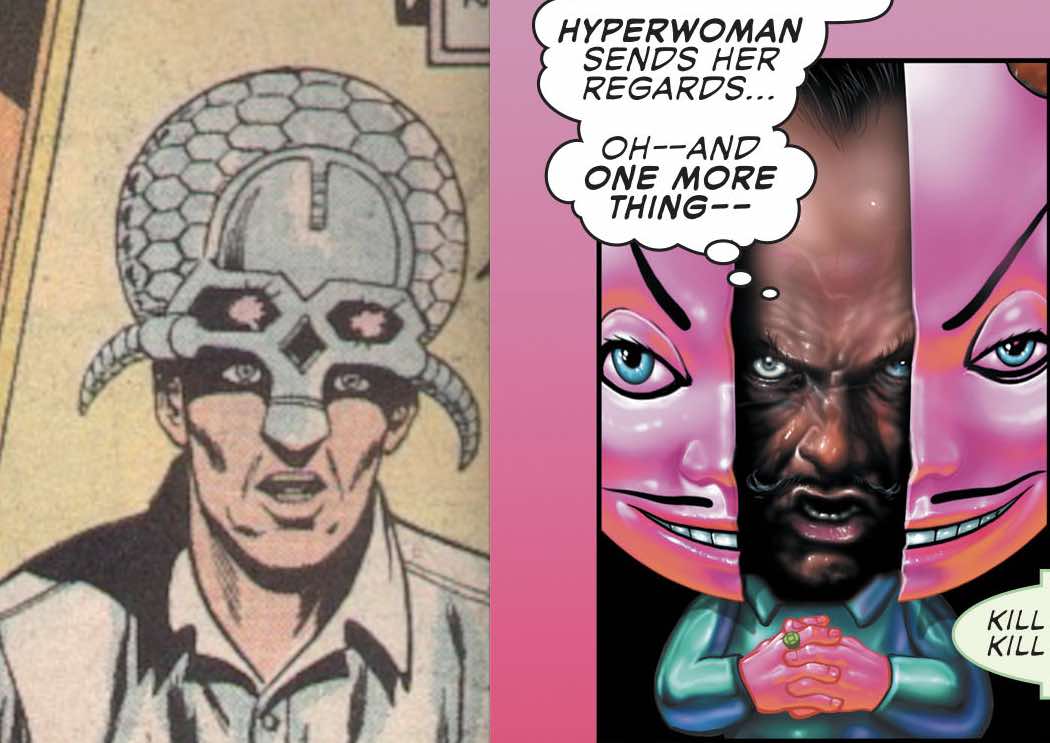
To return to the potent influence of WHTTMOT, the entire arc of Season Two has led us there. In Moore’s story, light-hearted Superman characters like Bizarro, Toyman, and the Prankster become homicidal. In Morrison’s, light-hearted Superman characters like Hyperman and Power-Boy become homicidal. At that point in WHTTMOT, Superman asks, “If the nuisances from my past are coming back as killers… what happens when the killers come back?” He is soon answered by the arrival of an array of his killer villains. Hal, at the end of #11, is stunned to see that the Nomad Empire, at Hyperwoman’s request, has gathered a collection of his more serious foes, including the Shark (deadly), Black Hand (virtually synonymous with death). The final attack on Superman in WHTTMOT is led by a Brainiac-possessed Luthor, featuring a weird composite of their heads, and lo, the leader of this final attack on Hal is led by Hector Hammond, with a weird superimposition of Sinestro over his head. Coincidence?
Chiaroscuro
Earlier in Season Two, we saw Hal in a seemingly fatal jam, falling from the sky at the end of #3, when his bird-sidekicks caught him in midair. By issue #11, they have already grown to maturity and seem to leave him, and Hal is notably saddened. A family of birds referring to their guardian as “Unca Hal” – this is a lighthearted echo of Huey, Louis, and Dewey. They’ve saved him in the past. But for now, they have left him. This is the light…
…and subsequently, the dark: Hal has found himself in the most dire of circumstances. His bosses want to end his time as a Green Lantern. His foes have planned his annihilation. The entire setup on Athmoora is modeled on the darkness of Game of Thrones, from the comically parallel issue title “Contest of Crowns” to the map of multiple kingdoms and Hector Hammond saying, “Hyperwoman sends her regards” paraphrasing a key line in Game of Thrones, “The Lannisters send their regards.” In both stories it is a threat. Like Batman in Batman, R.I.P., Hal is in a trap made just for him, with a new villain asking his old villains to participate. Like Superman in WHTTMOT, this is to be Hal’s final fate.
Or will it? We know the pattern in which the hero pulls out the win at the end. We might suspect that Hal’s bird nephews will bring the light aspect of comics to him and save him once again. This is the R.I.P. ending. But how will Morrison’s view of real world “mass consumption… mass destruction” play into this? And we already know that this series ending will not be followed by another series with Hal right away. Maybe according to Morrison’s final GL issue, maybe according to the plans of the writers who take over next, this really is a grim fate awaiting Hal Jordan.
Showing posts with label alan moore. Show all posts
Sunday, March 7, 2021
Wednesday, December 18, 2019
Doomsday Clock 12
There is a war between optimism and pessimism, a childlike joy triggered by how wonderful things can be and then there is an awe and fascination in how terrible things can be, a desire to see the old ways shattered and hell let loose. But does that describe Doomsday Clock #12, or does it describe what has happened in DC Comics since Rebirth? Or does it describe both, with the two situations delivering up opposite outcomes? And which will lay the ground for 2020 and beyond?
Ordinarily, I would respond to an issue of this series by going into the small details and see where they are going. As the previous eleven issues, as well as DC Rebirth #1 and "The Button" and various crossovers like the Mr. Oz subplot beforehand ticked by at a remarkably leisurely pace, those small clues pointed us towards the end, an end which in many broad strokes – the JSA and the Kents returning; Superman turning Dr. Manhattan "good" – was visible from the outset. Other details led my prognostications, anyway, onto wrong paths and dead ends; perhaps there were some red herrings in some places, but then again, maybe some plans were changed. In many ways, we don't know, at the conclusion of issue #12, how things end because we ought to be wondering, is Doomsday Clock a turning point in DC's plans or is it a now-out-of-continuity story from a writer who has lost favor during the slow roll of this long, long running miniseries? I will post again on DC #12, looking into the small details, in the days to come. But as I reach the end of this issue, I find myself thinking most about the big picture, and that's what I discuss here.
Without unpacking them, I'll chronicle a list of plot points that I found relatively surprising: That the Superman-Manhattan meeting began as backdrop to a continuing attack on Superman from various villains. That Johnny Thunder had no significant role in saving the day. That the LSH and Superman's career as Superboy were affirmed while Bendis' LSH series seems to have taken a different path. That Veidt's plan prevailed and was not interrupted by Batman or anyone. That Johns provided an expansion of the Multiverse, placing old familiar timelines into the "Earth-" + number scheme. That Johns would flash-forward through the future of DC's reboots "predicting" many future years' worth of stories and hint at this continuing for over 900 more years. That Dr. Manhattan will get to live a non-superpowered life as a married man, a bit like the ending that Alan Moore gave Superman in Whatever Happened to the Man of Tomorrow?
In many respects, there were no major surprises at all. Superman's goodness prevailed and as far back as DC #5, I posited, "Veidt will likely… orchestrate a meeting between Superman, the DCU's symbol of hope, and Dr. Manhattan. But to what end, and to what intended end? Veidt sees the DCU in stark terms, and his only goal is to get Dr. Manhattan to return to his own universe and save it." That was a bit over one and a half years ago – the ending of Doomsday Clock was visible from farther out than any of DC's previous events have even lasted in their entirety!
But as the story ends, I find myself noting the possible dissonance between Johns' prognostication and what I see in much of the rest of DC's output, and I don't mean on mere small plot points (are the Kents alive again?).
Watchmen delivered up a worldview in which superheroes couldn't possibly be the sunshiny and beneficial saviors of a world, at least not one interestingly like ours. Johns, we could see from early on, was going to show the darkness of Moore's vision being illuminated and vanquished by the unstoppable optimism of Superman. On the page, in his own story, and his own miniseries, Johns had the power to make that happen. But what about the rest of DC's superhero comics? What about, as it was dubbed two weeks ago, the Depressoverse? DC has called 2019 "The Year of the Villain." Their flagship character in the making is Harley Quinn. The demonic force behind the scenes of several titles' stories is The Batman Who Laughs. While Johns' story tells us that Superman prevails in the long run, are DC's other stories – are the sales figures – telling us that characters with morality closer to that of the Comedian and Rorschach prevailing in their future output? Was the year of the villain a harbinger of many more years of the villain to come, or is it ending now to deliver up something closer to Johns' vision than to Snyder's? I reach the last page of Doomsday Clock more curious than ever to see how the story will end. We'll start to find out in 2020.
Labels:
alan moore,
doomsday clock,
dr. manhattan,
geoff johns,
superman,
veidt
Sunday, October 6, 2019
Doomsday Clock #11
Three details. Thinking over Doomsday Clock #11, I began to focus on three details ranging in scope from a few words in a single panel to the longest scene in the issue. Each of them made me wonder, why this detail? In each case, I wondered if Geoff Johns put a significant key to the finale in plain sight or if the details are just random happenstance of no great importance. Upon further contemplation, I noticed that each of the three has a parallel event in the Watchmen Universe, which inclines me to believe that there is a deliberate pattern, though that need not be the case for all three. Those three details concern:
• Batman's battle with the U.S. military.
• The reference to John Hinckley.
• Veidt revealing much of his plan in a long speech.
If these details are simply there to move the plot along in a convenient way, then people may remember Doomsday Clock as an unworthy sequel to Watchmen. If, however, they are there as a matter of design, we have an intricate finale awaiting us. I'm going to consider each of these three details in turn and then pull back to see how what they tell us is likely to fit into the finale.
1) Batman vs. the USA
In just a few impeccably drawn panels, Gary Frank shows us a fight between Batman and several uniformed members of the U.S. military. There is voiceover narration by a newscaster, but the details don't seem to match. What is Batman doing, anyway? The interfaces referring to "launch" seem to mirror similar scenes in Doomsday Clock #1, when they indicated ICBM launches and a nuclear war. I don't think that's what they mean here, though.
The answer may lie in the uniform patches.
First, we see Batman in what appears to be a missile launch facility, subduing four or more soldiers. One of them has a patch showing the Earth and space. Then, from behind him, at least four more soldiers emerge, with two arms revealing yellow patches. The narration indicates that the National Guard arrived in Gotham City in order to arrest Batman. Later, on Veidt's monitor, we get a hint that Batman has – not astonishingly – emerged from the fight victorious. What happened?
The Earth and space patch is close to that of a U.S. Space Force that existed before 2002. It appears as though Batman is preventing a missile launch that one might associate with the risk of a civilization-destroying nuclear war, one that Batman certainly couldn't stop if he needed to be in more than one launch facility at a time. Is the DCU on the verge of nuclear war?
No. The apparent scenario is that the missile launch was a staged event, designed to lure Batman into a trap that sprang when the yellow-patched soldiers – the National Guard – burst into the room, with Batman's backward glance indicating apparent surprise. Thus, the television coverage is about the relatively minor matter of Batman battling the authorities and not about the infinitely larger concern of nuclear annihilation. According to what we see on Veidt's monitor, Batman has escaped from the ambush, surprising no readers, and is free to continue his quest, as Alfred reveals, to find Reggie and join forces in confronting Veidt – the only plot point of the issue that is described in the solicitation of #11. Evidently, how that search plays out will be important in the finale.
What this shows is that the U.S. government has turned on Batman, and a later scene shows that Superman is also subject to arrest, but Superman's intention to speak with the President is sidelined by other events. Ultimately, the point of the Batman scene is not that nuclear war is imminent but that Veidt's frame-up of Superman succeeded in turning the U.S. against both Superman and Batman. Veidt has a plan and his wish to pervert American power has succeeded, although he may or may not have anticipated – or cared – that Batman would still be on the loose.
2) Why does Dr. Manhattan refer to the 1981 assassination attempt on Ronald Reagan by John Hinckley?
Not often does such a small detail seem so important. Dr. Manhattan narrates history often, but why would this particular event be chosen? Why not the inauguration of any of the 45 Presidents? Why not the British occupation in 1814?
This occurs in DC #11 during the continuation of a scene that began at the end of DC #10. Looking only at the portions that occur in #11 make it quite confusing: Dr. Manhattan is on the sidewalk in Washington, D.C. when he narrates the 1981 event, then promptly says that four hours later, his confrontation with Superman will take place. But the confrontation with Superman is in the present, not 1981, so we have two confusing gaps: 1981 to 2019 (38 years) and the aforementioned 4 hours. What is going on here?
The earlier portions of the "scene" in DC #10 shed some light on the structure, or lack thereof, of Dr. Manhattan's narration. His narration is moving wildly back and forth through time, and from event to event: About 12 years ago, Five years ago, one year ago, 1938, the present, 1954, 1971, 1938, 1954, 1985 (in the Watchmen Universe), and only then 1981, and the present. At a minimum we can say that the wild gyrations are more salient than any of the individual events.
The Hinckley assassination attempt stands out from the other events that Dr. Manhattan names in that it only involves actual historical figures. For what it's worth, it occurred in the real world and in the DCU, but not in the Watchmen Universe, in which Ronald Reagan was not President in 1981.
The location of the Hinckley assassination attempt was in Washington, D.C., about two miles from the White House, where Superman encounters Black Adam. It is plausible that the punch that lands Superman where Dr. Manhattan was waiting for him knocked him those two miles in distance. So, the location of their encounter may match the 1981 event. That could partially explain the connection, but since the event was 38 years earlier, why mention it? Why single that one event out from other events that have taken place in Washington? There are two likely answers that build upon one another.
First, there is a corresponding and contrasting event in Watchmen: It is asserted in a very small number of panels that Dr. Manhattan knew in advance of the Kennedy assassination but did nothing to stop it. (Watchmen #3: "failed to prevent J.F.K.'s assassination." Watchmen #4: knew Kennedy would get shot but didn't do anything; he states that he "can't prevent the future. To me, it's already happening.") Brief though those may be, they do much to illustrate Dr. Manhattan's stoic indifference to humanity, and Moore included this not as an incidental minor detail, but a major insight as to the nature of Dr. Manhattan's role in his universe.
Second, Hinckley's assassination attempt may thematically symbolize Veidt's plan (whatever its precise details may be) as the attempt of a violent (and unstable?) figure to bring down a leader. And in this, if so, what is significant is not the violence that took place (alternately, Reagan's injury and Superman's incapacitation and loss of prestige) but that the effort failed (Reagan survived with a quick recovery and we may likely see Superman prevail in the next issue). Thus, it symbolizes not a successful attack but a failed one, and its inclusion bodes poorly for Veidt's plan.
What would be more meaningful would be if the contrast with Watchmen's JFK assassination is explored actively in the finale and we learn that during his time in the DCU, Dr. Manhattan intervened in the attempted assassination of Ronald Reagan, saving Reagan's life, and that in some other timeline, without his intervention, Reagan died. This would show the moral arc of Doomsday Clock to be one of redemption, with Dr. Manhattan losing his stoic indifference, or fatalism, or the predetermined nature of his action and inaction. While this could involve some sort of sci fi mechanism to explain it, it would also entail moral development on Dr. Manhattan's part, and the triumph of Superman's hope versus Veidt's cynicism.
3) Veidt's long, expository speech
Reading Doomsday Clock #11, my thoughts turned to a speech from Watchmen's issue #11. I'm sure most of you recall it:
"I'm not a Republic serial villain. Do you seriously think I'd explain my masterstroke if there remained the slightest chance of you affecting its outcome? I did it thirty-five minutes ago."
That is surely one of the best-remembered lines from Alan Moore's Watchmen. It is also likely to become one of the keys to how Geoff John's Doomsday Clock is remembered. Because, if Veidt's long, expository speech to Saturn Girl in Doomsday Clock #11 (one that largely revealed things already decoded from Doomsday Clock #10 and earlier) turns out in the final analysis to be what it seemed on the surface, Adrian Veidt is at least a notch or two less sophisticated in Johns' story than he was in Moore's. (FWIW, Republic Pictures was a maker of films and not-so-well-regarded serials. Characters in Republic serials included Zorro, the Lone Ranger, and even Captain America.)
And, sure, it could be argued that Doomsday Clock's Veidt is so absolutely certain that Saturn Girl cannot interfere with his plan that his expository speech to her cannot do harm. But let's be clear about what the "Republic serial villain" line meant in Moore's original. It wasn't a tactical examination of how Nite Owl, Silk Spectre, and Rorschach, in Antarctica, might possibly have interfered with events in New York. It was Moore elevating his characters and his work above those of other, clumsier works from the past. Now, if Veidt has revealed the better part of his plans in Doomsday Clock and there is no forthcoming reference to his "Republic serial villain" remark from the same-numbered issue of Watchmen, it will have seemed as though Johns has dropped the ball.
It could play out in one of three ways:
• Johns goes on with his story without returning to the "Republic serial villain" line. Veidt's speech to Saturn Girl was ultimately without major effect except to reveal his plan to the readers and one character that is no longer alive. In essence, Johns' version of Veidt will be one notch less self-aware than Moore's, and if the story itself does not address that, then Johns' story is one notch less deep than Moore's.
• Veidt is eternally a step ahead, and was knowingly speaking those words in order to facilitate his plan. We are going to get an intricate reveal in #12 indicating how he, again, is on a higher level of awareness than those "Republic serial villains."
• Before pride comes the fall: By speaking those words aloud, Veidt has unwittingly doomed his own plan because someone in a position to ruin his plan has heard them. If so, that would almost certainly be Johnny Thunder, dismissed with contempt by Veidt. We know that Johnny is close enough to Veidt's conversation with Saturn Girl to have overheard. We also know that Johnny's return to power is coming, whether it involves Alan Scott's lantern or the Thunderbolt or both. In essence, Johns' version of Veidt will be less sophisticated than Moore's, and the story will make the contrast clear.
Which of these will we see? I hope it's the third. (Though the second might set up a brilliantly complex finish that I can't anticipate.) Small details – a close-up of the lantern and the fact that Johnny could overhear the conversation – seem too salient to be coincidental. We are seemingly ripe for an ironic turnaround where Johnny Thunder – the most lighthearted and laughable member of the Justice Society – could instruct the Thunderbolt to act on what he has overheard and upend Veidt's plan, either by intervening in the Superman-Manhattan showdown and/or by having it take the lantern back to 1940 and save Alan Scott's life and Green Lantern career. This is what I think will be a pivotal event in #12, and Veidt giving his speech to Saturn Girl may be what #11's title refers to as a "lifelong mistake." It will turn out that Veidt is not Moore's bitterly cynical genius trampling over optimistic superhero comics, but is, indeed, no better than a Republic serial villain, and will have blown his evil (well, extremely Machiavellian) plan by reciting it aloud.
The Big Picture
Around the many small details in Doomsday Clock – the three upon which I focused here, and many, many others – there is a larger design and it has a striking simplicity to it, with a great deal of symmetry. From the Watchmen Universe, we have the blue superpowered godlike figure Dr. Manhattan and a counterpart of sorts, a non-superpowered genius, Veidt. From the DCU, Superman and Batman play a similar role. There are supervillains from each, with Mime and Marionette representing their universe to the many supervillains at home in the DCU. The American cast of superheroes is mirrored by other groups internationally. The international politics of the Watchmen Universe and the DCU both reflect a U.S.-Russia dynamic in the real world which is taking form and being revealed too quickly for Johns' story to capture faithfully. And as intriguing guest stars from other teams, we have another kind of symmetry: Johnny Thunder representing the past and Saturn Girl representing the future. This symmetry is not accidental, not in a story where multiple panels show off Rorschach's eponymous symmetries. And now, Black Adam's lightning calls to mind the numerous shout-outs to the Thunderbolt.
Doomsday Clock was introduced in the final pages of "The Button" storyline in Batman and Flash monthlies and it ended with a bold image: The soiled and marred Superman symbol in close-up. This told us, provocatively for an image in the pages of Flash, that the story ahead would focus on Superman. Given the small reveals in the dialogue of Dr. Manhattan and a few others in Doomsday Clock, we may interpret it more firmly according to the interpretation that Mark Waid gave us in Birthright, that the symbol means "hope." It is this idea that Veidt attacks after hearing a hospital employee say that, "Superman's the only thing you can believe in anymore." However, in Dr. Manhattan's vision of the upcoming calamity, he "saw a vision of the most hopeful among them… now hopeless." He also shows a sort of transformational disappointment in the fact that Carver Colman was once full of hope but died an early and inglorious death.
Knowing all of this, Veidt concocted a plan for the upcoming encounter between Dr. Manhattan and Superman. He knows there are two possible outcomes: Either Superman destroys Dr. Manhattan or Dr. Manhattan destroys the universe. What is Veidt's plan?
The pivotal moment in Veidt's orientation occurs in Watchmen #2 when the Comedian bitterly declares that the world cannot be saved from nuclear catastrophe by people in costumes fighting crime. On the basis of that moment, Veidt moves towards a plan to save his world by bringing about a catastrophe. In order to prevent total annihilation, he orchestrates a massacre. In order to save billions, he kills millions.
His plan for the DCU is no different. "In order for things to change, they must hit rock bottom. So what if I could turn the world against Superman?"
The dialectic in this story has been clear from the beginning: Veidt, Dr. Manhattan, and the Comedian are, in their own ways, morally bankrupt. Johns will show the DCU's leading lights upend Veidt's bleakness.
Veidt believes that the DCU will be his tomb. He likely believes, then, that Dr. Manhattan will give up hope when he sees Superman fail. He may believe that Dr. Manhattan will reboot the DCU, making it better, then return to the Watchmen Universe to save it, too. Instead, we seem sure to see things rebound in the DCU without hitting bottom. The future is gone (as the new Bendis LSH reboot already shows). But the past is not.
I believe that one or two of the DCU characters will "turn" Dr. Manhattan, this will be one or both of Superman and Johnny Thunder.
We've read many stories over the years where someone tries to corrupt or break Superman and cannot. The victory is not in Superman's immense powers but in his unrelenting sense of hope. Will this happen? Perhaps. We see Superman attack Dr. Manhattan in a rage, likely when he learns that Dr. Manhattan's manipulation of the timeline killed Jonathan and Martha Kent. But is that the last moment before catastrophe? Is there a last-second change of heart, Superman pulling back his fist in the last instant?
Or (and/or) we could get the Johnny Thunder finish. If we find out that Dr. Manhattan was, all along, the Thunderbolt, then Johnny could successfully summon him and pull him away from the final encounter with Superman, then set him to the task of fixing everything on both Earths. It is perhaps key that the death of Alan Scott "saved" the lantern from being applied to the third and final of its three roles, which have always been since its first appearance in 1940 been, "once to bring death, once to bring life, and once to bring power." Johnny could now use it for power, and be the savior in the story.
We also have Batman and Luthor both seeking to intervene, and other players, such as the superheroes on Mars, could step in as well. Between the showdown in Washington and Johnny in the cell and Batman and Reggie in Gotham, what is the key series of events? Will Johnny Thunder save Superman or vice versa? Will Batman play a key role at all?
Whatever the intricate details, I see the finale taking the form of a comedy, as opposed to Watchmen's tragedy. As the Thunderbolt always represented cheerful, humorous fun, it would be a symbolic defeat of Moore's dour pessimism if it turned out that this story transformed Dr. Manhattan retroactively into a benevolent character who has always been a bit of a gag.
I think Johns' mind may turn to a pair of JLA-JSA crossovers from the late 1970s, each of which, scripted or co-scripted by Martin Pasko, became more elaborate by adding a third world to the mix. In JLA #137, Johnny's Thunderbolt personally zapped the unpowered Marvel Family into becoming their superpowered identities. In the very next JLA-JSA meeting, the LSH was the third team joining them. The juxtaposition of Johnny Thunder and Saturn Girl in Doomsday Clock makes me wonder if Johns also remembers these stories and has chosen Black Adam as one of the major threats onstage precisely because the Thunderbolt can take the place of magic lightning and zap him into his powerless identity.
The long interval between issues of Doomsday Clock allows a lot of time for us to contemplate the story, and I for one am in favor of it. While, in many cases, I have blogged about issues the day they came out, I have pondered this one for weeks before compiling my thoughts. With weeks to go before the finale, I'm sure there is more to contemplate still.
Labels:
alan moore,
batman,
doomsday clock,
dr. manhattan,
geoff johns,
johnny thunder,
jsa,
superman,
veldt,
watchmen
Sunday, June 9, 2019
Doomsday Clock #10: Superman and Dr. Manhattan
Doomsday Clock #10 was
unusually packed in reinterpreting DC history, and there are so many facets to
it, I will split my comments into two posts. In this one, I will focus on the
major players in the issue and what seems to be the message of the issue, at
this late stage in the game, comprising a lot of the message that Johns intends
for the series. In a second post, I will comment on the Justice Society and the
striking – to me – omission of Batman.
Doomsday Clock
#9
featured one of the most sprawling casts the DCU can muster, with a huge force
of superheroes taking part in a showdown on Mars. Issue #10, in contrast,
shrank the whole story down to a few principal characters; though a few
characters from the past and some from this story had extended cameos, almost
all of the major narration focused on a few men. These characters are not merely
playing roles in this story. Johns uses them to deliver a reframing of the
history of superhero stories. It is probably most instructive to see these
major characters in the issue as archetypes, standing for major eras in comic
book / heroic fiction. The focus of the issue is primarily about the use of and
messages conveyed by Johns' use of the following: Nathaniel Dusk, Alan Scott,
Superman, and Doctor Manhattan. Along the way, there is heavy use of Carver
Colman, the actor who plays Dusk in the movies.
The
story intertwines, in a legitimately weird way, several different substories
– some of them classics of the superhero genre – some more obscure
stories from the past, one – of course – Moore's Watchmen, a comment on the superhero genre, and then the main plot
of Johns' work that we're discussing here – Doomsday Clock, along with the side plots and stories within a
story. All told, we have nearly a dozen separate fictional universes wound
together into one larger story. But, unlike the pre-Crisis or Morrisonian DC
Multiverse, these worlds are not parallel. Part of what Johns is doing here,
within his story and no doubt to launch a reframing of DC's sub-universes is to
discard the notion that all these separate universes are separate but equal.
C'mon, we always knew that Earth 3 and Earth 19 and Earth whatever were not
universes equal to Silver Age Earth One. Most of the universes in the
Multiverse are and always were derivatives of the main DCU. Johns is advancing
the conversation in this issue by recognizing that in the cosmology, the main
Earth is special, and other things flow from it.
The
story has so many threads going, of such different kinds, that the issue alone
needs a map of them, or at least a list. It goes as follows:
1)
DCU timelines, keying around the origin of Superman:
Golden Age 1: Superman debuted in
1938 before Alan Scott
Golden Age 2: Alan Scott debuted in
1940 in a world without Superman
Silver Age: Superman debuted in 1956
in a world without Alan Scott
Byrne: Superman debuted in 1986,
long after Alan Scott
Birthright: Same Golden Age
backstory as GA2
Secret Origin: Same Golden Age
backstory as GA2
Wally West and Johnny
Thunder remember this
New 52: Same Golden Age backstory as
SA
Rebirth: Same Golden Age backstory
as SA
Seemingly inevitable reboot: Same as
Secret Origin?
2)
The Watchmen Universe
3)
The Nathaniel Dusk universe
4)
Carver Colman's story: He inhabits various DCU timelines, possibly all of them,
though we only get direct indications of his intersection with the first two
DCU timelines, and after that, at least in the one we last saw, he is dead.
One
of the jarring aspects of the story is how profoundly obscure Dusk and Colman
are, and yet Johns elevates them to central roles in the story. The Colman plot
takes a man of no particular importance and gives him one of the most
influential roles in DC history, with the (in some respects) godlike Dr.
Manhattan pairing up with him in a strange and somewhat incomprehensible
partnership, meeting once a year in the same location. It is easy to see how
Dr. Manhattan's vision of the future provides a pivotal, life-changing boost
for the career of Colman, but less obvious why the company of such an
unimportant man would be a draw for Dr. Manhattan. Similarly, the Dusk sideplot
is, on the surface, a distraction from the main story, of no causal
relationship to it. Neither Colman nor Dusk seems of interest on a par with the
superbeings who headline the series. Why did Johns give them these roles?
For
Dusk, the answer is clear: He is an archetype of the detective genre. His kind
starred in comic books, novels, and movies, peaking in approximately that
order. The "D" in DC stands
for "detective" and that hearkens back to 1937, a little over a
year before the debut of Superman. One of the detectives who launched the Detective Comics title in issue #1 was
Bruce Nelson, name-checked by Johns in the end materials in Doomsday Clock #3. Nelson and other,
generally similar, tough guys who tackle crime appeared in the monthly title
for 26 issues until they were overshadowed by, and ultimately replaced and
virtually eliminated by a new feature in that title — Batman. Ultimately,
old-style detectives did not survive contact with the likes of Batman; he
immediately took over the cover art of the title and the conventional detective
stories inside the issue rapidly became scarce, as well. A similar rise and
fall took place in the movies, as well, with the film noir genre starting to peter out during the same mid-50s
timeframe that, in Johns' story, sees the onscreen death of Nathaniel Dusk. Dusk
serves as a single example of that kind of character, standing in for comic
book Bruce Nelson (whose run ended in 1940), and movie detectives like Nick
Charles, Mike Hammer, and Sam Spade, whose popularity also rose then fell (but
later enjoyed various revivals).
Dusk's
story, though, is packed with references to the meta-story arc that Johns gives
us about DC history, most obviously when he is given a glass globe representing
a "world" from the past, and he smashes it while using it as a
weapon, with the voiceover narration echoing a Crisis on Infinite Earths tagline, "Worlds live. Worlds
Die." Just as various DC timelines (and eras) have died, just as the eras
of comic book and movie detectives ended (or, at least, greatly waned in
popularity), Dusk's storyline came to a definitive end in The Adjournment. Moments after Dusk shatters the globe, he is shot
in the back, and his world – his time as a detective in the movies, anyway
– also dies.
Much
the way that Batman and other costumed heroes ended the run of Bruce Nelson and
his kind, Dr. Manhattan elevates, then indirectly ends the life of Carver
Colman. Colman initially feels (literally) blessed by the presence of Dr.
Manhattan in his life, wondering if the erstwhile superhero is an angel. But
from the beginning, their association takes Colman down a tragic path. Colman's
movie success brings him fame and riches, but his fame combines with secrets
and lies to attract the blackmailing that ends his life. Colman receives from
Dr. Manhattan in much the way that Faust received from Mephistopheles, getting
precisely what he wished for in the short run, but damnation in the long run.
Clearly,
the rise and fall of Dusk and the actor who played him, Colman, are told in
parallel fashion, both killed from behind in successive panels after being
betrayed by a woman they loved. As I have suggested that Murray Abrahams plays
a part intended to parallel that of Dr. Manhattan, we see them occupy the same
position in that pair of panels. However, Abrahams is actively the killer,
facing Dusk and pulling the trigger, while Dr. Manhattan passively brings about
the end of Colman, with his back turned as Colman is killed. As Dr. Manhattan
himself narrates, he could have stopped it, but did nothing. He is a being of
inaction in a world where the heroes practice action.
"Action"
is the title of the issue's story, and it should be interpreted on a few
different levels. It is yelled by the director on the set, and it is what, in
Dr. Manhattan's formulation, distinguishes Superman from himself. It is, of
course, the title of the series that launched Superman, the title whose first
issue appeared on the newsstands on April 18, 1938, the very date during which
Dr. Manhattan appears in the DCU. Johns also slipped the title of the famous
comic book into the climactic dialogue at the end of Infinite Crisis, with Superman telling Superboy Prime that being
Superman is "about action." (Much the same synopsis of heroism
delivered a couple of years later in Batman
Begins: "It's… what we do that defines us.")
Dusk
and Colman are no-name characters used as archetypes in Doomsday Clock, and Dr. Manhattan is also an archetype, created by
Alan Moore to make a comment of his own. It may be easy to forget reading Doomsday Clock in 2019 that, if there is
a single character that Dr. Manhattan was meant to represent, it was Superman,
at least Superman as he was when Moore plotted the story around 1984. Blue,
buff, godlike, weirdly dysfunctional in relationships with women, incapable of
symmetric relationships with the people closest to him, phenomenally
self-absorbed (as Moore has Superman say of himself in Whatever Happened to the Man of Tomorrow?, "over-rated and too
wrapped up in himself"): These are the characteristics of Bronze Age
Superman that Moore packed, with distaste, into his rendition of Dr. Manhattan.
Dr.
Manhattan is toxic, and he was meant to be. Moore was trying to use him to tell
comics fans, see how sterile, self-serving, and off-putting your heroes really
are. Johns turns Dr. Manhattan loose in his interactions with Colman, all of
his godlike powers ultimately availing his friend nothing when he watches
unconcerned as Colman is murdered by his own mother.
Remembering
this, consider the question that Dr. Manhattan has asked of the blackout
following his upcoming encounter with Superman: Does Dr. Manhattan destroy the
universe or does Superman destroy him? The interesting thing is not to take
this as the headline on a "versus" thread – how do the powers of
the two characters match up in a fight – but how do the two visions of a
comic book superhero square off? And here, I think we return to the message
that Morrison closed on in Final Crisis,
with Mandrakk representing, for the most part, Alan Moore in that story and Dr.
Manhattan representing Moore's worldview in this one. If Moore was right, the
superhero genre was on a path towards oblivion way back in 1985. This is 2019,
and the good guys haven't given up yet, so Johns has plenty of room to take the
opposite side of the argument.
And in case there's any doubt where that is going, the final lines of the end materials, featuring the screenplay of The Adjournment give it away: Dusk, seemingly shot dead during the scenes that were filmed, survives the shooting and recuperates to walk again. The good guys aren't dead yet.
Labels:
alan moore,
carver colman,
doomsday clock,
dr. manhattan,
geoff johns,
superman,
watchmen
Saturday, December 22, 2018
Doomsday Clock 8
I've paused considerably before posting thoughts on DC #8. While the narration in the issue is considerably action-packed and the physical events that occur are presented in a clear fashion, there is a disorienting degree of uncertainty surrounding the hows and whys of these actions. The majority of the issue is devoted to a two-phase catastrophe in Moscow, but some events that get less coverage are still striking and mysterious. It's clear that some very important events took place off-panel and/or inside someone's mind between the meeting between Veidt and Dr. Manhattan in DC #7 and Firestorm's arrival in Moscow in DC #8.
To be succinct, the framing scenes with Veidt that start and end DC #8 strongly imply that he is directing all of the major events in Moscow, making moves behind the scenes and from a distance to give Superman, many Russian citizens, and apparently Firestorm one very bad day. His stated goal is to save everyone and everybody, and apparently, and in keeping with his master plan in Watchmen, he is quick to sacrifice many individual lives along the way. But what is happening, and why?
Moscow: Superman, Firestorm, and (?) Dr. Manhattan
What happens in Moscow? Firestorm arrives, which is to say that Ronnie Raymond has decided to confront those he perceives as his tormentors who have aimed the Supermen Theory against him and other superheroes. His temper and his powers get out of control and this leads to many Muscovites being turned into glass. Firestorm flees the scene. Later, Superman gives Firestorm a pep talk after which Firestorm succeeds in changing one of the glass people back to normal. When Firestorm and Superman arrive in Moscow seeking to restore the many other glass people, Russian superheroes and Russian military forces under the command of Vladimir Putin respond with force rather than give Firestorm a chance. This escalates rapidly into Superman losing his status as the world's one, truly universally respected superhero. Immediately thereafter, an explosive blue flash leads to Superman (and Firestorm) disappearing and damage done to many of those in and near Moscow, including a rapidly-approaching Batman.
As others have already noted, this structurally resembles Veidt's surreptitious plans in Watchmen: Firestorm's angry outburst, followed by the use of his powers, resembles Dr. Manhattan's angry outburst when a talk show guest accuses him of having caused many people's cancer. Second, a large explosion in the middle of a city resembles Veidt's master plan creating mass casualties in New York. We may further note that Firestorm is one of the DCU equivalents of Dr. Manhattan (Captain Atom may fit the bill better, but Firestorm is the one who's on-panel here). However, the similarity with Watchmen only goes so far: Superman seems to be the main target of all of this, and Firestorm seems to be more of a weapon used to place Superman in this situation.
This leaves us in search of an understanding of why and how Veidt is making all of this happen. We should moreover be wary of false assumptions, because there are some inferences made at many points in the discussion, and some anomalies that are surely setting up some major reveals.
Perhaps the biggest clue to all of this is the alternate cover that shows Veidt's hands manipulating marionette versions of Superman and Dr. Manhattan on Mars. It seems like a good bet that the blue flash at the end of the Moscow crisis consists of Dr. Manhattan's powers teleporting Superman and himself to the surface of Mars, a getaway that Dr. Manhattan also chose in Watchmen. Veidt tried, unsuccessfully, to get Dr. Manhattan to return to the Watchmen universe, and that is still his goal. His plan may be as "simple" as believing that a face to face meeting between Superman and Dr. Manhattan will produce a conversation in which Superman, as the paragon of hope, talks Dr. Manhattan into doing the right thing, which will be what Veidt wants, to save everyone and everybody. We may also predict that this won't work: Saturn Girl already disapproved of Veidt's plan, Dr. Manhattan's vision of the future shows him and Superman in battle, and both the art and the dialogue cast Veidt as the same sort of would-be-hero-but-villain role that Alexander Luthor played in Johns' Infinite Crisis.
Even if this successfully describes the aim of Veidt's plan, it is unclear how he goes about it. He seems to have engineered the following events that seem to be the product of others' choices, or by chance:
• Ronnie Raymond decides to go to Moscow as Firestorm
• Many citizens are turned to glass – apparently by Firestorm
• One glass citizen is turned back
• Dr. Manhattan's powers send Superman away, probably to Mars
Some of this seems to require superpowers, and some does not. Veidt is hyper-intelligent and skilled at manipulating others into doing his bidding while they think they are utilizing their own free will. Veidt could probably trick Ronnie into going to Moscow with something as simple as a forged text message or handwritten note. Turning people to glass, however, is not part of Veidt's skill set, so he apparently accomplishes this through one of the following:
• Bubastis has some version of Dr. Manhattan's powers and is capable of using them as Veidt desires.
• Veidt uses some DCU power such as Alan Scott's lantern or a kidnapped superbeing such as Zatanna, the Martian Manhunter, or Psycho Pirate to make the glass transformations occur or Firestorm to cause the transformation.
Finally, the teleportation to Mars may be performed by Veidt or by Dr. Manhattan himself, as a response to events in Moscow.
I will note a (literally and figuratively) glaring detail on page one: The lighting in the Oval Office scene switches from bright (white) to dark (blue), which may symbolically indicate that Veidt is creating a darker reality, or may mean that Bubastis is glowing blue as we've seen before. This is also echoed symbolically in the next scene when Perry White refers to Clark Kent's "blue suit" and Kent says that it's navy (a darker blue). Of course, Kent's more famous blue suit is that of Superman.
Given that list of options, it is perhaps not so important as to how Veidt manipulates events: There are plausible means at his disposal for doing so, and his choice seems like a mere detail. That gives us a broad explanation for much of the Moscow scenes. But, we have a puzzle piece unmatched and a hole where a puzzle piece should go: Where is Dr. Manhattan, and why is Martin Stein referenced so much in this issue (but unseen and unheard)? In the broader story, we have a major puzzle piece yet to fit and a hole regarding the Supermen Theory and the unobserved plan of Dr. Manhattan. It is likely time for all of these to fit together. I can't cite everyone who has previously posited that Martin Stein is the DCU identity of Dr. Manhattan, but the evidence stacks up pretty deeply now.
Martin Stein and Jon Osterman have similar enough careers. Both were nuclear physicists and both were given nuclear transmutation powers because of a nuclear accident. Luthor said that the head of the Supermen Theory conspiracy was a metahuman and a former JLA member, and Stein qualifies as both. Dr. Manhattan was likely present for the events in Moscow, and Stein – as the subordinate personality inside of Firestorm – was known to be present. The Supermen Theory produced many new metahumans and we know that Dr. Manhattan at some point manipulated the number of superheroes in continuity by allowing Alan Scott to die. And, there has to be a good reason why the Supermen Theory subplot is part of Doomsday Clock, which has not yet been completely explicit.
And, there's one more subtle detail way, way down in the weeds. In the end materials for DC #6, the file for the supervillain Typhoon says that his metagene was deliberately triggered by exposure to radiation, and that he was named "Typhoon" by the Director of the U.S. Government's secret Department of Metahuman Affairs. Typhoon first appeared in a Firestorm story as a backup feature in Flash #294 (1981), a story I happened to buy off the newsstand. Johns uses the introductory issue as a code name for three metahumans, including Typhoon, Moonbow, and Puppet Master, with Typhoon as FL294-1981. With just a few pages per issue, the Firestorm story played out over multiple issues, and the name Typhoon was first thought and then said in Flash #296 by Firestorm, who is both Ronnie Raymond and Martin Stein. Though technically this indicated the will of Ronnie, that seems to be a knowing clue that Martin Stein is the head of the Supermen Theory conspiracy. Furthermore, the director's name is blacked out in the end materials of DC #6, and it appears to start with a vertical stroke (as 'M' does) and be of about the right length (this depends upon the font, which may or may not be Arial Narrow) to be Martin Stein.
Let's examine Martin Stein's wishes as relayed by Ronnie in the issue:
• Didn't want to come to Moscow
• Get back in the sky
• Give up trying to restore the glass boy
• Don't trust Superman
• Can't restore the glass people
• Wants Superman to leave
• Says thanks to Superman
• Tells Ronnie to leave Moscow
Stein is constantly striving to prevent or end the situation in Moscow by having Firestorm and/or Superman quit and/or leave. Seven of his eight comments are to that effect, while the remaining one thanks Superman. The likely explanation for this is that, as Stein, Dr. Manhattan is forced to go where Ronnie wishes. Knowing what will occur, Manhattan/Stein would naturally be upset about the deaths of bystanders and, perhaps more important to him, the tarnishing of Superman's reputation. It is essential to this that Veidt's plan arose in response to a small number of comments in which Dr. Manhattan identified the hope in Superman and Colman Carver as something to which he responded and apparently seeks.
The question is, is that all Veidt's plan? Veidt knows, as of DC #7, that Dr. Manhattan seeks hope, and that Superman is the ultimate representative of hope. By ruining Superman's reputation, Veidt ruins Dr. Manhattan's quest for hope, and thereby eliminates Dr. Manhattan's stated objective for refusing to return to the Watchmen Universe. Now Dr. Manhattan is motivated both to fix the DCU and also the Watchmen Universe. But does Veidt actually know that Dr. Manhattan was present inside Firestorm, or is that by happenstance? It depends what he means when he looks through the files in the White House and says "Yes. Yes, this one will do nicely." If he's selecting Firestorm as an arbitrary weapon to frame Superman, then maybe his plan didn't depend upon Dr. Manhattan to be present for the tragic events. If he knew that Firestorm included Dr. Manhattan, then "should do nicely" may mean that he was selecting some other DCU individual to assist him in the control over events.
Dr. Manhattan's course of action, then, seems to be one in which he has continually tinkered with the timeline in search of some outcome he finds desirable, and then using his powers to reboot the timeline, with changes, when the last version did not work out. This is, also, like the role that Alexander Luthor played in Infinite Crisis. The sequence of timelines he has experienced or witnessed may include:
• The Justice Society as originally seen in All Star #3
• The Justice Society with Dr. Manhattan as a member (seen on a cover for DC #9)
• The DCU without a Justice Society (described on the first page of DC #7)
And causes of his disenchantment, making him give up hope may include:
• The JSA surrendering before HUAC
• Colman Carver's murder after he stands up to HUAC
• Superman losing his status as a universally beloved hero (at the end of DC #8)
The Justice Society
A brief, but weighty, event early in DC #8 shows Lois Lane receiving a package that Reggie/Rorschach sent last issue. This contains a keychain drive with newsreel footage of the Justice Society in action, dated 1941 like the corresponding story in All Star Comics #4, the first in which the JSA went into action together as a team. The underlying fact is not new to us – there is a timeline, since banished into oblivion by Dr. Manhattan and/or Johnny Thunder's Lightning Bolt, in which the JSA existed in the Forties. But we have no explanation how Reggie obtained that imagery. We know that Johnny Thunder told him about the JSA, but where did the pictures come from? Something cosmic is working on Reggie's side. Maybe Alan Scott's lantern. Maybe Dr. Manhattan. Maybe the Thunderbolt or some other JSA-era force with cosmic powers has returned. A clue may be in the fact that someone rummaged through Lois' desk before the mail arrived. It seems like someone who knows a lot about what's going on is working at cross purposes with Reggie. Veidt? Someone else?
Superman v Batman (and Black Adam): Where's the Hope?
One of the episode's surprises is the flight of Batman (almost certainly towards Moscow) as he monitors the situation and calls out to Superman. He has learned some things during his painful brush with the Watchmen Universe characters, and he seems to have made some important inferences, getting ahead of the readers. As he shouts out desperate orders contradicting Superman's intentions, orders that Superman does not heed, the final tragedy and explosion seems to indicate that Batman is informed and wise while Superman is uninformed and foolish. The dynamic also looks bad for Superman when Black Adam tells him that the Supermen Theory is correct (which documents in DC #7 already showed us).
This is news because the first seven issues of Doomsday Clock were unrelenting in showing a Batman who was unprepared for the challenges that faced him, from being outplayed by Rorschach and Veidt, subdued by a crowd, and shocked by the Joker. The series had begun to look like a polemic against Batman while Superman was elevated to the embodiment of hope. Here in the final pages of DC #8, the dynamic reverses, with Batman's perspective seeming to prove correct as Superman, by taking sides, leads to catastrophe.
But was Batman correct? He certainly seems to have tactical knowledge of the situation, including the fact that Superman's words would anger Putin and the fact that the pending explosion was not due to Firestorm (but rather, it seems, due to Dr. Manhattan, although it could be more complex than it seems). But perhaps Superman was on the right moral track, saying, correctly, that Firestorm was not to blame. Batman says that Ronnie is a reckless kid who has too much power, but perhaps both Ronnie's rashness and the tragic events in Moscow were due to Veidt's manipulations, not Ronnie's decisions or actions.
As action escalates, this is still a confrontation primarily of beliefs and ideals. There is likely to be little pause in the final issues of the series now that Superman and Dr. Manhattan have, apparently, met. It'll be fun to watch the action, but Johns' big message is probably going to come across in the speech balloons, not the art.
Monday, October 1, 2018
Doomsday Clock 7
Something big happened. Now that Doomsday Clock begins its second half, some of the key meetings have taken place and the biggest one yet to come – Superman facing Dr. Manhattan in battle – has appeared in Dr. Manhattan's future-vision.
Early on, Johns added detail to the backstory of how Dr. Manhattan changed the DCU by deleting the Alan Scott Green Lantern from its history; this is something I sketched out in my review of DC #3 as matching "the subplot of a JLA/JSA crossover in which an evil Johnny Thunder on Earth One used the Thunderbolt to prevent the Justice League from existing." Just as the Thunderbolt in that story prevented, for example, the lightning that gave Barry Allen from striking his lab, Dr. Manhattan in this story prevented Alan Scott from obtaining his lantern (and, moreover, causing his death). We can be sure that most if not all JSAers were similarly interfered with.
With a scene that looked almost literally like a set stage, DC #7 was centered around a group meeting (after a brief, frantic battle) that put Mime, Marionette, the Comedian, New Rorschach, Veidt, Batman, and the Joker together with Dr. Manhattan. And what followed was, for the most part, talk. In the meantime, Dr. Manhattan teleported the Watchmen Universe members of the group to three different times and places, as significant backdrops of relevance that was not stated directly. First, they go to an idyllic nature scene by a waterfall. Then, to an anti-superhero riot at night in Washington, D.C. Finally, they enter a movie theatre in 1954, terrifying the audience seeing the final Nathaniel Dusk film, The Adjournment. And during this time, with a lot of talking and a couple of one-sided fist-fights, something big happens. What is not immediately clear is: What is that something big?
Dr. Manhattan says "No" to Veidt's request. That happens immediately, and seems obviously irrevocable. There is a little more discussion, including the revelation that Veidt was lying about his brain cancer in order to manipulate Reggie into assisting him. (In retrospect, this was foreshadowed by the Veidt jigsaw puzzle that Reggie was working a couple of issues ago. In one frame, Veidt's head had a piece missing. Then Reggie put the correct piece in place and said that it was in front of him the whole time.)
But this is a big scene for some reason besides those. We know this because when Veidt returns to the Owlship, he believes that he no longer needs Dr. Manhattan's help, and that he has a plan to save everybody. These thoughts frighten Saturn Girl, who believed at the beginning of the issue that everything would turn out fine, but at the end believes that Veidt's new plan will ruin everything. This is yet another turn in her demeanor as seen during "The Button" and makes the details of her mental state an important part of the picture.
Why? Whatever Dr. Manhattan said or did changed Veidt's plan is the mystery in front of us the whole time. It was cryptic for us, and we know things that most of the characters don't. We know that the Nathaniel Dusk movies are tied in some way to the JSA-era superheroes, but Veidt presumably does not know that. So what did Dr. Manhattan say that instantly changed Veidt's worldview?
Dr. Manhattan says a few things with a lot of implications, and some pithy but key statements of his concern the two children of Mime and Marionette. Those statements tell us a lot and tell Veidt a lot, too, but not necessarily the same things. First, we find out that Marionette is pregnant again, which means that the child was conceived in the past few hours in the DCU. Second, we find out that their first child will do or has done something that is so significant to Dr. Manhattan that it is for that child's sake that he spared Marionette's life during the bank robbery we saw in DC #2.
If the information that suddenly changes Veidt's worldview is this, then why? Very likely, because Veidt has some reason to suspect that that child would not have a valuable future ahead of him. And we can guess at several reasons why. First, there was a nuclear war happening on the Watchmen Earth when last we saw it, and that is reason enough. Perhaps Veidt even knows from the child's location that he is dead due to the nuclear attack. Also, the photo of the child that New Rorschach gave to Marionette was "a few years old": Perhaps the child died between 1987 and 1992. In any of these scenarios, Dr. Manhattan's statement may give Veidt hope that the entire timeline can be altered. And therefore, it gives Veidt hope that the past can be changed for the better. This is likely the information and motive behind his current plan.
Dr. Manhattan's comments and thoughts also tell us a lot about Dr. Manhattan's plan. First, we find out that he prevented the rise of the JSA through the murder of Alan Scott. In the same passage, introducing the issue, we find out that one of the events in Alan Scott's timeline of which Dr. Manhattan was aware was the JSA's surrender to HUAC, causing the superheroes of the DCU to disappear. Second, we find out that he was greatly dispirited by the death of Colman Carver, which led him to say that his comment at the end of Watchmen was wrong, and that "Nothing ever ends" has been replaced in his worldview by "Everything ends." Why? The connection here likely lies in the inconspicuous details of DC #3's end notes about Colman Carver and a simple panel at the beginning of that issue. According to those references, the screenwriter of Carver's 1947 movie went to prison for refusing to cooperate with HUAC. This was in fact a real man, Ring Lardner, Jr. who really was imprisoned and then blacklisted from Hollywood just as the fictional DC #3 says. Why include this information? This is likely the key as to why Johns has included the Colman Carver subplot in Doomsday Clock. Knowing that HUAC exists in the current DCU timeline, we also know that the same threat that caused the JSA to retire was not dissipated by Dr. Manhattan's alteration to the timeline entailed by the death of Alan Scott. We now know that killing Alan Scott was not a petty or malevolent act on Dr. Manhattan's part, but a calculated one intended to bring about a positive outcome. And this tells us a lot about Dr. Manhattan's and Johns' intentions:
The notion of an entire generation of Golden Age heroes retiring due to pressure from HUAC was introduced in 1979 as I noted in my review of DC #4. This is an idea that Alan Moore copied in Watchmen, with Hooded Justice retiring (like Alan Scott) and Mothman (a major focus of that issue) ending up in a sanatorium (like Lardner). Mothman remembers this when, after Veidt's scheme killing millions is revealed, he says "They're rounding them up" in reference to the events of 1992. Mothman remembers when his generation, also, was rounded up.
And Dr. Manhattan remembers, too. He was discouraged by the lack of hope in both the Watchmen and post-Infinite Crisis DCU timelines entailed by the surrender of the heroes to the political pressures of their respective times. Removing Alan Scott prevented the JSA from existing, and therefore from surrendering to HUAC. But the death of Colman Carver extinguished the hope that Dr. Manhattan found in that. Why? Here, I see two possibilities, not mutually exclusive. One, based on no more information than an offhand comment early in DC #3, that Carver was regarded by Johnny Thunder's fellow inmate Donald as a hero suggests that Carver resisted the political pressures but remained working and in fact subsequently won an Oscar. A second, as I mentioned earlier, is that Carver actually is one of the would-be JSAers, likely Hourman (obsessed with clocks), and his movies had inspired positive heroism, until his death (being beaten to death with his own trophy like Watchmen's original Nite Owl).
And this tells us what is driving Dr. Manhattan. He, too, is driven by hope. He has been altering the timeline of the DCU, trying to achieve a more hopeful outcome. He deleted Alan Scott's Green Lantern career, trying to prevent the surrender of the JSA (which resembled a sad occurrence on his own world), but it didn't work, culminating with the death of Colman Carver. And now, he is seeing how the events finally play out, with Superman, the current symbol of hope, in some future act of war against Dr. Manhattan himself. This is fated to fail, and at that point, Dr. Manhattan ends the current timeline. The post-Flashpoint DCU is an experiment that Dr. Manhattan is running and he (and Johns) deem it a failure, set to end a month from now. The now-explicable scene at the end of DC #1 showing the deaths of the Kents shows another Dr. Manhattan-triggered tragedy that edited the timeline for the sake of an experiment that turned out tragic. When Dr. M (and Johns) give up on the current timeline, some version of the previous timeline, with Alan Scott living and the JSA existing will prevail. And, by implication, we will also get the Kents back. The fistfight between Superman and Dr. Manhattan will not end with the punch making contact, but with the implied sense of malaise leading the entire timeline to come to a dour close.
In the background, another, probably far less consequential mystery concerns the "identity" of Dr. Manhattan in the DCU. We get three clues. One, Dr. Manhattan himself says that he thought he "might find a place among" the DCU. Two, he says that he stood (physically) on the set of The Adjournment in 1954. Third, Bubastis' eyes glow when he is staring in the direction of The Comedian. I don't see a clear resolution behind all these details, but I do see a misdirection. Veidt believes that his cat responds to The Comedian, but New Bubastis already faced The Comedian and had no such response in DC #3. Either the trace of Dr. Manhattan on The Comedian's body happened after that or Bubastis isn't responding to The Comedian at all but to the man who happens to be standing behind him – The Joker. But we see The Joker still standing there after Dr. Manhattan manifests, so The Joker can't be him, as I postulated earlier, but is possibly "on" him in some fashion, or has left his trace there. I don't see how the details shake out yet, but there is some connection between the old movie set (predating most or all of our current DCU adults) and The Comedian and/or The Joker.
Still, whatever the small details, the large details are now apparent. We know Dr. Manhattan's actions and motives and where they lead. We also know that Veidt has a different plan and it isn't the one that Saturn Girl is hoping for, no doubt leading to her horror in the opening scenes of "The Button." Veidt's new plan is supposed to fail, then, and hope lies elsewhere.
And on the note of hope, the theme I mentioned earlier is emphasized once again: Batman comes across very poorly in DC #7. Although he manages to show his competence in battle, it is with mixed results, as he is injured by Marionette and then sucker-zapped by The Joker. Dr. Manhattan takes us to an anti-Batman riot in Washington and, though Batman is the last man standing after the fistfights of DC #7, he comes across as a mere brawler achieving temporary victories while Superman is "the most hopeful." Veidt, Dr. Manhattan, and Johns are all seeking hope. And we hear again and again that Batman is not it; Superman is.
Early on, Johns added detail to the backstory of how Dr. Manhattan changed the DCU by deleting the Alan Scott Green Lantern from its history; this is something I sketched out in my review of DC #3 as matching "the subplot of a JLA/JSA crossover in which an evil Johnny Thunder on Earth One used the Thunderbolt to prevent the Justice League from existing." Just as the Thunderbolt in that story prevented, for example, the lightning that gave Barry Allen from striking his lab, Dr. Manhattan in this story prevented Alan Scott from obtaining his lantern (and, moreover, causing his death). We can be sure that most if not all JSAers were similarly interfered with.
With a scene that looked almost literally like a set stage, DC #7 was centered around a group meeting (after a brief, frantic battle) that put Mime, Marionette, the Comedian, New Rorschach, Veidt, Batman, and the Joker together with Dr. Manhattan. And what followed was, for the most part, talk. In the meantime, Dr. Manhattan teleported the Watchmen Universe members of the group to three different times and places, as significant backdrops of relevance that was not stated directly. First, they go to an idyllic nature scene by a waterfall. Then, to an anti-superhero riot at night in Washington, D.C. Finally, they enter a movie theatre in 1954, terrifying the audience seeing the final Nathaniel Dusk film, The Adjournment. And during this time, with a lot of talking and a couple of one-sided fist-fights, something big happens. What is not immediately clear is: What is that something big?
Dr. Manhattan says "No" to Veidt's request. That happens immediately, and seems obviously irrevocable. There is a little more discussion, including the revelation that Veidt was lying about his brain cancer in order to manipulate Reggie into assisting him. (In retrospect, this was foreshadowed by the Veidt jigsaw puzzle that Reggie was working a couple of issues ago. In one frame, Veidt's head had a piece missing. Then Reggie put the correct piece in place and said that it was in front of him the whole time.)
But this is a big scene for some reason besides those. We know this because when Veidt returns to the Owlship, he believes that he no longer needs Dr. Manhattan's help, and that he has a plan to save everybody. These thoughts frighten Saturn Girl, who believed at the beginning of the issue that everything would turn out fine, but at the end believes that Veidt's new plan will ruin everything. This is yet another turn in her demeanor as seen during "The Button" and makes the details of her mental state an important part of the picture.
Why? Whatever Dr. Manhattan said or did changed Veidt's plan is the mystery in front of us the whole time. It was cryptic for us, and we know things that most of the characters don't. We know that the Nathaniel Dusk movies are tied in some way to the JSA-era superheroes, but Veidt presumably does not know that. So what did Dr. Manhattan say that instantly changed Veidt's worldview?
Dr. Manhattan says a few things with a lot of implications, and some pithy but key statements of his concern the two children of Mime and Marionette. Those statements tell us a lot and tell Veidt a lot, too, but not necessarily the same things. First, we find out that Marionette is pregnant again, which means that the child was conceived in the past few hours in the DCU. Second, we find out that their first child will do or has done something that is so significant to Dr. Manhattan that it is for that child's sake that he spared Marionette's life during the bank robbery we saw in DC #2.
If the information that suddenly changes Veidt's worldview is this, then why? Very likely, because Veidt has some reason to suspect that that child would not have a valuable future ahead of him. And we can guess at several reasons why. First, there was a nuclear war happening on the Watchmen Earth when last we saw it, and that is reason enough. Perhaps Veidt even knows from the child's location that he is dead due to the nuclear attack. Also, the photo of the child that New Rorschach gave to Marionette was "a few years old": Perhaps the child died between 1987 and 1992. In any of these scenarios, Dr. Manhattan's statement may give Veidt hope that the entire timeline can be altered. And therefore, it gives Veidt hope that the past can be changed for the better. This is likely the information and motive behind his current plan.
Dr. Manhattan's comments and thoughts also tell us a lot about Dr. Manhattan's plan. First, we find out that he prevented the rise of the JSA through the murder of Alan Scott. In the same passage, introducing the issue, we find out that one of the events in Alan Scott's timeline of which Dr. Manhattan was aware was the JSA's surrender to HUAC, causing the superheroes of the DCU to disappear. Second, we find out that he was greatly dispirited by the death of Colman Carver, which led him to say that his comment at the end of Watchmen was wrong, and that "Nothing ever ends" has been replaced in his worldview by "Everything ends." Why? The connection here likely lies in the inconspicuous details of DC #3's end notes about Colman Carver and a simple panel at the beginning of that issue. According to those references, the screenwriter of Carver's 1947 movie went to prison for refusing to cooperate with HUAC. This was in fact a real man, Ring Lardner, Jr. who really was imprisoned and then blacklisted from Hollywood just as the fictional DC #3 says. Why include this information? This is likely the key as to why Johns has included the Colman Carver subplot in Doomsday Clock. Knowing that HUAC exists in the current DCU timeline, we also know that the same threat that caused the JSA to retire was not dissipated by Dr. Manhattan's alteration to the timeline entailed by the death of Alan Scott. We now know that killing Alan Scott was not a petty or malevolent act on Dr. Manhattan's part, but a calculated one intended to bring about a positive outcome. And this tells us a lot about Dr. Manhattan's and Johns' intentions:
The notion of an entire generation of Golden Age heroes retiring due to pressure from HUAC was introduced in 1979 as I noted in my review of DC #4. This is an idea that Alan Moore copied in Watchmen, with Hooded Justice retiring (like Alan Scott) and Mothman (a major focus of that issue) ending up in a sanatorium (like Lardner). Mothman remembers this when, after Veidt's scheme killing millions is revealed, he says "They're rounding them up" in reference to the events of 1992. Mothman remembers when his generation, also, was rounded up.
And Dr. Manhattan remembers, too. He was discouraged by the lack of hope in both the Watchmen and post-Infinite Crisis DCU timelines entailed by the surrender of the heroes to the political pressures of their respective times. Removing Alan Scott prevented the JSA from existing, and therefore from surrendering to HUAC. But the death of Colman Carver extinguished the hope that Dr. Manhattan found in that. Why? Here, I see two possibilities, not mutually exclusive. One, based on no more information than an offhand comment early in DC #3, that Carver was regarded by Johnny Thunder's fellow inmate Donald as a hero suggests that Carver resisted the political pressures but remained working and in fact subsequently won an Oscar. A second, as I mentioned earlier, is that Carver actually is one of the would-be JSAers, likely Hourman (obsessed with clocks), and his movies had inspired positive heroism, until his death (being beaten to death with his own trophy like Watchmen's original Nite Owl).
And this tells us what is driving Dr. Manhattan. He, too, is driven by hope. He has been altering the timeline of the DCU, trying to achieve a more hopeful outcome. He deleted Alan Scott's Green Lantern career, trying to prevent the surrender of the JSA (which resembled a sad occurrence on his own world), but it didn't work, culminating with the death of Colman Carver. And now, he is seeing how the events finally play out, with Superman, the current symbol of hope, in some future act of war against Dr. Manhattan himself. This is fated to fail, and at that point, Dr. Manhattan ends the current timeline. The post-Flashpoint DCU is an experiment that Dr. Manhattan is running and he (and Johns) deem it a failure, set to end a month from now. The now-explicable scene at the end of DC #1 showing the deaths of the Kents shows another Dr. Manhattan-triggered tragedy that edited the timeline for the sake of an experiment that turned out tragic. When Dr. M (and Johns) give up on the current timeline, some version of the previous timeline, with Alan Scott living and the JSA existing will prevail. And, by implication, we will also get the Kents back. The fistfight between Superman and Dr. Manhattan will not end with the punch making contact, but with the implied sense of malaise leading the entire timeline to come to a dour close.
In the background, another, probably far less consequential mystery concerns the "identity" of Dr. Manhattan in the DCU. We get three clues. One, Dr. Manhattan himself says that he thought he "might find a place among" the DCU. Two, he says that he stood (physically) on the set of The Adjournment in 1954. Third, Bubastis' eyes glow when he is staring in the direction of The Comedian. I don't see a clear resolution behind all these details, but I do see a misdirection. Veidt believes that his cat responds to The Comedian, but New Bubastis already faced The Comedian and had no such response in DC #3. Either the trace of Dr. Manhattan on The Comedian's body happened after that or Bubastis isn't responding to The Comedian at all but to the man who happens to be standing behind him – The Joker. But we see The Joker still standing there after Dr. Manhattan manifests, so The Joker can't be him, as I postulated earlier, but is possibly "on" him in some fashion, or has left his trace there. I don't see how the details shake out yet, but there is some connection between the old movie set (predating most or all of our current DCU adults) and The Comedian and/or The Joker.
Still, whatever the small details, the large details are now apparent. We know Dr. Manhattan's actions and motives and where they lead. We also know that Veidt has a different plan and it isn't the one that Saturn Girl is hoping for, no doubt leading to her horror in the opening scenes of "The Button." Veidt's new plan is supposed to fail, then, and hope lies elsewhere.
And on the note of hope, the theme I mentioned earlier is emphasized once again: Batman comes across very poorly in DC #7. Although he manages to show his competence in battle, it is with mixed results, as he is injured by Marionette and then sucker-zapped by The Joker. Dr. Manhattan takes us to an anti-Batman riot in Washington and, though Batman is the last man standing after the fistfights of DC #7, he comes across as a mere brawler achieving temporary victories while Superman is "the most hopeful." Veidt, Dr. Manhattan, and Johns are all seeking hope. And we hear again and again that Batman is not it; Superman is.
Labels:
alan moore,
batman,
doomsday clock,
dr. manhattan,
geoff johns,
joker,
rorschach,
superman,
veidt
Subscribe to:
Comments (Atom)


