Tuesday, November 16, 2021

Jon Kent: Man of Tomorrow?

They married 58 years after they first met. Superman and Lois Lane certainly had a long courtship, so it’s not surprising that they took another 19 years before having their first child.

For decades and decades, the status quo of Superman and Lois Lane turned so slowly you might have thought it was going backwards, and in fact, sometimes it did go backwards. They had fake weddings, imaginary story weddings, weddings on alternate Earths. In one line of stories, Superman had a son whom we saw and a wife who seemed to be Lois but whose back was always to the camera. They had a son on the last page of a famous imaginary story, an adopted son who was written out of history, had Jon Kent in a reality that was written out of history, and there were so many stories whose reality was considered to be imaginary or not, or hinted to be imaginary or not that even a DC editor couldn’t possibly keep track of which stories were asserted when to be real.

For over half a century, writers made Superman into the ultimate bachelor wary of commitment, and even now that he’s definitely married with a son, if you wanted to collect the issues where revealing his identity to Lois, the engagement, marriage, and birth occurred, you’d end up with a curiously thick stack where those events happened, then were altered or revised. However, if you want a quick summary of the lifetime that never actually unfolded in a single version of continuity, there’s an 11-panel spread in Action Comics #976 that gives you the latest story of how Clark and Lois met, married, and had a child. Then the way that their son grew up in space, on an alternate Earth, and in the future is another story or two.

Then, suddenly, in four years, Jon Kent was born, grew up, and became Superman, sort of replacing Chris Kent, sort of replacing Connor Kent, sort of replacing both teenage and then adult Clark Kent.

I establish all of this curious timeline to set the context for today’s big news regarding Jon Kent’s one-panel kiss, which has been and will be variously portrayed as either the biggest cultural change in comics or no big deal at all, and for those seeing a cultural earthquake in it, will be variously portrayed as a very good thing or a very bad thing.

And given the shifting pace of change over Superman’s 83 years, I see it as a very precarious thing. What happens now has an undeniable tendency to unhappen or rehappen. Just as DC was for decades extremely reluctant to allow Clark to commit to Lois, DC is now extremely reluctant to allow anything to happen without a high chance of unhappening. And they have, I believe, creatively painted themselves into a corner. One way or another they have to change their ways, and I’m not sure that decision makers inside the company see that yet.

When the news about Jon Kent’s orientation broke last month, I thought of Sam Zhao as a cautionary tale. Do you remember the name Sam Zhao? Does anyone?

In 2012, the New 52 version of Earth 2 introduced an old-yet-new version of Alan Scott, young and in his prime like the original was back in 1940. Very soon, we learned that Alan Scott was a gay man with a partner and fiancé named Sam Zhao, who promptly died (one issue after his introduction!), then was resurrected as a sort of elemental spirit. Sam Zhao’s last appearance was in 2015, Sam having lost, in rapid fashion, his life, his planet (literally destroyed), and then their entire plane of reality. The 2012 Alan Scott was erased. The previous Alan Scott (it becomes tedious even to enumerate all the previous Alan Scotts, who were variously discontinued, killed, resurrected, renamed, banished to Valhalla, and so on) then became a sort of symbol for the destructive retcons of the DC Multiverse, with Dr. Manhattan’s erasure of Alan Scott’s life as Green Lantern becoming retroactively the single symbolic act of creating the pre-Doomsday Clock timeline. Dr. Manhattan brought that timeline back. But then even Doomsday Clock didn’t happen, and even the timeline after Doomsday Clock has now unhappened, and that was only 2019! Then for good measure, the current version of Alan Scott (who closely resembles the post-Infinite Crisis Alan Scott) earlier this year came out as gay like it was new (because in a sense it was). Sam Zhao and his version of Alan Scott are buried deep behind multiple numbers of destroyed past realities, like a sheet on a bulletin board papered over by newer announcements many times. And so I say, beware to Jon Kent, or to Jon Kent’s creators.

Sam Zhao was [that specific] Alan Scott’s Lois Lane, but Lois Lane remained Superman’s love interest for decades and Sam Zhao appeared alive on only three pages of one issue. And in various ways, Sam Zhao is a Lois Lane for our times, while Jon Kent is a [2012] Alan Scott for our times. DC’s creators want to do something momentous and meaningful with Jon Kent as they did with Alan Scott, but the persistence in sticking out creative decisions is a proclivity or capacity that DC has perhaps lost.

Let’s look at the timelines again. DC took 77 years from the introduction of Superman to the introduction of Jon Kent as his then-infant son, but only 6 years from the introduction of Jon Kent to his succession as the Earth’s primary Superman (and, making more headlines, as a bisexual young man). That’s a remarkable acceleration, and in the new, accelerated DC, a “Lois Lane” might only survive three pages. Sam Zhao’s entire planet was destroyed within two years, and his timeline gone soon after that. To turn this pragmatic, let us identify, finally, what caused this acceleration, from Superman revealing his identity to Lois back in 1991, through Superman’s death, resurrection, their marriage, and all the many reboots that made Lois and Clark’s marriage and Chris Kent and Sam Zhao come and go – big events drive sales.

This is the corner into which DC has painted itself. They, and many readers, celebrate the ascension of Jon Kent, and his identity, and what that means for representing so much of humanity on the stage of DC’s historical flagship property. This is the gesture made halfheartedly nine years ago with the immediately-doomed Sam Zhao. This gesture is at odds with the reality (or metareality) within DC since about 2006, that accelerated and increasingly accelerating change is a booster shot needed for keeping the readership reading. If DC now shuffles Jon Kent off to the limbo where Chris Kent, Sam Zhao, and the 1978 marriage of Earth Two Superman and Lois dwell, they retract a major statement of representation. If they lock Jon Kent in as he is today, they lose the creative strategy that has defined the last 15 or so years of DC, to reinvent constantly. One of these has to go.

There is, perhaps, another way. To consider yet another major DC brand’s invention and reinvention, the main Flash in DC Comics was Barry Allen for thirty years, but then changed hands four times in three years, when in 2006’s Infinite Crisis Wally gave way to a brief interlude with Jay Garrick, then Bart Allen, then Bart to Wally, and Wally back to Barry. But then Barry stuck around for a while. Let’s forget for a moment that along the way, Wally switched dimensions, Bart died and was resurrected (along with his friend Connor Kent, who is another character coming and going through a wildly-revolving door), and then “Wally” was reintroduced as a boy with the same name but another race, came back to our reality, became a tormented and possibly homicidal cinder of his former self, but then became a healthy and happy superhero and the main Flash again… Yes, there is another way, a return to stable timelines and realities, but as the case of the Flashes demonstrates, DC has neither the proclivity nor capacity to take it.

Let us add one more undeniably true observation of pragmatics: Nobody planned any of this mad scramble of timelines and characters and lives and deaths. A writer may have a year or two planned, but that writer moves on, and the juice that has kept sales up necessitates 180° turns when the next writer comes along. This isn’t any one writer’s or editor’s decision. Continuity has become a blender set to “liquify” and perhaps nothing can survive it for long, though every now and a second 180° turn undoes a previous one and we end up, for a while, back where we were, and so Alan Scott is re-introduced to us as gay – twice.

Jon Kent’s orientation is too important of a statement for DC to erase the way they annihilated Sam Zhao, but the blender’s slicing and dicing blades haven’t stopped for anyone. Jon Kent’s timeline or reality or status will change, and there’ll be 180° turns – plus ça change, plus c'est la même chose. In 2031, DC Comics will most likely still have a Jon Kent, and he’ll most likely “still” be LGBTQ, but will he be in the main Superman title? Will his life be rebooted back to conception and birth and start up from scratch again? Will he, like Alan Scott, come out twice? And will anyone, in 2031, be able to tell you who Jay Nakamura was?

Saturday, October 30, 2021

Superman & The Authority 4


Grant Morrison’s last monthly comic for DC Comics (for now, anyways) begins with a walk down memory lane as the Ultra Humanite asks Superman, “Remember the first time?” I doubt if any of us were reading back then, but it’s in the archives. The first – the very first – superhero–supervillain matchup was between these two, in
Action

2021: Ultra-Humanite, Superman, and a Saw
#13, a story that began remarkably ordinary, with a taxi racket (a gang taking out competing taxis and their drivers with violence and other dirty tricks) that surprisingly and strangely ended up being the brainchild of a mad scientist with superhuman intelligence bestowed upon him by “an experiment.” In that story, Ultra strapped Superman to a table and attempted to kill him with a metal saw to the head – the first time that anyone (other than foolish, frustrated gunmen) tried to kill Superman. Morrison lovingly takes us back to 1939, and once again, Ultra’s attempt to saw Superman’s head open fails. Some things never change, hmm? In the present story, Ultra waxes nostalgic over his/her/its other schemes, with references to a purple plague, invisible car, and atomic disintegrator, all stories from the first year of showdowns between Superman and his first supervillain. Remember the “her” I just mentioned? Well, Ultra’s first brain-body swap was with a Hollywood actress, and eighty years before Mac gives us his pronouns in this issue, the Ultra-Humanite was referred to as “she” in a little bit of sci fi gender nonbinary identity.

Soon enough, the homages switch from the Golden Age to the Silver, as Superman and Lois tag-team and provide a shout-out to white kryptonite (the perfect weapon to use against Solomon Grundy’s swamp body). Lois shoots it out of a K-rifle with variant settings and makes a red kryptonite joke when she says that she’s glad she didn’t accidentally use the wrong setting and turn Ultra into something ludicrous and more dangerous. It’s a symphony of old classics – Superman winning a fight with his magnificent strength after not having really lost his powers (not in the same way that I predicted after issue #1, but to the same effect). Then, after Superman brutally wrenches off his enemy’s head (but nobody really dies), he discovers the real mastermind whom we saw speaking in computer-font green speech balloons last issue – Brainiac.

1940: Ultra-Humanite, Superman, and a Saw


A devilish-looking red Brainiac (inexplicably but marvelously in suit and tie, space-monkey on shoulder) and Superman then battle by… talking. All the issue’s main action shows Superman’s superior squad, the new Authority, taking down all the villains  with perfect mismatches (light vs. darkness, magic vs. science, compassion vs. cruelty, and expanded social consciousness vs. a literal Nazi). During a string of wins that eventually becomes as tiresome for Superman as it is noxious to his foes, Superman verbally whips the villains with quips and smirks.


The issue’s – and the series’s – key word occurs after those battles are over: “convince.” For all of the dynamic action with punches, kicks, magic spells, floods of subatomic particles, and flashes of light, from the first pages to the last, the good side ultimately wins more often than not by convincing someone – not necessarily a bad person – of something. Superman convinces Manchester Black to join him. Manchester Black convinces the team to join them. The team convinces Enchantress to save herself. Superman convinces D’z’amor of a contradiction. Apollo convinces Mac that they’re on the same side. Manchester Black convinces Coldcast that he doesn’t want to be on the same side as a Nazi. And ultimately, Superman convinces Brainiac that he is quitting the field of battle, thereby ending the conflict for now. Along the way, Superman becomes convinced that Manchester Black is redeemable, that Siv has good reason to be frustrated with her people’s treatment. The Ultra-Humanite, despite his rage, and Brainiac, despite his predatory goals, both speak of their lofty aspirations to save the planet better than an international council is managing to, and even the villains try to convince humanity of something. With the exception of the aforementioned Nazi, virtually every character in this story exists somewhere on the spectrum between good and evil, including the binary characters of Eclipso and Enchantress and a Superman who is not quite as much of a Boy Scout (ripping the head off his defeated foe) as he once was. This series from the start is about reconciliation, and that’s not just a way to make this four-issue miniseries work: Morrison articulates a vision here of how DC’s future might look thematically, and it’s an important parting message for a DC that has increasingly headlined super-evil versions of its heroes as their marquee titles each month.


And in a world where the characters are trying to convince someone of something, rather than (or in addition to) delivering a beat-down, the battleground becomes one of words, message, and communication, and this is explicit throughout the series and the final issue. It moreover becomes clear that this theme is a comment – an explicit one – on discourse in the real world, on the Internet. Iron Cross whines that his Nazi ideology doesn’t get a fair shake from those who celebrate “free speech.” Manchester Black warns Coldcast that for siding with a Nazi, he might end up “canceled.” Lightray decides to leave social media. Eclipso tries pathetically to convince her that he is famous, and includes “the dark web” among his passions. Can you picture Silver Age Eclipso sitting at a desk looking at a computer screen? Throughout the miniseries, Morrison calls out the toxicity of discourse on the Internet, and it’s a kind of toxin that the superheroes aren’t particularly equipped to solve.


Many of the battles end with reconciliation. with Natasha Irons and Superman offering sympathy for Siv and the Haven, with Midnighter and Fleur de Lis joking about pride parades and financial advice. Only the most evil are beaten down physically, both literally (Ultra-Humanite, Iron Cross) and symbolically (Brainiac) decapitated.


And on that final point, Superman’s declaration to Brainiac, is quite a stunner if we can believe it. Superman tells Brainiac that he doesn’t believe that the two of them will likely cross paths ever again, then ends both the battle and the conversation. Brainiac is confused though Ultra-Humanite seems not to be. Superman wins a point in a battle of minds with this move, but leaving Earth is something that he apparently has to do anyway. And then, in one of the series’s several endings, Ultra-Humanite declares that he will continue the battle against Superman’s son. This is reminiscent of Morrison’s final pages of Batman, Inc. with R’as al Ghul ranting to the camera about his next big plan to attack Batman. That’s a Batman plot that subsequent writers didn’t pick up, nor, likely, was Morrison expecting them to. The point wasn’t that Morrison was to choose the continued direction of Batman as they stepped away from their years of writing, but that the genre does that itself. There’s always a big villain plan coming next; back then, why not R’as and now why not Ultra-Humanite? This is Morrison putting the toys back in the toy box so the next creators can start fresh.


However, like Batman, R.I.P., this story has multiple ending scenes, one after another. And, one of the series’s other endings does tie in with what’s coming next, as Superman’s upcoming mission to Warworld in Action will be scripted by Phillip Kennedy Johnson and that is coordinated with Superman and The Authority… but loosely. Some of the details of the two series don’t quite mesh, but that’s nothing new for Morrison events – think of Aquaman returning in Final Crisis then not really being returned after that event ended. We can look past such tiny details as Superman’s graying temples and the timeline running from Superman’s meeting with JFK up to the story’s present, its hints that the vintage lineup of the JLA had left in defeat, and with the two works being written years apart, acknowledge that the plots match up well enough. At the very least, this issue explicitly mentions the correct issue number of the next Action issue, and the scene where Superman changes back into his classic uniform might be the last detail added – note that the dialogue makes no reference to the costume change while we see it take place in the artwork – that makes this work transition into what’s coming.


Two other plot points may – or very well may not at all – lead into the future of Superman comics. One, the repeated, murky, and in the end never resolved comments about kryptonite may mean that Superman’s departure from Earth has a motive pertaining to kryptonite, even though other titles’ discussion of Superman’s departure don’t include this… or do they? If Superman is gradually weakening, is this perhaps tied to some circumstance on Earth – and might we hope, potentially a reversible one – involving kryptonite specifically on Earth? I don’t think we should be surprised if we eventually get an explanation like that, or on the other hand if we don’t. Plans shift, creators add their own creative details, and the odds are fair that this detail is up in the air rather than being predetermined.


Finally, the issue’s final ending, with Superman revealing a message from the Source Wall’s Uni-Friend (a floating hand of fire, going back to the first issues of Kirby’s New Gods) telling us “Lightray Is.” This is, perhaps, just an extra looming plot, as if Morrison had ended their run with Batman by showing us a big, shadowy plot by R’as and then one by Two Face. The implication is that Lightray, obscure but glamorous character whom Morrison borrowed and then largely reinvented, could have a future role comparable to that of Darkseid. But here we have to remember the original Kirby Lightray, a male New God wearing white. Are the two linked by some sort of cosmic reincarnation? Is this a bigger DC plan that we’ll see in the future, relating, perhaps to all of the references to Great Darkness in Bendis’s LSH? Time will tell. It is a resounding connection with the comics’ past (Kirby dots in the artwork, recycled character name, and all), but may not show up again in the future.


And that’s the same note on which we say goodbye to Grant Morrison. Their goodbye to us was on the last page of The Green Lantern, with Hal’s zooming off into deep space, uncertain destination, symbolic of Morrison’s. Superman and The Authority was written first, but published afterwards, but however you want to think of the sequence of these two stories, whichever is really last, both of these two final Morrison works for DC ends with the superhero taking off into space for a new adventure. This one, like Superman Beyond, ends with the words “To be continued.”


I first picked up a Morrison story in the pages of Legends of the Dark Knight #6, cover date of April 1990. Here we are 31 and a half years later. Morrison will undoubtedly be asked to write some of those features that you see in big anniversary issues, where writers from the past, or even other genres jot off a story some four to eight pages long, something cute and out-of-continuity, and perhaps those will be coming down the road. Perhaps in a few years there’ll be a big rapprochement and DC will get Morrison back for some other “last” major commitment, say, a twelve-issue series about Barry Allen, or Ray Palmer. You can’t predict these things, and retirement announcements, even definitive declarations, have a way of being mutable over time. One way or another, for Superman, for Grant Morrison, for you, and for me: To be continued…

Sunday, October 10, 2021

Retro Review: The Sand Superman Saga

Imagine that Superman begins to lose his powers. A new Superman is on the scene and we’re not sure if the original, Kal-El, will ever be the same. That’s the situation in 2021, but what goes around comes around, and it also was true in 1971, half a century ago. Dennis O’Neil’s Sand Superman Saga, perhaps Superman’s first great alteration – at least, one that was written into the plot of a story – has just passed its silver anniversary.

Before there were cosmic reboots, when creative minds wanted to change a detail about a comic book character they just changed them. Sometimes they didn’t even seem to do so on purpose. If the readers noticed when the Daily Star suddenly became the Daily Planet, or when Superman could fly instead of merely jumping high, there was no Internet or even letter column to leave a record of reactions to those retcons. But another way to revamp a character is to write a change into the plot of the story, and and that’s what O’Neil did, changing Superman in unprecedented fashion.


This saga unrolled over the span of ten issues in 1971, but two of the issues in the middle – one written by O’Neil, one not – were not part of the larger plot. Thus, in eight issues, O’Neil, under the direction of editor Julius Schwartz, made bold and “permanent” changes to Superman, but most of the literal ones occurred, or began to occur, in the very first of those, Superman #233. In that one, bold issue, an experimental test of a new energy generation system destroyed all green kryptonite on Earth, Clark Kent became a reporter working on television rather than writing for a newspaper, and an epilogue teased the introduction of the nameless guest character who would do, basically accidentally, what hundreds of villains had attempted but failed – the permanent powering-down of the Man of Steel. However, the story did not fully culminate in one issue, nor could it have and been effective. Instead, O’Neil took Superman’s powers away, then gave them back, then took them again. In repetition that almost wears down the reader’s ability to keep track, Superman lost his powers partially or completely, sometimes one at a time, over and over, and in response became unsure whether he wanted them in full or at all. And keep in mind that two of these plot changes worked in nearly opposite directions: The elimination of kryptonite made Superman more potent than ever, while the varying loss of his powers and other injuries made him quite easy to defeat – and, moreover, to dislike.


Lest there be any confusion, this wasn’t simply Superman being written in a new style to the tastes of a new writer. This was a deliberate plan, with a flashy cover somewhat deceptively proclaiming “1” on issue #233, the first issue of the story arc: The amazing “NEW” adventures of Superman. The captions on the first page announced, “Beginning… a return to greatness!” and a subsequent caption called what was to follow “stunningly new.” Then, an extradiagetic splash page showed three panels of Superman flashily displaying his super powers while a suffering Superman in silhouette served as the black background for more introductory text, teasing that Superman has “a dark side” – a mention of his dark side on text written visually on his literal dark side! But as for style changes, there were those, too – beginning in this issue, Clark Kent’s previously-universally blue suit became brown.


But there’s real substance behind the style, so much so that a reader familiar with the series as it had been wouldn’t have been ready to read it the way O’Neil allows to unfold. After all the kryptonite on Earth is destroyed, Morgan Edge memorably questions whether the removal of Superman’s primary weakness is a good thing: “Power corrupts… and absolute power corrupts absolutely.” But Morgan Edge was a pawn of Darkseid, and thoroughly unlikable in his best scenes; for Edge to say this begged for the reader to conclude the opposite, a sentiment which Superman soon enough articulated, saying that the destruction of kryptonite freed him up to do more good that ever. A reader who set down #233 for the first time would have to conclude that Superman was the moral compass to follow on this, or any other point. But by the last page of #242, that perspective had been definitively defeated.


Does absolute power corrupt Superman? In the scenes following the elimination of kryptonite, he casually knocks three criminals unconscious with blows to the head, when there’s seemingly no need for him to do so. His mental narration is full of hubris and self-celebration which is immediately followed by harsh contradiction from reality: twice, after Superman mentally celebrates his near-invincibility, he suddenly experiences the failure of his powers. This creates drama, but also makes the saga into a morality tale about pride coming before the fall. But after he loses those powers he regains them, then loses them again, for a total of four times in only the story’s first two issues. What this repetitive and disorienting gyrating accomplishes is to create dialectic and dialogue where previously Superman’s story was one of simple, fairy-tale moral certainties.


As Superman’s problems deepen, three issues – the saga’s second, third, and fifth – build up an impending sense of doom as Superman keeps losing his powers – one power or another, or all of them partially – as the mysterious Sand Superman flies by, with an origin, purpose, and even name unknown to Superman. In these three issues, Superman takes on the challenge of an erupting volcano, a callous business magnate, a vengeful and bitter man named Ferlin Nyxly who uses a (perhaps magical) device to steal Superman’s powers one by one, and eco-terrorists who try to use a seized geothermal power plant to bargain their way into greater power. By and large, the Sand Superman looms nearby as a mysterious added conundrum, though for some uncanny reason, he helps Superman defeat Nyxly (who was later referenced in Grant Morrison’s Action run). Throughout this string of predicaments, Superman suffers the consequences of lost power, as the Sand Superman – initially made of sand – slowly becomes more visibly his duplicate, costume and all. But while the plot and the action move along in these issues, the theme that was initially invoked with Morgan Edge’s “power corrupts” line goes largely unaddressed.


That changes in the saga’s fourth issue, #237. After Superman rescues the pilot of an experimental rocket plane, he finds that the pilot has been transformed horribly by germs originating in space. (Recall that this story was published less than two years after the first lunar landing.) Contemplating that he himself may have the same germs on himself after exposure to the pilot, Superman takes the step of flying up into Earth’s natural radiation belts in order to cleanse himself, thinking, “NO bug could survive exposure to these radioactive waves!” However, Superman is simply and smugly mistaken, and when he returns to Earth, the germs that he has carried back on his body infect an entire room of staffers at the Daily Planet. Moments later, he learns that Lois Lane, investigating a swarm of killer ants in Latin America, is in unrelated danger, and Superman becomes stricken with angst that he is unable to act normally to save her without spreading the infection to her and others, like those in the Daily Planet building behind him. Then the Sand Superman follows him on his way to try to save Lois, draining his speed and power. Superman tries to act from a distance, stopping a swarm of jungle ants but infects two of them, which makes them grow to the size of elephants.


Now the array of problems facing Superman – the worst of which appears to be his own fault –fills him with helplessness, guilt, and despair. He declares to himself, “I’m the worst enemy the planet has! … Should I fly away… lose myself in the vastness between the stars… and never return?” How the mighty have fallen! Only a few issues back, Superman exulted in being truly, absolutely invincible, with no weaknesses, free to solve any problem, and here, he finds himself worse than helpless, unable to save Lois, losing his own powers to a nameless doppelgänger who follows him around, and having spread a plague in Metropolis. However, as he floats in space despairingly, he carefully thinks over the day’s events, and decides that, in a twist, contact with the Sand Superman seems to have sterilized his right hand of the germs that he’s carrying. He deliberately seeks full contact with his erstwhile antagonist, and an explosion occurs, after which – he decides – he is now free of the germs. Superman saves Lois with a hint of anger in his tone, “I’m doing the same as I’ve always done – saving your silly, precious life!” Unable to fly, Superman holds Lois and the pilot of her plane and leaps with them to a place of safety, then with noticeable difficulty defeats a gang of bandits who had earlier menaced Lois. Then he confronts the Sand Superman (who was following close behind) and unleashes a verbal tirade at his unnamed nemesis and for the first time, the Sand Superman, who has now almost become identical to Superman in appearance, speaks, telling Superman in a cliffhanger that he is a being woven from Superman’s own mind, heart, and soul, that he is going to continue to drain Superman’s powers until he has half, until they are exactly equal, and that the process might kill one of them.


Superman’s hubris in viewing himself as invincible has at this point been well-developed. He tries to hide his loss of power from the world, telling himself that this it to avoid emboldening criminals, but he hides it also from Lois Lane, and he seems to be full of shame as well as self doubt, which escalates heading into the saga’s final three issues. This is introduced by the cover of Superman #240 where an angry crowd lambastes Superman, who holds a Daily Planet proclaiming, “SUPERMAN FAILS!” and the titular hero tells the Earth’s people, “You miserable ingrates – I’m through with you!” This foreshadows the issue’s first sequence in which a weakened Superman is no longer able to disguise his relative loss of power: While saving people from a burning building, he tries to support the skyscraper from structural collapse but visibly fails while the fire department and crowds watch. With the building now too heavy for him, Superman is knocked to the ground by the falling structure, and is photographed walking away in shame. In the following day, as his enemies conspire to take advantage of his weakened state, crowds mock his loss of strength, and Superman stews with antagonism, bitterly thinking of the public as “ingrates” who don’t appreciate his “years of service… of sacrifice” in which he “denied [himself] the comforts of home… family” while helping people. In a true turning point, Superman has not merely lost his physical power (which is, after all, as old a plot point as kryptonite itself) but has begun to lose the will to continue on his mission, turning his back on a bank robbery with the thought, “it’s no concern of mine! The smug citizens can solve their own problems!” Moments later, he relents and engages the bank robbers, but is momentarily struck down and humiliated by their military weapons. After he succeeds partially in defeating them (their leaders escape), he privately reflects, “as a Superman, I’m a wash-out!”

At this point, and for the remaining duration of the saga, I-Ching enters the story. An O’Neil invention from his concurrent run on Wonder Woman, the Chinese sage and mystic arrives to counsel Superman on the loss of his powers and how he can and should regain them. By unhappy coincidence, just as I-Ching places Superman under a trance, criminals who had surveilled Clark Kent arrive and strike at the unconscious Superman as well as I-Ching. A nearly fully depowered Superman wins a fistfight with the criminals after taking painful blows to the head and chest, which concludes with Superman deciding that perhaps, if he can win a fight without powers, he’s not sure that he cares if he ever regains them. At the beginning of issue #241, Superman shares this thought with I-Ching that he would like to remain powerless, and rid himself of the “responsibilities… the loneliness… of Superman.” The mystic man, however, talks Superman into reluctantly accepting his help in regaining his lost powers, and after a brief ceremony in which an astral form of Superman finds and power-drains the Sand Superman, the titular hero awakens with his full powers intact… seemingly the end of his troubles, but here things soon reach their darkest and strangest point.


As the issue continues, Superman finds that his physical powers are at their usual, maximum state, but his behavior, a reader can’t help but notice, is increasingly erratic, egotistical, and hostile to others. As I-Ching and Diana Prince notice from the news, Superman makes destructive mistakes in the use of his powers, and moreover makes reckless decisions that inconvenience good people while punishing evil doers. I-Ching determines that the cause is the blow that Superman earlier took to the head while depowered. Here, the story becomes a curious sort of sci fi / fantasy parable about mental health, with Superman angrily denying that he has a problem while his friends – Diana Prince and I-Ching – try to get him to accept help. Here, for the first time, the reader receives an explanation of what has been going on, as I-Ching’s magic reveals the nature of the Sand Superman.


Here, O’Neil introduces us, through I-Ching and the Sand Superman, to a dimension called the Realm of Quarrm, a “state of alternate possibilities, a place where neither men nor things exist, only unformed, shapeless beings” – sounding a bit like Plato’s conception of forms, superior to the things in our real world. We learn that the explosion at the outset of the saga created a rift between Superman’s world and the Realm of Quarrm, bringing one nameless creature through who assumed, through proximity to Superman, a link to him that caused the creature to take his form and begin to drain his essence and powers.


In performing a ceremony that procured this information, I-Ching, however, has made a serious mistake, opening a new rift between the DC Universe and Quarrm and allowing a second spirit to enter our world. This one animates the statue of a Chinese war demon, which then begins wreaking havoc in Metropolis. As the saga’s penultimate issue concludes, the odd trio of I-Ching, an unpowered Diana Prince, and the Sand Superman hope to cure Superman of his mental impairment, while the real but ill Superman is knocked out in battle by the War Demon, which drains most of his powers into itself.


As the finale begins in Superman #242, a pair of malevolent street criminals find that the War Demon will follow their orders and, after beating a now-depowered Superman mercilessly, they utilize the War Demon as a sort of evil genie on a rampage of crime. Doctors operate to repair the brain damage suffered by the fully-depowered Superman while the Sand Superman, possessing by its own calculation just a third of Superman’s original powers, fails to vanquish the War Demon.


In time, the War Demon turns on his masters, killing them, then is drawn to the hospital where Superman is recovering, seeking to kill him, too. But, in the presence of Superman, power flows back from the War Demon into Superman until the two of them are equal, and fight to a stand-off. Then the Sand Superman arrives on the scene and joins the original Superman in battle against the War Demon, which – outnumbered – flees back to Quarrm.


Now that the battle’s three are down to two, the Sand Superman declares that he wishes to take the place of the original Superman. With each possessing half of Superman’s power, they decide to fight a duel to the finish to see which will survive to continue as the only Superman. Over the course of a few pages, their super duel causes devastating damage to the Earth’s interior. Within six minutes, the strain placed on the planet causes massive earthquakes and eruptions that wipe the planet clean of all life… or so we see. I-Ching then reveals that he has simulated the battle in the minds of Superman and his double, when actually no battle at all has taken place.


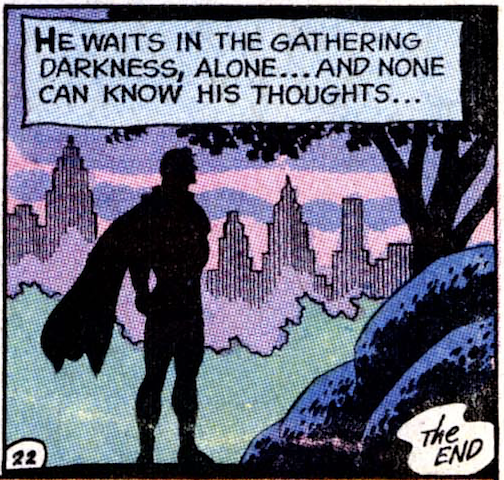
Then the saga concludes with stunning suddenness. The Sand Superman decides to return to Quarrm to avoid such a conflict. When I-Ching proposes that he could perhaps return the stolen half of Superman’s power back to him, Superman refuses this, saying, “No! I’ve seen the dangers [of] having too much power… I am human – I can make mistakes! I don’t want – or need – more…” And in a shadowy final panel, Superman stares off into the distance, alone in his thoughts, with half the power he had when the saga began.


The sense behind having Superman renounce half his powers doesn’t quite add up. When he makes mistakes in this story, none of those would be avoided by reducing his powers by half. If Superman decides to leave a car atop the Empire State Building, or if he accidentally infects people with an extraterrestrial germ, those things occur just as easily with half his powers as full. Moreover, in a DC Universe with many highly-powered beings, Superman just demoted himself relative to many villains such as the Phantom Zone inmates, Solomon Grundy, Bizarro, and others. In fact, in the series’s next issue (scripted by Cary Bates), Superman notes that “it would take a hundred Supermen many life-times to solve all [Earth’s] problems.” In the subsequent issue, again penned by O’Neil, Superman is knocked down by an energy monster and declares, “I’ve never been hit that hard…” Well, it would have been nice to have the other half of your powers back, then, wouldn’t it, Supes?


Numbers aside, O’Neil’s saga injected some thoughtful characterization to DC’s flagship hero, and measurably powered up the maturity of the title. First, it shifted the black-and-white morality of the series to add some shades of gray. Superman could be wrong, not only about matters of fact (that the elimination of kryptonite made him invincible), not only making serious mistakes in the use of his powers (that a particular radiation exposure would kill the alien germs on his body), but it also showed that he was fallible in tone, aggrieved and bitter, subject to humiliation – in other words, human. This was a far bigger change to the character than twiddling his power levels in some meaningless way. And, for all the story’s quirks, it brought Superman down to our level – in character as well as sometimes in power level – by showing the folly of the sin of pride, a story arc right out of Greek mythology.


An irreplaceable way to gauge the impact of story is to look at what came before it, and what after. Twelve issues before the Sand Superman saga began, the cover of Superman showed a morbidly obese Superman bursting out of a telephone booth and calling himself, in language that is shockingly insensitive, “a super-fatso” with the story title, “The Two-Ton Superman.” Five issues after the saga ended, Elliot S. Maggin’s highly-regarded “Must There Be A Superman?” story ran in issue #247, elaborating on the saga’s themes, as Superman must decide for himself when to intervene in human affairs and when not to intervene. That is quite a “before and after” comparison, showing a 1970 title with nothing of value to say and a 1972 title that was, if not high literature, at least asking questions with some relevance to real-world society, morality, and personal responsibility. We might gauge the impact of the story – both O’Neil’s capacity as writer and Schwartz’s as editor– in the increasing years in the age of the target reader rather than in how much Superman could lift or how fast he could fly. The Sand Superman story was part of the character maturing, and gave the series a creative direction it followed for nearly 15 years before its next big transformation.


Fifty years later, while the character, and DC superhero comics as a whole, have been through numerous alterations, and the plot points of the Sand Superman saga are entirely unrelated to current continuity, it may be argued that the Superman title never took a bigger step up in maturity than it did in and around that story. Indeed, remembering that it appeared at the same time as a pivotally thoughtful story about control and rebellion in Teen Titans #31 and during O’Neil’s monumental Green Lantern/Green Arrow run – the story about Roy Harper’s drug addiction appeared just after the Sand Superman saga ended – 1971 might be the year in which DC Comics grew up the most. In the fifty years since, have they grown up any more?