Sunday, March 7, 2021

The Green Lantern: Last Chapter

 The End?

With one issue and less than two weeks until the end of Grant Morrison’s 28-issue The Green Lantern, it’s clear that we’re headed for a climactic finish, quite a bit like the final two issues of Batman, R.I.P., where the hero is facing a carefully-prepared trap made just for him. It’s not just a tank of piranhas or some walls squeezing in or a vat of acid. This finale is not just about one particular gizmo or one particular scenario. This will be an existential crisis, with multiple enemies. And it’s big enough that we can’t see the broad edges around him: What will he face? Who is behind it? And is it unrelated that the Guardians have just told him that his time as a Green Lantern is basically up after this mission, and that the very way he has always operated is anathema to them? Hal Jordan is facing total doom. After all, he’s already escaped death multiple times in this run, and not just by dodging death, but actually coming back from it. The stakes in the finale are not comic book death but the total destruction of Hal Jordan.

If you’ve ever read or watched anything about the superhero genre, what I’ve just said may not move you. You know what to expect. He’ll pull victory out of nowhere. He’ll will a power ring to do something it’s never done before. He’ll defeat six entire corps of enemies with a wooden spoon. We’ve seen Morrison’s JLA give the whole human population super powers. We’ve seen Morrison’s Batman climb out of a grave. The hero wins at the end. That’s how this works, right?

Maybe. But in fact, Hal was killed out of DC Comics once before and it lasted for quite a while. And in fact, the April solicitations for DC hint that we may not be seeing any Hal comics in the coming era. When Trilla Tru says, in #11, “You okay, Jordan? It’s like you’re saying goodbye,” in fact maybe he is.

The Money Plot: Mass Consumption, Mass Destruction


There’s another thread to this story, one bigger than just Hal Jordan, that goes back to Morrison’s works early in the last decade. There’s a meta-story, as with most good DC events from the better writers over the past thirty-six years. Morrison has assiduously laid out a theme in which the bright, happy superheroes really are in trouble. There really is a threat to them, and Morrison believes it. There is a sharp turnaround from Final Crisis and Superman Beyond in which the irreducible optimism of Superman – as a fictional character – overpowers any threat on the printed page or off of it. Beginning with Action and Multiversity, Morrison depicts a real threat off the page to optimistic superheroes, one in which depressing stories prove more marketable, and we may really see these market forces in the real world put an end to the like of Hal Jordan.

I commented in my last post about TGL Morrison’s theme of this meta-enemy they associate with “mass production, mass consumption, mass destruction” of the DC superhero franchise, but I’m returning to it here because it’s hard to say anything about the run – at least since TGL Season One #9 – without putting this theme front and center. What I mentioned about this theme in my last post comes up so centrally from the first page of TGL Season Two #11 (“worthless toys… and those towers of shining glass”), and I gave the whole series a re-read looking for how this abstract theme interacts with the specific plot of TGL, to see how the former drives the latter.

First, Morrison takes many, many of the most light-hearted characters from the most light-hearted era of Silver Age comics and turns their stories dark, making some of them into psychopaths, and others into victims. The Hyperman family is the most prominent example of happy, sappy heroes turned into killers, but we also see the death of Vartox and the ghosts of the Superman, Wonder Woman, and Batman of the “perfect universe” Earth-15. We see the now-wicked Powerlord (once Power-Boy) pledge allegiance to a “Great Lah!”, a reference that confounded me until I finally, with head-slapping clarity, realized that “Lah” is “Hal” spelled backwards. We later learn that the Qwa-Man’s name is Qwa-Lah.


The meta-message is hammered home in TGL Season Two #4 when the Golden Giants of Neo-Pangaea declare that a court is in session, overseen by judges in the colors magenta, yellow, azure, and black. That’s a strange set of colors, isn’t it? Not four colors you’d likely see come up in any combination except that those are the four colors of printing – magenta, yellow, cyan, and black. These judges order Hal to submit and be destroyed and he escaped them back in #4, but their kind, the Nomad Empire, is back now, and as we’ve been warned, Hal’s going to face a worse version of them in #12. The specific reference to printer’s ink colors tells us that Morrison’s not referring to an abstract sci fi entity but something in the real world – the publishers of the comic book themselves.

Another meta-message made clear in #11 is when we, and Hal, find out that the new Young Guardians will surprisingly be leaving and be replaced soon, right after they were born and after a short reign. Hal notes, “But they’ve barely been here! You mean they changed everything and we’ll be left with the consequences?” I think here Morrison is commenting on many of the lead writers at DC in the 2015-2020 era. And throughout this run, Morrison has used the Antimatter Universe as a comment on the dark themes of the Dark Multiverse, the Joker Who Laughs. In the Hal Jordan storyline, antimatter has meant opposite and evil since the first mention of Qward in 1960. In TGL, the light-hearted Power-Boy who turns into the dark Powerlord now worships Lah – Hal spelled backwards, a representative of the evil antimatter world. Morrison has created a central plot line in this run about money, but it is about what money in the real world is doing to the comics industry.

This begins in Season One #10 when Hal says, “Some profiteers kick a hole in the antimatter border.” An Illegal antimatter mining operation blows a planet to pieces, and destroys many of the happy, positive Silver Age heroes while turning others of them evil. This is not the offhand creation of a plot device to make the story go. I suggest that this is a comment on writers (recall the printer’s ink) mining dark themes, which is lucrative (higher sales) but destructive (e.g., Vartox is killed, Hyperman and Hyperwoman become psychopathic killers). The central plot of Season Two is a critique of the direction of DC’s output over the past few years, a critique earlier seen pointedly during the Green Lantern: Blackstars interlude with the Depressoverse spawning a Batmanson whose evil, laughing Bat-family was “infectious now.”

But Morrison’s first invocation of this theme was in 2012, with Superdoomsday. The language that Morrison used then was “maximum cross-spectrum, wide-platform appeal.” This sardonic celebration of business values is echoed in TGL Season Two #2: “all-out opportunism” and the toy plot of #4, then picked up again in #11, in Samandra’s vision of “wild trolls chained to moving belts building worthless toys… and those towers of shining glass.” If the Dark Multiverse inspired Morrison to parody it as the Depressoverse, it was a development confirming the direction they saw coming well before DC: Metal began in 2017.

Moore of the Same?

In my 2018 analysis of Final Crisis, I expounded at length upon the many elements of Alan Moore’s work echoed and commented upon in FC. There, Morrison took a very different trajectory from Moore’s pessimism, particularly 1986’s Whatever Happened to the Man of Tomorrow? Now, in 2021, we see a few elements from Moore’s late-1980s work arise again.

Strikingly, Moore’s unpublished Twilight of the Superheroes had as its pivotal event a royal wedding between two “houses” of superhero, particularly involving the son of Superman to a powerful princess, Mary Marvel Jr. In TGL Season Two, the pivotal political event was a royal wedding between Hyperboy – the son of a Superman knock-off – and a powerful princess. In Moore’s story, this event would make the two families so powerful that other parties planned to start a war to prevent it. In TGL, the groom-to-be’s identity as the son of a Superman surrogate is parallel, and there is also a sense that the marriage will guarantee the power of the two families, in both cases a Superman Family to be feared, and a fear in turn, by Hyperwoman, that revelation of Hyperman’s criminal activities would cancel the wedding, and so she has to kill Hal Jordan before he can arrest Hyperman. As it turns out, the trial and conviction of Hyperman and the arrest of Hyperwoman fail to halt the wedding, which falls apart on its own. In Morrison’s story, the “success” of the dark family is doomed of its own sterility, with Hyperboy rejecting and insulting his “Shadow-Princess” bride-to-be at the altar and the two of them vowing war against one another. Mining the darkness of antimatter – or in comics – is not to be successful in the long run after all.
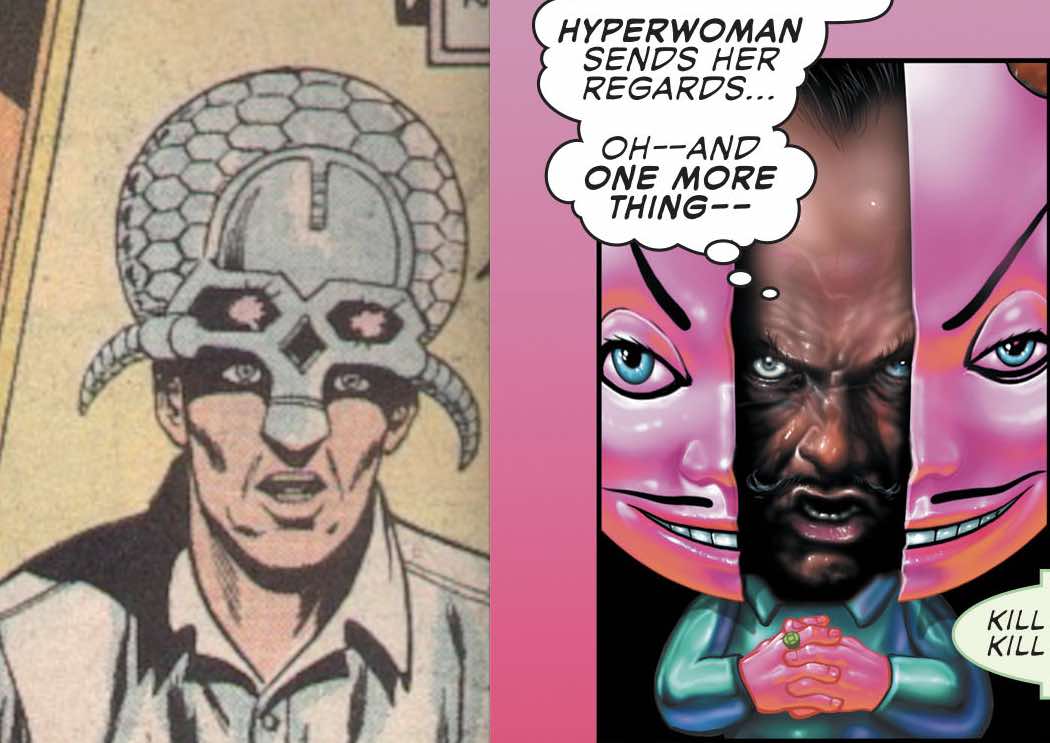

To return to the potent influence of WHTTMOT, the entire arc of Season Two has led us there. In Moore’s story, light-hearted Superman characters like Bizarro, Toyman, and the Prankster become homicidal. In Morrison’s, light-hearted Superman characters like Hyperman and Power-Boy become homicidal. At that point in WHTTMOT, Superman asks, “If the nuisances from my past are coming back as killers… what happens when the killers come back?” He is soon answered by the arrival of an array of his killer villains. Hal, at the end of #11, is stunned to see that the Nomad Empire, at Hyperwoman’s request, has gathered a collection of his more serious foes, including the Shark (deadly), Black Hand (virtually synonymous with death). The final attack on Superman in WHTTMOT is led by a Brainiac-possessed Luthor, featuring a weird composite of their heads, and lo, the leader of this final attack on Hal is led by Hector Hammond, with a weird superimposition of Sinestro over his head. Coincidence?

Chiaroscuro

Earlier in Season Two, we saw Hal in a seemingly fatal jam, falling from the sky at the end of #3,  when his bird-sidekicks caught him in midair. By issue #11, they have already grown to maturity and seem to leave him, and Hal is notably saddened. A family of birds referring to their guardian as “Unca Hal” – this is a lighthearted echo of Huey, Louis, and Dewey. They’ve saved him in the past. But for now, they have left him. This is the light…

…and subsequently, the dark: Hal has found himself in the most dire of circumstances. His bosses want to end his time as a Green Lantern. His foes have planned his annihilation. The entire setup on Athmoora is modeled on the darkness of Game of Thrones, from the comically parallel issue title “Contest of Crowns” to the map of multiple kingdoms and Hector Hammond saying, “Hyperwoman sends her regards” paraphrasing a key line in Game of Thrones, “The Lannisters send their regards.” In both stories it is a threat. Like Batman in Batman, R.I.P., Hal is in a trap made just for him, with a new villain asking his old villains to participate. Like Superman in WHTTMOT, this is to be Hal’s final fate.

Or will it? We know the pattern in which the hero pulls out the win at the end. We might suspect that Hal’s bird nephews will bring the light aspect of comics to him and save him once again. This is the R.I.P. ending. But how will Morrison’s view of real world “mass consumption… mass destruction” play into this? And we already know that this series ending will not be followed by another series with Hal right away. Maybe according to Morrison’s final GL issue, maybe according to the plans of the writers who take over next, this really is a grim fate awaiting Hal Jordan.

Monday, February 8, 2021

The Green Lantern, Before the End

If The Green Lantern is to be Grant Morrison’s last work writing a monthly title for DC, the final two issues should be a grand gesture, long remembered. With twenty-five of the issues behind us, what can we say of Morrison’s love letter to Hal Jordan? Where has this journey led and how will it finish?

In some regard, Morrison’s earlier runs with Batman and Superman (on Action) are two of a kind, with this Green Lantern run as the third in a set. These are not just runs that start with a story, followed by another story, then another, until there’s a last one. Morrison builds a structure. His Batman run had, primarily, three arcs, with a Big Bad lurking in the shadows until late in each run. His Action run, the shortest, had just one such season, with one primary Big Bad, Vyndktvx. Morrison’s run, thus far, organized around three distinct titles of 12, 3, and 12 issues, has had one clear Big Bad in the first, but the third has not, so far, suggested any one central villain lurking.

All of these plot lines have rosters of villains backing up the main one; sometimes they are underlings of the boss, and sometimes they are parallel, lesser, but unrelated threats. The Batman stories had Doctor Hurt and Talia as the central villains, but Ra’s al Ghul, the Joker, and Darkseid’s Hyper-Adapter and several others played major roles. In Action, Vyndktvx was the central villain, but Super-Doomsday was pivotal, the muscle in some respect, to Vyndktvx’s brains. And in The Green Lantern’s first twelve issues, the Qwa-Man, Hal’s antimatter double, is something like that for Commander Mu.

The structure even for Season One (the first twelve issues, not formally named as a season) was more complex than “seasons” of Morrison’s other runs. It appeared, near the end of issue 6, as though Commander Mu’s plan had reached fruition, and he had just about built the machine at the center of his master plot, hinted as far back as issue 1, and then… he was killed, by Alanna, no less. Furthermore, Hal and the universe as a whole were at death’s door along with him. But then, late in #12, we found out that Mu had not died (and perhaps could not die), and the plan suddenly went forward just exactly twice as far into the story as when it had seemed to have been halted the first time. And just as before, Hal was faced with imminent death. Just as before, creating, and giving to Mu, the miracle machine (Geh-Jedollah, the very same ultimate wishing machine from Final Crisis) seemed to be the only way for Hal to save his own life. And then, once again, Hal feigned compliance but at the end of the three-issue mini-season, Green Lantern Blackstars, it turned out that Hal had a massive ruse going, letting the Blackstars win in a different universe. Belzebeth believed that she would be able to fight back, but, once again, Mu had turned out to have escaped death and perhaps to be beyond death. Even fifteen issues in, the run had turned out to be a sort of Möbius Strip of repeated subplots. Has Mu won? Has Hal? Yes, no, yes, no, yes, no, yes.

For Hal, too, being on the verge of death, and actually dying, has occurred three times so far: around the midpoint of each season, and then at the end of the first. Everything is cycling; the run is not only a flashback to each of the major themes of Hal Jordan’s publication history, but a repetition of them. Old girlfriends come up early in each season. The Qwa-Man and Zundernell come up in both seasons. Marriage comes up near the end of each season. Each season has a buddy team up with a Silver Age JLA member important to Hal’s lore: first, Green Arrow; then, the Flash.

And, of course, as with Morrison’s Batman run, this run features plenty of alternate Green Lanterns; what the League of Heroes and other imitation Batmen were in that run, the Green Lantern Corps and Green Lanterns of other Earths in the Multiverse (no pair being more memorable than Batman Green Lantern and Hippie Green Lantern) are in this one. Hal succeeds where Superman and the JLA fail in Season One, manipulates and bests Superman in GL Blackstars, fights and ultimately bests the Superman surrogate Hyperman in Season Two. Repetition is everywhere, until even Hal, in Season Two #2 (two twos like Harvey Dent is behind it) says, “Feels like I’m trapped in my own history.” Morrison’s Green Lantern run is a carousel ride, repeating Hal’s history while it also repeats itself. Girlfriends, Silver Age -style sci fi plots with aliens, coming back to Earth, going back to space, buddy team-ups, the anti-universe, death, weird doppelgängers, his Guardian bosses, betrayal, defeat, victory. It all repeats, then repeats again. Morrison’s GL run is a microcosm of Hal’s publication history, but it’s also a microcosm of itself, loops upon loops.

And what is the story of Hal Jordan? Limitless talent, limitless self confidence, limitlessly prone to screwing everything up and then getting it all back again. He works as a pilot and is on the hot seat. He works for the Guardians and is on the hot seat. His knack for disobeying authority makes him the ultimate inside agent to bring down the Blackstars from the inside. He faces death and survives. He even dies and comes back. He wins over the lady and then blows it. His real romance as Green Lantern is with the power ring, personified as Pengowirr in Season One. His big scary enemy, the (yellow!) Zundernell, he shrinks down into a harmless joke. He’s a little bit comfortable in absolutely every situation and at home nowhere. In Season Two, the big universe-ending Crisis on Infinite Earths gets remixed and turns into another riff. Morrison didn’t invent any of this – it all goes back to the dawn of the Silver Age. Morrison simply refines it and repeats it. And this is the perfect time to pause and consider the story before its final arc because in the last story line, a proposal to Carol Ferris just might break the loop couldn’t do that because, as Carol said, “In the end maybe but it’s not – it’s not the end… not yet.”

This isn’t just the story of Hal Jordan. It’s also a work – potentially his last DC work, potentially a touchstone work – by Grant Morrison, and it may be following one long, slow-developing story that is taking perhaps the medium and perhaps the author on a path towards disenchantment.

After Final Crisis, Morrison’s three high-profile series have been Action, Multiversity, and The Green Lantern. FC and Superman Beyond delivered a message of optimism about the medium, that Superman was bigger than the writers, bigger than any of us, and the story of Superman drew so much power from its optimism that it was destined to go on forever. But in the three subsequent runs, we see this optimism undercut by metatextual messages in the stories as Morrison works in subplots that are about the superhero medium and the superhero as merchandise. In Action, perhaps the most ominous foe faced by Superman is Superdoomsday, “a brand” with “maximum cross-spectrum, wide-platform appeal, a violent, troubled, faceless anti-hero... a global marketing icon.” In Multiversity, The Empty Hand, symbolizing the economic pressures on the publishers and The Gentry, symbolizing the market and market forces that pervert the heroes, often, into something darker and more sensational, reinforce the message that marketing and branding would lead to something violent and troubled. And while I didn’t see it at first, I feel sure that it is significant that the agents of The Empty Hand, seemingly sweet and benign but dark and possessed were the Little League of Earth-42. Above all others, these are the versions of the DC characters aimed directly at the youngest, most innocent readers. And is there a common thread here? Yes, definitely: The Little League first met darkness when Superdoomsday from Earth-45 arrived and killed their Superman. And by the time we see them in Multiversity Guidebook, they are evil, possessed, red-eyed agents of marketing as perverted into darkness.


And now, in The Green Lantern, two subplots echoed and built upon this pessimism. First, the darkly satirical metatexual opening to GL Blackstars #2 amplifies the grim tone of Heroes in Crisis, the Dark Multiverse, and other works, with a Depressoverse, culminating with a clearly Batman Who Laughs -inspired Batmanson who is infectious, making the real Batman, the paragon of conviction in the DC Universe, “give in.” Later, quite parallel to the Little Leaguers, the team-up with the Flash in TGL Season Two #4 introduces Hal and Barry and Olivia Reynolds to an enemy world of toys. The world itself is a toy, smelling of “canned plastic” and ultimately, Olivia’s career expertise in toys allows her to defeat them, but not before we see how dark these toys are in a very modern way, “beta-testing” the heroes, play until they break, and when the lead toy, Quing, is broken, how unsympathetically he is replaced with one of the others as the new Quing.

In all of this, we see the underlying optimism – an affirmation of the superhero medium – turn to a darker metatextual comment with marketing as the enemy that may corrupt superheroes for once and for all. And it may not be coincidental that this message has picked up pace now as Morrison is, perhaps, moving on.

And so, a run that is full of repetition is going to stop repeating soon, because the end is coming. The big finale (#11 and #12) will take place on Athmoora, a world first shown in two panels of GL #16 back in 1962. Morrison places Hal on Athmoora in Season One #9, where Hal visits just for the fun of the adventure of brawling in combat where his ring is weakened. That is one of astonishingly many times in the run that Hal has voluntarily forsaken the security of his ring, confident in his ability to face danger in any circumstance. Now he returns to that danger again. If we have just two issues left of new Morrison monthlies to enjoy, I will be enjoying them and looking forward to seeing on what directions he takes Hal and us in his finale.

Sunday, September 20, 2020

Legion of Super-Heroes 1-8

Against the background of 82 years of DC comics, storylines begin and storylines end. A writer, sometimes paired with a particular artist will work on a series and usually it’s a pairing that few will think of very often afterwards. At times, though, a run will take hold of the imagination and command a vast readership and serve as the foundation of many memories and future directions for years to come.

With those eight decades of precedent, it’s more often the case now that a writer will take something old and make it new rather than inventing from scratch. Brian Michael Bendis came to DC from Marvel and his great talents were aimed first at Superman. It’s a run that has entertained me considerably and keeps me engaged but if there’s a title now that seems to me to show the full potential of superhero comics in the third decade of the 21st century, its Bendis’ work on the Legion of Super-Heroes.

The LSH had already been invented, reinvented, and reinvented again literally to death. The LSH began as a fertile Silver Age lark, then under Paul Levitz and Gerry Conway became a more mature work, taking the characters and by extension the readers through adolescence. A post-COIE storyline by Keith Giffen narrated a series of cosmic reboots before things settled into a new continuity – one that has since been rebooted three times now – or four?

Like many series over the years, the Bendis Legion mixes old continuity (not necessarily the latest one) with some entirely new elements. It also mixes in elements of DC history that were never associated with the LSH before, which often has the feeling of a puzzle piece fitting in where it had previously been missing. This is by no means the first such addition to the LSH, with Rond Vidar bringing in the legacy of the Green Lanterns way back in 1966, followed shortly thereafter with the Tornado Twins tying in the history of the Flash. Bendis makes some more unusual choices, with Rose (of “and Thorn” fame) actually kicking off the story, aside from cameos showing the new LSH in Doomsday Clock and the Superman titles, and the various worlds of Batman, Aquaman, and Doctor Fate making appearances along the way.

It’s not a cast of characters that make for a great run, but what Bendis does with them, and 10 issues in, we see enormous potential for character development. The LSH has always had some members who are more equal than others, with Superboy originally and often at the forefront. Pointedly, Bendis’ boldest creative decision is in placing Jon Kent in the central role for the first time. And throughout the first issues, Jon Kent plays a role that’s familiar from other literature: the newcomer. Or, in terms of children’s literature, he’s the new kid in school. He begins automatically in this new century facing unlimited amounts of unfamiliarity and social awkwardness. A recurring subplot about a missed orientation presentation fills one with dread as he continues to be behind on his lessons. But Jon Kent not only fills the shoes and chest emblem of Superman – he is (“will have been”) Superman, and the reverence that the LSH shows in his presence develops the Jon Kent character in an interesting way. It is in a future that we – and he – have not seen that has earned him the LSH’s initial respect. Thereby, every word, every glance is potentially foreshadowing, and we have to wonder why. This was not so true with the teenage Kal-El of LSH past, whose future – much of it – we had already seen. However, Bendis also elevates Jon Kent with his leadership in the “present” (as the narration comes to us). The boy who had previously appeared as a child grasping instruction from his parents has a star moment in issue #7, mending a conflict between the LSH and the United Planets with a short, effective speech after Brainiac 5 and Cosmic Boy had failed in their attempts.

In the character development of several other LSH members, Bendis explores parent-adolescent conflict with a variety of experiences that range from rebellion to submission. Ultra Boy is highlighted most of all, as his father becomes something of the LSH’s primary opponent in the series so far, but the old setup of heroes and villains is much closer to gray here. Ultra Boy never stops thinking of the General as his father, and we see a struggle between his relationship with family vs. that with friends and in all things, he is reluctant. Cosmic Boy and Lightning Lad also struggle to be the successes that their lives ask them to be. Reep Daggle is still within the grasp of parental authority, acting as a spy, if a benevolent one, for his mother, R.J. Brande, who is the Legion’s biggest frenemy thus far. But the women shine: Saturn Girl has moved without doubts beyond and above her family expectations, and Lightning Lass, initially reluctant to join the Legion, is perhaps the boldest member they have, at least among those who have had some time to develop.

Perhaps the most interesting Legionnaire’s story for me so far is that of Mon-El. As with the other primary characters, we know him from previous history, but we don’t know what Bendis may have changed. As the LSH is struggling in their first battle with the General Nah, Mon-El flies in with complete confidence and takes him down with one punch. But then it turns out that it’s a political nightmare, and the easy win has made Mon-El the new leader of Rimbor. After that punch, almost everything crumbles, and Mon-El is full of self-doubt, insecure in his romantic standing, insecure as the most powerful Legionnaire after the arrival of Superboy, (and he eventually loses a rematch with the General Nah when the LSH’s own power is turned against it). And there are a pair of revelatory tweaks to his backstory: this Mon-El is Kryptonian, not Daxamite, and he is a descendent of Jon Kent. From time to time, a critic will say that a superhero isn’t interesting if they’re too powerful. Here is a rebuttal; Mon-El’s story, sharing screen time with the rest of his team, is interesting in multiple ways, even when he is invincible in battle.

For all the characters who are battling to overcome something, there are others where something else is going on. Having read Bendis’ work only for the past couple of years, I don’t know if he plants clues that spring on us later, but if he does, watch Triplicate Girl. In issue #1, the pink-haired version asks a question that the blue-haired one answers. Innocuous detail, right? In issue #4, she tells us that when they merge back into one body they all gain the accumulated memories of each of them. This pair of details means that the Triplicate Girls have not remerged in a while. Meaningful? With another writer, I might feel certain that this was done for a reason, but in this case – we’ll see.


I don't hate this part.

And the last character study of particular interest says something about Bendis’ larger direction: Bouncing Boy, whose biography has not been explored as much as some other Legionnaires, seems particularly joyful and free of angst. In one quick interaction with Superboy in #5, he exudes confidence and capability, and, ostensibly because of his hand on the former’s shoulder, Jon Kent, a paragon of physical strength, says, “You’re strong, Bouncing Boy!” to which the latter says, “Aw, thanks!” When nearly every other Legionnaire is battling some sort of insecurity or strife, this is exceptional. I wonder – time will tell – if this choice is making a deliberate counterpoint to the body image issues that might otherwise poke fun at a person carrying great weight, and which have made Bouncing Boy an object of humor (and lesser status) in previous incarnations.

In a similar vein, we see overt changes made to several characters – including the Ranzz/Lightning siblings as well as Ultra Boy – to introduce some racial diversity where there had been none before. One may recall that the LSH’s Ferro Lad might have been DC’s first Black superhero had editor Mort Weisinger not vetoed Jim Shooter’s plan, and thus the team had members from other planets who were green and orange when it was too controversial for one to represent a non-Caucasian from Earth. Bendis is taking this one logical step further and supposing that beings on other planets might just have skin colors resembling the non-Caucasian people of Earth.

With the series now tallying over 10 issues when crossovers are included, there is a lot more to say about it, particularly regarding the swirling plot. From my point of view, this run has the potential to be a true classic, and the plot is not the reason why. Bendis has thus far given us a world that is both fun and funny, social and socially aware, new and studiously mindful of decades of past history. The last time I was this fond of the Legion of Super-Heroes was the 1980s, and Bendis is bringing back many of those memories, proving that time travel is not only science fiction.