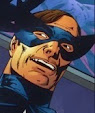

Doomsday Clock has paid considerable attention to a story within the story, a 1954
detective movie called The Adjournment.
Like the pirate story "Marooned" in Watchmen, the story within a story can and almost certainly does
provide insight regarding the main story. This is particularly fertile given
that the star of The Adjournment is
intertwined with some of Doomsday Clock's
main characters, and the screenwriter himself is a Golden Age superhero. It's
certain to be with good reason that Geoff Johns has devoted seven pages so far
to giving us the story of The Adjournment,
but what is that reason, and what does this story tell us?
There are at least three
directions to follow in understanding The
Adjournment.
1) On a surface level, what
is its story? It's a story we've
only seen the early portions of and we don't know its ending and/or the answer
to its central murder mystery. This may not be highly compelling in and of
itself, but it is part of the big picture.
2) Probably most important,
what does the movie plot tell us about the main Doomsday Clock story? It seems highly likely that it parallels part
of the main plot, and understanding that parallel could be used either to
predict what is coming or to see what Johns is emphasizing as the most
important aspects of the larger story.
3) Because the superhero
Tarantula is the movie's screenwriter, the story may tell us something
important about him and his relationships with other Golden Age characters.
The Adjournment's Plot
First, the facts. We have
seen only the first portion of the movie, and while we have two spoilers
regarding the upcoming portions, we don't know how it will end, nor do we know
if there are more major characters to be seen. But we do know this:
• Nathaniel Dusk is an
ex-cop turned detective.
• On Christmas Eve, a former
colleague of his, Murray Abrahams, comes with him asking for help with a case
that involves the death of Abrahams' brother-in-law.
• Two men, Alastair Tempus
and Bentley Farmer, have been shot dead and lie in blood on Tempus' floor alongside
the pieces of a chess game.
• Dusk and Abrahams visit
three different buildings: The crime scene; the former home of Dusk's dead
lover, Joyce; and, the home of Tempus' employee Wellington.
• There is considerable
friction in the lives of these men: Dusk doesn't consider Abrahams a friend;
Abrahams "never liked" Farmer; Wellington stole from Tempus; Farmer
is divorced; Dusk has enemies he's hiding from on both sides of the law. At
both of the last two stops, Abrahams warns Dusk against "breaking and
entering."
• We are told of the
men's various female companions: Dusk's "greatest love" is dead.
Abrahams is married with young kids. Tempus' wife is dead. Farmer is divorced.
Wellington claims to want a sex-change operation, which may or may not be an
excuse for the women's clothing in his luggage.
• The crime scene appears
suspicious: There is only one chair visible near the chessboard. A white knight
is standing on its base on the floor, an extremely unlikely position for a
chess piece to settle into after a table is knocked over. Dusk is in a position
to see if the knight was on the floor before blood flowed around it or if it
was set down into the blood.
• Dusk seems to believe that
Wellington is not the killer, despite the cash he has stolen from Tempus.
• In the last frame we have
seen, two scarab beetles appear onscreen behind Dr. Manhattan. I don't see the
relevance of this, but they are linked to Blue Beetle, who was the inspiration
for Nite Owl, and there were two Nite Owls in the Watchmen Universe.
• We are told of a
"big twist, where one of the dead guys turns out to be a killer,
too."
• The cover of DC #10 shows a man stepping on Dusk's
head while a woman in an eye-catching dress looks on with scorn.
• The very first comment by
Abrahams in analyzing the scene concludes that Tempus was the killer's intended
target and Farmer was not. Dusk does not agree that this is certain.
The Solution
In a strict sense, we cannot
solve this mystery with any certainty. Johns has a free hand to augment
considerably the little we have seen of the movie, even bringing in several new
characters. What we know so far may end up insignificant in comparison to what
is coming. However, if we can solve it given what we've seen, there is only one
plausible solution (and it is bolstered by working backwards from some things
that would follow if the rest is true):
The killer (of at least one
of the two men) is Murray Abrahams. Farmer is a primary target of the killing.
We have the following
evidence:
• The crime scene was
tampered with. Abrahams saw it before Dusk did.
• Abrahams did not like
Farmer.
• Abrahams is not a friend
of Dusk, which makes him suspect.
• Abrahams is smarter than
Dusk gives him credit for.
• The only characters in the
movie besides Abrahams are Dusk, the two dead men (at least one of which had a
killer who wasn't one of those two), Wellington (who, Dusk assures us, is
innocent), and two unnamed women (Farmer's sister and Farmer's ex).
• One more reason involving
a parallel to the main plot that I will mention later.
Abrahams knows more than he
is letting on, and is either the killer or, at the outside, is covering for the
killer. He is looking for Dusk to solve the case incorrectly, and in so doing,
clear him. Therefore, he wants to lead Dusk off the correct track.
Perhaps we will see more Adjournment characters in the story yet
to come, and my solution will prove to be off-track, but there are reasons
besides the internal logic of The
Adjournment that make it an effective solution.
Parallel Plots
Whether this or something
else is the solution to the whodunit, we still have to deduce why Johns is
sharing any of this with us. I have, over the past several months, considered
many combinations of characters in the main story and in this one, trying to
find patterns where someone in the movie matches someone in the main DC plot.
1) Alastair Tempus = Alan
Scott?
A few clues point me in a
particular direction. First, the killing of someone, in this story, if it's to
represent a pivotal event, would
stand a good chance of representing Dr. Manhattan's killing of Alan Scott in
1940, changing the timeline. Now, zero in on the first part of
"time"line and note that Alastair Tempus' last name is Latin for
"time." This seems like a good place to start. Does Alastair Tempus
represent Alan Scott? There are some matching characteristics, such as age and
wealth. And look at the name alone:
ALA_S_Tair → ALAn ScotT
It's quite an odd choice of
given name, increasingly the likelihood that that similarity is deliberate. (Also
note: Alastair is derived from Alexander and Veidt is obsessed with Alexander
the Great.) But "tempus" means "time" in Latin, not "lantern"
or "scott." It may be more apt to posit that Tempus represents the
post-COIE or post-Infinite Crisis timeline, with the JSA
living in the JLA's past, and that the death of Alastair Tempus represents the
end of the Alan Scott timeline, which is to say the entire pre-Flashpoint
continuity.
2) Nathaniel Dusk = Adrian
Veidt?

Another pair who may match
up is Dusk and Veidt. Look at these panels that occur in DC #3, Veidt in the lower-left corner of page 7 and Dusk in the lower-left
panel on page 17 – ten pages apart, in the same part of the page. The
composition is identical, and their hair is similar, though the lighting is
nearly opposite. Now consider the following lines of dialogue:
Erika Manson to Veidt:
"What's the price on your head anyway?"
Abrahams to Dusk:
"Everyone knows about the price on your head."
And, consider the thematic
arcs for each: Veidt is disgraced and preoccupied with tragedy in his past
while trying to make sense of a new mystery. This is also true of Dusk. Most to
the point: The prime mover in the Doomsday
Clock plot is Veidt undertaking a plan to save the Watchmen Universe by
finding Dr. Manhattan. The Adjournment
centers on the investigation by Dusk of a pair of murders. The central figure
of The Adjournment should likely
correspond to a central character in Doomsday
Clock and that's quite a short list. The aforementioned clues place the
focus on Veidt.
3) Murray Abrahams = Dr.
Manhattan?

If the first two matches are
correct, then Abrahams has to be Dr. Manhattan. We already know that Dr.
Manhattan is the killer of Alan Scott; killing Scott changed the timeline and
Tempus is the timeline, so whoever killed Tempus represents Dr. Manhattan. Dusk
and Abrahams have an established relationship, have worked together before, but
are not friends. Reggie, the New Rorschach could also fit the bill of Abrahams,
but then he certainly didn't work with Veidt before this case. And Dusk asks
Abrahams for the favor of helping him revisit Joyce's home; Veidt's entire
mission begins with seeking Dr. Manhattan's help, and nobody else in The Adjournment plays that role. These
panels from #5 and #7 may provide another clue that this pair of characters is
linked.
4) Bentley Farmer = The
Reverse Flash?

Two players in this story are
associated with changed timelines. Two, counting "The Button," are
killed by Dr. Manhattan. Thawne recognized Dr. Manhattan when he saw him,
indicating a past interaction between the two. And Alan Scott is not a killer,
so the other of the two victims must be. Pandora – killed by Dr. Manhattan
in Rebirth – could possibly also fit
the bill, but for centrality to the larger story, a better match is the Reverse
Flash. If you recall the details of "The Button," Reverse Flash
actively sought out Dr. Manhattan, with confidence that the latter had never
faced anyone like him. That didn't go well for Eobard Thawne. The two had some
past association, just as Farmer and Abrams are related by marriage. The art,
again, may hold clues, as Farmer was shot in the left side of his face and
Thawne was blasted, strangely, with the left side of his face blown off. To
match the main plot, we may end up learning that Farmer tried to kill Abrahams,
but was himself killed in the attempt.
5) Jasper Wellington =
Johnny Thunder?

There's a curious
complication about the JSA's removal from the timeline, which seems to involve
both Alan Scott and Johnny Thunder: We know that the JSA is not part of
anyone's memory in the current timeline. The fact that Dr. Manhattan removed
Alan Scott from the timeline might seem to be part of a larger pattern that
removed the entire JSA. Dr. Manhattan indicates in DC #7 that when he removed Alan Scott's survival from the timeline,
the meeting of the JSA in November 1940 did not go on to occur. According to Rebirth, Johnny Thunder belonged to a
"covert team of mystery
men." He later told his Thunderbolt to protect the JSA at the meeting
wherein McCarthy told them "Take off your masks" in October 1951. It
appears that the JSA was removed from the timeline in two steps: First, Dr.
Manhattan moving the lantern in 1940, then Johnny Thunder sought to protect
them via his Thunderbolt at the hearing in 1951. The cause-and-effect
relationship of timeline alteration may be pretty tricky, but the chronology of
those two "events" goes from Dr. Manhattan in 1940 to Johnny Thunder
in 1951. Now, we can say that he removed the JSA from their would-be lives, but
unlike Dr. Manhattan's killing of Alan Scott and the Reverse Flash, he didn't
actually kill anyone. The visuals are a tip-off, too. Check out this pair of
panels, both from issue #5. And how many characters wear a bowtie? Finally, one
of those ambiguous speech balloons in that issue refers to Wellington with
"This poor man never hurt anybody" and overlaps with a panel of
Johnny Thunder, a hint that they are the same "poor man."
6) Chess pieces = Characters
in the DC Universe?

If Tempus and Farmer
represent Scott and the Reverse Flash, who in turn involve timeline
manipulation, then the chessboards and pieces may represent those timelines and
the characters within them. Flashpoint has
been referenced in this for a reason. Perhaps each of the pieces we see
represents particular DC characters. When we see, then, Dusk closely examining
the white and black kings, this may represent Veidt considering the DCU, and
contemplating two opposing sides, either the heroes and villains, or the polar
icons of Superman and Batman.
Now, does all of this wash?
I wouldn't bet the farm on this, but a lot of details fit together in a pretty
comprehensive way. Others don't, such as the fact that Alan Scott and the Reverse Flash never played a game of chess against one another, so far as I know, and if any characters in the larger plot are akin to chess opponents, there would be better ones to choose from. Because this is all on the level of symbolism, the story
isn't obliged to declare that the plots are parallel in the way I describe
here; this is the sort of thing one may see or not see or argue about weeks or
years after the series is over. I'm going to go out on a limb, though, and
suggest that these alignments of details in the plot and the art are part of an
intended framework of parallels.
In any case, the Adjournment plot is much smaller than
the Doomsday Clock one and I spent
some time considering if the older and younger victims might represent the
personalities of Firestorm – Martin Stein and Ronnie Raymond. It could just be
that they work in that fashion, too, because parallels aren't obligated to be
unique. "Marooned" certainly doesn't map to the Watchmen plot in a singular way. This or other parallels may work
in addition to or instead of the ones I have mentioned. We don't know, but in
the meantime, I find myself thinking that the art parallels are not likely a
coincidence.
Author, Author
The Golden Age Tarantula is
not one of DC's most beloved and enduring characters, but Johns has mentioned
Tarantula's alter ego, John Law, in some detail in DC #3. As the screenwriter of The
Adjournment and a suspect in Colman's murder, Law has at least two roles to
play in this story. His divorce from Libby Lawrence may be driving some
animosity between any other man who has tried or succeeded in winning Lawrence
over. This could explain why he's a suspect in Colman's death. If so, there's
some a major soap opera style plot going on. Consider that Lawrence, the
original Liberty Belle, is the mother of Jesse Quick / the second Liberty
Belle, and the possible connection (via "tick tock") between Colman
and Hourman: A romance between Lawrence and Colman could be a
one-generation-earlier pairing up like the marriage between Rick Tyler and
Jesse Chambers, a romance originally authored by Geoff Johns.
In addition, Law's angst
over losing Lawrence (shown in great detail in The Golden Age) could also surface in the plot of The Adjournment. In only seven pages,
we've seen how no fewer than three men have lost the women in their lives
– two to death and one to divorce. The evil-looking woman on the cover of
#10 may be another facet of Law's bitter feelings towards women and romantic
relationships.
Wheels Within Wheels
One unmistakable
characteristic of Doomsday Clock is
the attention to detail, something we have not seen in all that many works,
including some of Johns' more sprawling epics like "Sinestro Corps
War" and "Blackest Night" that are more broad and vast than
deep. I, for one, admire the obvious degree of intricacy in the scripting, and
I'm more than accepting of the slower release schedule that has been necessary.
It's a pleasure to have a story with our favorite superheroes be worthy of this
much attention. However posterity may remember Doomsday Clock in relation to Watchmen,
I think fans will salute the effort that Johns put in and the intricacy that
resulted. I'm looking forward to seeing what the next three issues bring and
how well the patterns I cite here continue – or don't – as the story
moves towards a finish.


