Showing posts with label batman inc. Show all posts

Wednesday, September 7, 2016

Retro Review: Grant Morrison's Batman Run, Ten Years Later

In September 2006, Grant Morrison began a stint as writer of the Batman title with issue #655. His more-or-less unbroken tenure jumped from one title to another, ending seven years later with Batman, Inc. (vol 2) #13, after a total of 75 issues across four titles, plus a handful of scenes in three other titles. Morrison portrayed three different heroes (and briefly, a fourth) as Batman, not counting a number of villains and proteges who posed as Batman or variants of Batman. In terms of the stature of the writer, the character, and the number of issues, it's a run that has been matched rarely if ever in DC's history. Now its beginning is a full decade in the past and its ending went on sale three years ago.

According to Morrison, he originally pitched a run 15 issues in length, and did not foresee that his tenure would end up five times that length. The entire body of work breaks down into three major stories averaging about two years each, augmented by a six-issue miniseries and then a few special features here and there. Even the first of those three major stories, though, ran past its planned length of 15 issues, to at least 23 by the most conservative count, before it looped back to include four more issues of Batman in related Final Crisis crossovers and a gem of an anniversary issue in Batman #700 that was largely separate plotwise from Morrison's other Batman work.

The stories making up the bulk of the run were:

• The Black Glove's attempt to destroy Batman, Batman #655-681.
• The battle between Batman (Dick Grayson) and El Penitente in Batman and Robin with the Joker playing his own game against both sides.
• Bruce Wayne's odyssey through time in Return of Bruce Wayne, trying to escape the doom planned for him by Darkseid.
• The effort by Levitathan to destroy Gotham and get final revenge against Batman, as chronicled in Batman,Inc.

The three longest arcs have certain distinctive characteristics that make them alike: Each lasted about twenty issues and told the tale of one master criminal plot headed by a single master villain who was, in each case, unknown to the reader until deep into the story. Those master villains worked through intermediaries, who themselves made formidable foes in their own right, challenging Batman – the various Batmen ­– to a respectable degree before a final round in which Batman squared off against the ultimate evil force in the story.

This mold was established in the first of those three, with the Black Glove's master plan revealing its first subtle – and at the time, inscrutable – clues in Morrison's very first issue, with Dr. Simon Hurt being revealed only very gradually, as a pair of hands holding binoculars, then a voice without a face, then as a figure in uncertain memories, never appearing on-panel in the present with Batman until the final pages of the second-to-last issue of Batman, R.I.P. The patience with which Morrison developed his story and its signature villain is nearly unmatched anywhere in the history of the medium of superhero comics. The lingering mystery, "Who is the Black Glove?", propelled Morrison's story to a high degree of notoriety, enthralling many fans while the plot's ambiguity and psychedelic weirdness frustrated others.

That first long arc in Batman also, eventually, turned out to follow themes that Morrison had shown in his earlier works. His very first Batman story, published only in a British publication as a text-only story, had Catwoman invade the Batcave. R.I.P. adapted the idea of a femme fatale inside Batman's sanctuary by having lover/enemy Jezebel Jet strike at Bruce Wayne inside the Batcave. Arkham Asylum showed Batman entering the titular institution to face a pack of enemies led by the Joker; this is what happened also in R.I.P. as the carefully-orchestrated "danse macabre" of Doctor Hurt. And Gothic, Morrison's classic four-parter from the early days of the Legends of the Dark Knight title, showed Batman in a supernatural story involving an ageless man who'd made a deal with the Devil. R.I.P. dropped clue after clue that Simon Hurt might be the universe's ultimate evil until Batman himself considered the possibility, a reveal that confused many readers, prompting Morrison to clarify that it was, indeed, "the story of how Batman cheats the Devil."

One of the great contributions of Morrison's run was in tying together so much of Batman's history, sending readers to the archives through whatever means they had, to investigate the Black Glove mystery by seeking clues in older – much older – stories. Morrison, like Steve Englehart before him, wrote a new Batman story that referred to considerably older ones, not from the past two or five years, but stories from decades earlier. Astonishingly, Morrison used a nameless character who appeared in one story in 1963 as the basis for his big, new villain. Using the freedom provided by Infinite Crisis' soft reboot, he made many minor changes to Batman's backstory, altering the 2005 status quo in order to bring back many miniscule facets of Batman's history such as Professor Nichols' time machine, Professor Milo's mind-altering gas weapons, and many long-forgotten Batman wannabes. As 2008 went by, readers were poring through the archives for the purpose of looking for Black Glove clues, but learning a heck of a lot about Batman lore as they went.

The first of Morrison's three long story arcs was what was originally planned as the entire run; when the next two came along, they copied that first once closely. The second, with replacement Batman Dick Grayson as the target of El Penitente, turned out to have the exact same villain, and many parallels to R.I.P., though turning, eventually, into a farce with Doctor Hurt slipping on a banana peel. The third, with a mysterious Leviathan who attracted an army of followers in Gotham, began according to a very similar script, though Talia was the villain this time, a "bad mother" instead of the first two stories' metaphorical bad fathers.

Given that the first run carried out Morrison's plan to fruition, at nearly double the originally-anticipated length, how does one perceive the rest of the run? As a corporation capitalizing on a business success by soliciting more of the same product from the same source? As a creative mind exploring fertile territory, going deeper and deeper? Both of these are true. While the Batman and Robin and Batman, Inc. stories were far less original in their architecture than the original run in Batman, they were finer in their craftsmanship. The Batman who began Morrison's run as overly gruff and self-admiring to the point of parody ("Hh. You didn't know I had a rocket.") turned into a finely-tuned and plausible optimum man by the work's end. The purple prose of the "Clown at Midnight" text-only Joker issue, the bombast of the adult Damian in issue #666, and the acknowledgement of Batman's silly past with the Club of Heroes and appearances by Bat-Mite struck many readers as overreach on Morrison's part; such judgments are subjective, but such fan criticism became rarer during the second and third long arcs. The Batman and Robin work is particularly noteworthy for Morrison's use of different pencillers, blending his scripts with each artist's visual style in virtuoso fashion. By the time Batman, Inc. began, Morrison was perceptibly more in command of his starring character and his world, with an Argentine tango of death, the daring of Batman's Matches Malone identity, flashbacks to Kathy Kane, and the passion of Damian Wayne all having just the right effect. Perhaps the second two long stories were refinements of the first, and perhaps one might imagine the three long arcs merged into one idealized version combining all of the three arcs' merits and none of their flaws, but we are richer for having the three, and to see Morrison's Batman evolve from the brooding loner who throws the Joker into a dumpster to the impassioned altruist who understands his destiny and is compelled to return from a brief retirement to start his war on Gotham's criminals anew.

Arguably the run's most prominent legacy will prove to be the character who was introduced (earlier inspirations withstanding) at the end of the first issue, Damian Wayne. It was a bold assertion by Morrison and his editors to add Batman's son to the mythos, one that was done with hesitation. Originally, Morrison planned for Damian's seeming death at the end of #658 to be an actual death, but the character returned, only to die near the end of the Batman, Inc. series, only to be brought back yet again by other creators.

Other innovations from throughout the run have been erased – at least for now – by DC's two new fresh starts, which make Bruce Wayne's revenge on Joe Chill a memorable scene that is no longer in continuity. The ambiguous clues suggesting that Doctor Hurt ordered the murders of Thomas and Martha Wayne seemed to build to a possible reveal that Morrison never got around to, and any possible intentions to that effect are now irrelevant insofar as 2016's continuity is concerned. However, the New 52 era of Batman, still largely in continuity, was led by Scott Snyder incorporating many Morrisonian inspirations, including an evil organization of wealthy Gothamites going far back into the past and led by central figures possessing unnatural longevity. Snyder's Court of Owls is sufficiently like the Black Glove to be perceived as an homage to Morrison's invention if not a needless reinvention of it.

In the era of trade paperbacks collecting the monthly titles, Morrison's run will be for sale indefinitely, and acquiring new readers at some rate far into the future. It is unlikely, though, that any of them will get the original experience had by readers who were picking up the new issues, particularly the middle portion of the run in 2007–2010. At that time, the monthlies had a tangled chronology – partly because Morrison's story involved flashbacks, hidden reveals, and time travel, and partly because different titles were simply giving us the story out of order. Sometimes this was jarring and seemed like an uncontrolled accident, as when the other Batman titles had R.I.P. Crossover on their cover and seemed to be telling stories set after Batman, R.I.P.'s conclusion, but whose writers, in retrospect, probably didn't know the ending of Morrison's story. In other cases, the big company-wide events linked up with Morrison's story out of sequence, most notably when his own Final Crisis involved Batman but was published concurrently with R.I.P. but was set after it. Thus, we were shown Bruce Wayne operating as Batman in a timeframe set shortly after R.I.P. even though R.I.P.'s climax as well as R.I.P. crossovers showed Dick Grayson and others mourning Bruce Wayne's seeming demise. Much later, a couple of extra Morrison issues showed us that Bruce simply swam out of the river and returned to the Batcave, making the climactic helicopter crash a mere inconvenience. Morrison and his editors tried to have their cake and eat it too, with big reveals that only seemed big at the time. This also played out with Simon Hurt's last stand as the Devil – or something that might as well be the Devil – but then getting a later backstory that made him something far less. And yet again, with Bruce Wayne "dying" in his confrontation with Darkseid, and the shock of Superman holding Batman's shriveled corpse proving to be, eventually, not at all what it seemed to be. To experience Morrison's run in the best way, those endings – the helicopter crash, Doctor Hurt's ambiguous reveal as the Devil, Superman holding the corpse – have to be endings for the reader, ones that last for a while before the plot reverses them in a do-over. For a new reader going through the story now, able to transition immediately from one ending to the next beginning, those retractions will seem weird or weak. And that's assuming that the reader is able to read the stories in the original print order, which scrambled the publication order with the logical and chronological order of the story, epitomized by Batman and Robin being published concurrently with Return of Bruce Wayne and dropping clues in a carefully-planned order even though their literal timelines were centuries apart. Simply put, it's almost impossible for any reader who picks up the trades to get the original experience, and that's a shame because the original experience was so fine.

This is another way in which the expansion of the run from 15 issues as planned to its eventual 75 came at a cost. If there was a carefully cultivated aspect of the first part of Morrison's work, beginning with the Joker killing "Batman" in front of disabled children and ending with the helicopter crash at the end of R.I.P., it was mystery – often achieved through ambiguity. In that first scene, with a fake Batman dying and shooting the Joker as his life fades, we were told that we couldn't believe our eyes, and that Morrison was going to feed us unreliable narration because, with the Joker speaking Morrison's thoughts, "I love messing with your head." Ambiguity and mystery remained at the forefront when we saw a pair of black-gloved hands holding the binoculars that watched Bruce kiss Jezebel, when Damian fought the Devil's servant in the (a? the?) future, when Bat-Mite seemed maybe to be real with a creepy insect-like alien behind him, and maybe to be imaginary, when Bruce spent a day with Honor Jackson, who turned out to have been imaginary or a ghost. We never got a clarification as to the reality of those things, with Bat-Mite humorously telling us, "Imagination is the 5th dimension" when he was asked point-blank for "one straight answer." But this made it clear that lingering, unresolved mystery was precisely Morrison's objective, with Doctor Hurt turning out to be "the hole in things, the piece that can never fit" who was simultaneously several things at once – possibly Bruce's father, possibly the Devil, and possibly neither of those. Morrison wanted us to know that R.I.P. was the story of how Batman cheats the Devil, but he also wanted us to know that we didn't truly know anything as a definite fact. This was what Bat-Mite's non-answer told us quite clearly about Morrison's story while it told us nothing about the facts. If Morrison's run had ended with Doctor Hurt on the helicopter, the mystery would have lingered at its fullest, and that was his original plan. The price of the run being tripled to quintupled in length is that the ending became a transition and not an ending at all, and the mystery became much less of a mystery with eventual expositional reveals, such as Simon Hurt being a pawn of Darkseid and the "bad" Batman who attacked Dick Grayson being a clone, being necessary to the plot but also a bit ugly as they defused Morrison's original objective of mystery.

What we got in exchange for the loss of mystery was, yes, more good storytelling, but also a deeper examination of the fictional ideal man, Bruce Wayne. Some of Morrison's finest work was when backstory was told with murky memories, such as the revenge on Joe Chill that Bruce imagined while experiencing cardiac arrest, and the synopsis of everything when Bruce was fighting death after expunging the Hyper-Adapter from his body. And what Morrison told us, in deeply and frankly psychoanalytical scenes, was that Batman was a man who lost his family and found life in his friends. He had a symbolic "bad father" in Simon Hurt, a bad wife (or co-parent) in Talia, two lost parents and a lost son – no family of any kind to count on. But he recompensed by finding four virtual sons, and the major climaxes in Morrison's run ended with each of the Robins saving Bruce's life once – Dick Grayson in R.I.P., Tim Drake in ROBW, Damian at the mid-point of Inc., and Jason Todd at the very end of the swordfight with Talia. And after Morrison admitted that it wouldn't make sense for the Justice League to fly in and save Bruce at the end of R.I.P., he ended ROBW in exactly that way, with Superman, Wonder Woman, and Green Lantern beating the Hyper-Adapter in a fistfight, and it felt right. Rather than being a cheap deus ex machina, Bruce Wayne having powerful friends upon whom he can rely was something touching and quite natural. Of course the ultimate man is going to have the ultimate friends, just as he is going to have imitators (the Club of Heroes) and need to summon greater resources around him (Batman, Inc.). Morrison doesn't skimp on giving Batman unparalleled stature in the DC Universe. After cheating the Devil, Batman gets out of bed to escape from Darkseid's death trap and wounds the dark god. Ultimately (in more senses than one), Batman goes to the end of time and becomes the central figure in the universe's final moments.


The central riddle in Morrison's Batman #700 was, "What can you beat but never defeat?" and the double answer was "Time and the Batman." The ten years that have passed since Morrison's run began passed quickly for me – your mileage may vary. DC has, remarkably, begun its world anew not once but twice since then with the monthly Batman title having restarted at #1 twice in the 2010s after having only one start in the seven decades before that. In the calendar of comic cosmology, I often think of the transition from the last JSA story to the first Barry Allen story as the time between epochs, but that was only five and a half years, and now since Morrison's long, contradictory, wonderful story began, we've had ten. The world has moved on and seems to be doing so at an accelerating pace. The Batman cinematic franchise that began the year before Morrison's run is also long in the past, with another actor having played the character twice while another actor plays him on TV. Batman's history is long and sprawling. These are the words with which Morrison ended his run: "Batman always comes back, bigger and better, shiny and new. Batman never dies. It never ends. It probably never will." There will always be a new Batman for readers and viewers to enjoy. It's possible that there was never a better time to be reading Batman than during Morrison's run.

Tuesday, August 6, 2013

Ouroboros

The central motif of Batman, Incorporated is the Ouroboros, the self-swallowing snake, a symbol that goes back to Egyptian antiquity. Beyond the visual imagery of a ring, the theme it represents is a cycle in time, things that occur in repetition, endlessly. A cycle is suggested at the moment the Batman, Inc story begins in the epilogue of Batman and Robin #16, when Bruce tells Damian, "Batman and Robin can never die" and it appears visually in the lower right corner of Inc #13's final panel, as shown here.

Cycles as a theme are a common motif in Morrison's stories. His Superman stories All Star Superman and Superman Beyond end with references to, respectively, a Superman 2 and "To be continued..."
The first panel of Batman, RIP shows Dick Grayson saying "Batman and Robin will never die" in a flash-forward which answers a comment made by Le Bossu in RIP's epilogue. Final Crisis has a platonic time-traveling bullet that goes back through time, then ends up in Darkseid's possession so he can fire it again. In like fashion, Bruce Wayne becomes part of his own inspiration when Darkseid fires him back in time.

Ouroboros as the "never-ending ring" is first mentioned explicitly in Inc vol 1 #3, when the Knight survives battle with Dedalus. This Knight is the second of three, with Morrison promoting one sidekick to replace the main hero in his earlier works, then promoting the sidekick's sidekick in this one. Things advance, but remain the same. A Knight followed by a Knight followed by a Knight.

We first see the Ouroboros later, a ring on Scorpiana's finger that Bruce Wayne steals while dancing with her. In this scene, Bruce Wayne performs super heroics, but he's not giving up his identity: Gaucho believes that it's Batman posing as Bruce Wayne, whereas unbeknownst to him it's actually Bruce Wayne posing as Batman posing as Bruce Wayne. This cycle of purpose and identity is immediately repeated in the Buenos Aires adventure that Batman and Gaucho undergo. They are given clues which lead them to a house. The situation seems to give away the criminal's location, to lead the heroes there. In reality, it's intended to lead them there, as a trap. But knowing it's a trap, they go anyway, confident they can prevail: A cycle of what the villain's plan seems to be, and what the heroes think of it, and what the heroes think of what the villain thinks of it.

It is here that Morrison's Argentina portion of Inc. becomes truly ingenious, if the complexity of a ring turning within a ring is not too dizzying for the reader. Batman and Gaucho realize that they are led to the house by a mystery resembling one in fiction, and Batman recounts a literary detective Espartaco Estraño who is led to his death by a similar trap. Espartaco, Batman recalls, was a fiction created by Jorge Luis Borges and other writers: A fictitious author created as a hoax by a real author, resulting in a real book, with a plot that resembled the one Batman and Gaucho were experiencing.

But there's another twist off the (comic book) page: The Espartaco hoax did not exist. Morrison has taken the plot of an actual Borges story, "La muerte y la brújula" (Death and the Compass), which is similar to the one that Morrison describes, and in that story, too, a fictional detective is led to a trap while working on the case of a serial murderer. Another twist? In that story, the fictional detective, Lönnrot, believes he finds a pattern in the murders committed by his nemesis, Red Scarlach. Actually, the pattern was coincidence, but Scarlach realizes that Lönnrot believes there is a pattern, so Scarlach sets a trap in the location he thinks Lönnrot will expect the next murder to occur.

It is almost painstaking to unwind the cycles that Morrison has built on top of Borges' original story. Borges' story itself is patterned on the dynamic: "he thought that I thought that he thought..." Morrison creates a fictional story, about Espartaco Estraño, that is almost the same as the original story, but is a hoax that exists only as a story. And this resembles the Batman-Gaucho adventure in Inc. The nested stories, in summary:

Story 1 - Writer: The actual Jorge Luis Borges. Detective: Lönnrot. Villain: Scarlach.
Story 2 - Writer: A fictional Jorge Luis Borges. Writer/Detective: Espartaco Extraño. Villain: Doctor Dedalus.
Story 3 - Writer: Grant Morrison. Detectives: Batman/Gaucho. Villain: Otto Netz using the alias Doctor Dedalus.

In each of these stories, the hero is led into a trap by the villain. But only in Story 3, does the detective, Batman, realize that it is a trap.

More twists: Daedalus, in Greek mythology, created the labyrinth the Minotaur occupied. Borges, in real life, wrote a story about a labyrinth called "El Jardín de senderos que se bifurcan" (The Garden of Forking Paths).

At this point, it is useful to note that Borges wrote a story called "El inmortal" (The Immortal) about a man who, as an immortal, finds that owing to his vast quantity of life experience, his memory is confused into a mixture of true and false recollections that he can no longer sort out. Back in Return of Bruce Wayne, Morrison has Vandal Savage, an immortal, say that this is also his experience, so that immortality becomes a kind of non-pathological senility.

This, too, surfaces in Inc. Otto Netz (very old, but not immortal) suffers from severe memory loss and, though brilliant, is confused and experiences things in sequence that may not be occurring. Later, in Leviathan Strikes, Netz uses a mind-control gas to defeat Batman by inducing the same condition in him, and a temporarily confused and addled Batman has his apparent victory over Netz turn to defeat and a humiliating realization that he has repeatedly, in a short space of time, believed that he's defeated Netz, then forgets both the victory and the defeat.

Once Batman and Gaucho arrive in the trap, they are required by Sombrero to fight to the death. Of course, Batman is no killer, and no loser, so he and Gaucho pretend to fight to the death while Batman works to rescue Sombrero's hostages. Yet, the false fight has some real punches thrown to hurt, because Batman is enraged when he learns of a past association between Gaucho and Batman's former lover, Kathy Kane. So, the Batman-Gaucho animosity is again: Reality within a fiction posing as the real thing.

Morrison's use of the works of Jorge Luis Borges as a story-within-a-story is perhaps his finest accomplishment in comics. Its almost horrifically complexity, and the paper trail through other fictional works (I almost cringe to note that Batman also references, in Inc vol 1 #3, another literary hoax by Thomas Chatterton) may leave few to appreciate it. In fact, I would suggest that virtually anyone who tries to decode this may find a bit of the same confusion creeping in that Otto Netz lives with and Batman suffers in Leviathan Strikes.

The Argentine subplot of Inc. thus introduces and brilliantly utilizes the Ouroboros idea which goes on to surface in other subplots.

In Inc. vol 1 #6, Batman helps cover his identity as Bruce Wayne by assuming an online identity of an amateur detective who argues that Bruce Wayne is Batman -- precisely the sort of inference that someone would make, incorrectly, if it were false. So that attempts to solve his secret identity is "lost in a blizzard of rumor, denial, and misinformation." The message board where this false chatter takes place resembles, probably not coincidentally, the forums where Morrison's stories are discussed online, and so yet another pattern encloses itself.

The Spyral plot with The Hood and Kathy Kane at its center is also full of reality within appearances seeming to be another reality. The Hood seems to join Inc, but has actually infiltrated it as a double agent, but must actually defeat his Spyral boss in order to serve Inc. As an ongoing bit of deception, Inc. stages the deaths of several agents, and we suspect that some of these deaths are real, but they actually hide the full strength of Inc's assets from Leviathan so to gain an advantage later. So early in volume 2, we see Damian's death faked. It turns out he is alive. But then later actually dies. Reality hidden in deception.

In Leviathan Strikes, Bruce and Lucius Fox discuss metamaterials, the substances which appear in the story as Talia's metabomb and the photonic crystal that Batman stole from Sivana. When shown the Ouroboros symbol, Fox notes that an exotic molecule with an interlocking ring structure might have remarkable properties. Here, Morrison references some impressively recent actual chemical research, working this, also into his pattern.

The Ouroboros pattern is visually apparent in the manner in which both Leviathan and Batman, Incorporated operate around the world, with the Earth's sphere creating a ring wherever Leviathan/Inc assets happen to approximate a great circle route around the globe. Netz refers to this as a "necklace of deadly meta-bombs places around the world like precious pearls." The location of these bombs becomes focal for the Leviathan/Inc war, and so a ring becomes a visual element in a literal circle. Of course, Netz' metaphor also recalls a circle of circles: a pearl necklace, only pages after we'd seen Batman hallucinate a broken pearl necklace on Professor Pyg's "mommy made of nails", two of many references Morrison has made to Martha Wayne's pearl necklace, a visual motif of profound importance for Batman's origin.

And it is in this respect that Ouroboros has its greatest relevance for Morrison's story, the payoff towards which this sprawling two-and-a-half-year, 25-issue, epic has endeavored. Morrison brings, eventually, his entire Batman plot back around to its beginning, and more importantly, brings the entire Batman plot back around to its beginning.

As we get closer to the end of Inc, Morrison brings back elements from early in his own run. The minor character Ellie has surfaced once before each season of Morrison's Batman epic has reached its climax. She was there when Batman was about to fight the Bane Batman, when he emerged from the Gotham River between RIP and Final Crisis, and appears late in Inc vol 2 before Damian meets his fate. Repeated patterns become ominous as Dick Grayson and Damian fight one last battle together, going into it cheerfully and with great mutual admiration, throwing their signature double-punch before the battle turns grim and deadly.

But the most important return to a previously-seen theme is the overarching one of Batman's whole legend. Inc began with a seemingly-unrelated story, a prologue to Batman: The Return that tells the story of the bat that flew into Wayne Manor's study one night to inspire Batman. Morrison almost whimsically makes drama of the bat's life, but why does he choose that occasion, in that issue, to tell that story? Batman, Inc., aside from its particular plot points of bombs and international spies, Inc is the story of Batman. Morrison includes such key details as the pearl necklace and the bat in the study because, just as RIP was Morrison's bid to tell the ultimate Batman story, Inc is Morrison's bid to create a recapitulation of Batman's entire story. The Return, tellingly, was published with a page of the script that provides a detail not in the illustrated story: That this was the same bat that frightened young Bruce decades earlier when he fell into the future Batcave. This seemingly random time to recall this event comes at the beginning of Inc because the entire series is a return to the making of Batman.

Jim Gordon has a central role in Batman, Inc #13 in order to close the circle of Morrison's run. Gordon is the first familiar character to appear in Morrison's run back in Batman #655. Like Ellie, he appears to recall a seven-year run by Morrison and bring it back to its beginning. But the issue as a whole serves to recall a seventy-year run by everyone from Finger and Kane to Christopher Nolan and Scott Snyder, and the details in #13 do so very deliberately.

The final five issues of Inc bring Batman back where he started. Bruce Wayne stands looking at two headstones, and he is overcome with grief, a sense of defeat. A family of three has lost two, and now Bruce stands alone, in sorrow. The connection between this graveside scene and the death of Bruce's parents is not obscure: It has been duly noted by most who have commented on the story. But it is also essential context for the grimness, or bleakness that some found off-putting. The seemingly invincible hero who arose triumphant from battles with the Devil and Darkseid was sunk into despair and defeat in #13... why? We may look at the character and psychoanalyze his grief and ask if it seems true to the character. We can ask what relationship Talia and Damian bore to him, certainly not a traditional wife or traditional son. We can weigh the steely, almost supernatural resolve that Batman has shown in earlier work, including Morrison's. But the bleakness and sense of defeat that Bruce feels in #13 is absolutely essential because that's what young Bruce Wayne felt when his parents died, and this story about the Ouroboros has to bring him back to that. Once again, Jim Gordon is there as he was at the beginning (in a detail borrowed from the Nolan films). Once again, Bruce is grieving, and for some limited time, he is not Batman. He is not ready to go on. And then, feeling once again what Morrison once called "a miracle in Crime Alley", he becomes Batman again. The Finger/Kane era is quickly brought up to the immediate reality of the summer of 2013 with a reference to the ongoing Zero Year story, much more a link to the immediate present than a dose of marketing schlock. And the Batman story is rebooted, reinvigorated with power. We see a villain whose very identity is, like that of Borges' character, immortal, and he's the perfect villain for this moment, more appropriate than, say, the Joker, because this is the moment that celebrates Batman's immortality.

Morrison's two aforementioned Superman stories ended, emphatically, on the note of continuation, that Superman is eternal, and inherently serial, and has a message of hope that will never end. He devoted only a panel or two each time to convey this message, boldly, and suddenly surprising the reader with it. His Batman run approaches a similar message through exquisitely more elaborate means, a story that comprises a not-negligible fraction of Batman's whole history. We see it all again. The bat from the cave, the moment in the study, the pearl necklace, the gun, all the past eras diced and sliced and respliced. Doctor Death, Axis Chemicals, Professor Milo, Batwoman, the International Club of Heroes, the Seventies and Ra's al-Ghul, the Eighties and the Killing Joke, the Wayne deaths, Joe Chill, Hugo Strange, Jason Todd, and everything. For it all to come back around, there had to be a moment of grief, a dark night of the soul in order to create a Dark Knight of the soul. It breaks Batman down and then rapidly, in a few panels, builds him back up. As the ring turns full circle it is, in some sense 2006 again, with Morrison's successors able to pick up where Morrison's predecessors left off, but with a character and fictional world greatly enriched by these past seven years.

Wednesday, July 31, 2013

Batman Inc, #13

Batman and his allies square off against one of his oldest and deadliest nemeses, and this time, the battle almost destroys Batman. That's the story, as it was framed from early on, and that's how it ends. There is no swirling cosmic complexity added at the end, as we'd seen in Return of Bruce Wayne. The things we knew must happen happen, give or take a couple, and the artistry of the finale is largely in the soft touches, the feelings and how this battle staggered our hero and how he rises from it.

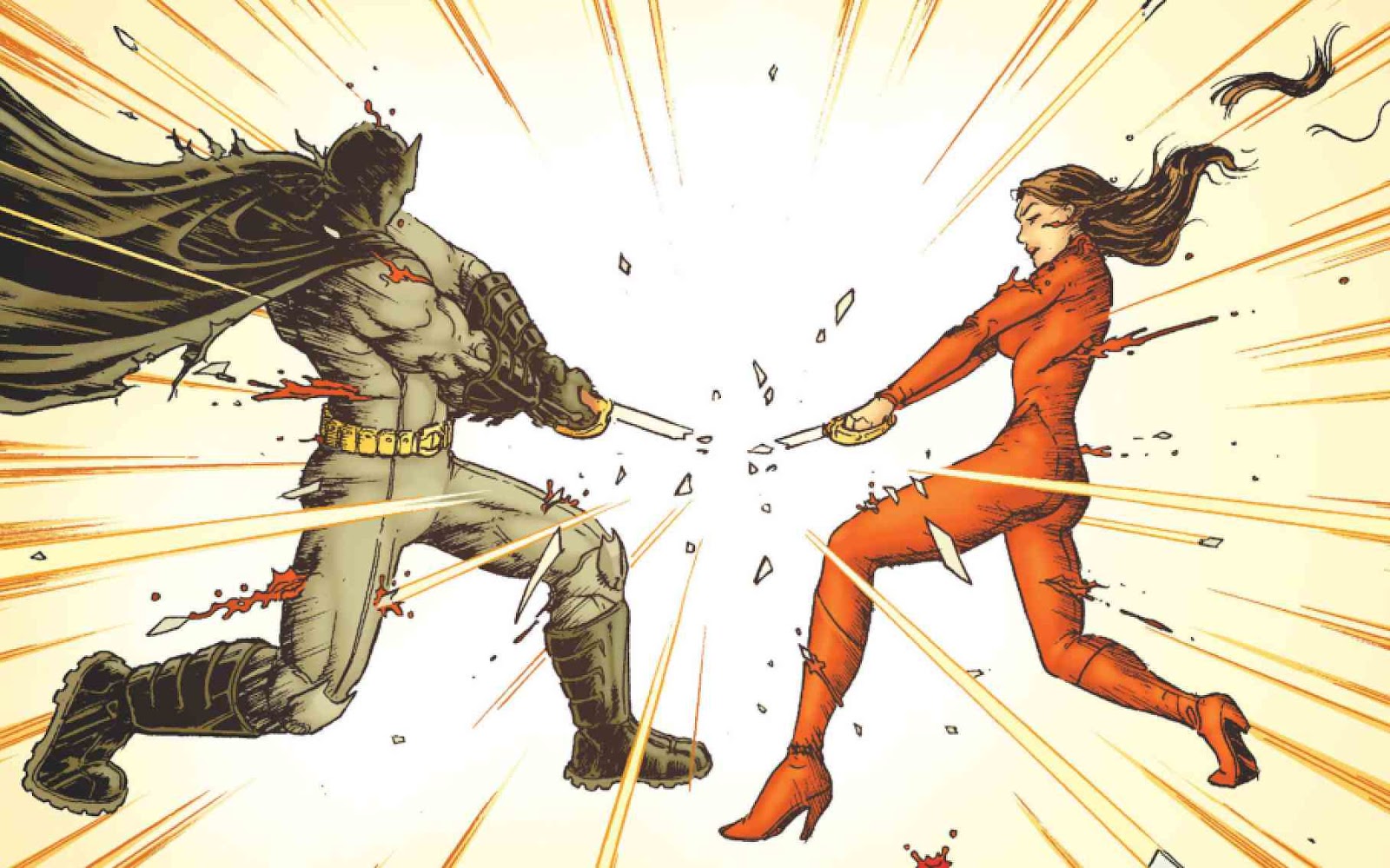
From the time Talia walks into the cave until Bruce walks out, needing stitches for the cuts on his face, probably minutes, only, elapse. Batman's allies are busiest as they go to work around the world neutralizing the threat of mass destruction, and Batman's allies come to his aid in the scenes that follow the end of his sword fight with Talia, one that she perhaps wins by cheating. Then two of Batman's allies enter the cave and cheat to save him. And then, intercut with all the action, Batman's fondest ally, Jim Gordon, helps to patch him up with words. And an extra surprise or two follows.

When Inc began, Batman and Selina Kyle stole a substance that Sivana had created, a meta-material that allowed him to turn invisible during his final battle with the Heretic. It also proved to have critical utility as an agent to neutralize Talia's ring of meta-bombs around the world, and in actions we see only in montage, the threat to the world at large is eliminated as Inc. agents make sure those seven bombs will never detonate. An old Morrison Batman principle at work: "The victory lies in the preparation."

But Batman loses the sword fight, succumbing to one or two poisons Talia snuck into the mix, and will die unless he begs for mercy. Just in time, Robin arrives. In this case, Jason Todd, who tricks Talia into giving Batman the antidote in return for the trigger to set off the metabombs. Talia accepts, but in vain, because with the metabombs neutralized, the trigger is worth nothing. And then, as she vows continuing revenge, Talia is abruptly taken down by a shot from the Headmistress, as expected, Kathy Kane, who briefly outlines her scope of operations in Spyral, and she departs leaving Talia dead and Bruce in a vacuum, the Leviathan threat at an end. But Batman is deeply shaken by the loss all around him. His child and the child's mother are laid to rest side by side, and he's unsure of continuing on.

This is the low point of Bruce Wayne in all of Morrison's run, the exact moment we saw in flashforward in Inc v2, #1, when Jim Gordon arrives to arrest Bruce Wayne, but in his interrogation of Bruce, Gordon plays the part of a sympathetic figure, a counselor, a priest. As Bruce talks through it, Gordon tries to understand the motives and how the madness was too large for him to control, and all throughout, Gordon knows that he might be speaking directly with Batman. And when it's over, he makes it clear that Batman is needed, and gives him the encouragement to suit up again, and return to his mission.

The events of #13 are full of mirrors to earlier stories. Bruce's lover enters the Batcave and belittles him, attacks him -- this is a key moment in RIP, with Talia serving a role now like Jezebel Jet did then. Morrison said that the image of a woman betraying Batman was the first thought he had for his run that began in 2006. Here, the same moment plays out, although the surprise of Talia's animosity has long been apparent. The sword fight itself is a mirror of one Bruce fought with Ra's in the desert in Batman #244.

Each of Morrison's long Batman arcs ends with a Robin coming to his aid. In RIP, Dick Grayson protects his blindside. In Return of Bruce Wayne, Tim Drake awakens the man inside the possessed Bruce-Hyper Adapter combination that returned from the future. And here, Jason Todd is the Robin who saves Batman, neatly giving each of the three Robins his turn. In fact, the coda of Inc's midpoint, in the Leviathan Strikes #1 special, gave Damian his turn to be the Robin who saves Batman, in a scene quite similar to this one, with Batman staggered and defeated at the feet of his enemy.

And so, in counterpoint to the grand message of RIP that the towering figure of Batman can defeat any enemy, rise above any menace, we have the grand message of Return of Bruce Wayne: Batman always had his allies; he was never alone. Inc #13 shores that up by showing Jim Gordon as the cop who comforted young Bruce Wayne on the night of his parents' deaths, a fact in Nolan's Batman films, but not -- previously -- in post-Infinite Crisis continuity. The appearance of a bat-themed woman ally who shoots the bad guy is also a key moment in Nolan's films, when Catwoman shoots Bane, remarking as Kathy Kane does here, that Batman's rule not to kill does not apply to her. And so the battle ends.

Bruce standing over two graves is a counterpoint to his childhood tragedy, he the only one left standing from a family of three. Jim Gordon's interview with Bruce Wayne is the counterpoint to whatever he gave young Bruce on the night of the Waynes' deaths (we may imagine it to be the same comfort we saw in the Nolan films). And we know from Gordon quoting it that Bruce saw all of this destruction as the "hole in things", Doctor Hurt's self-aggrandizing description, a void that nearly overwhelmed him until Gordon affirmed that Gotham needed Batman once more. So we see in montage that Batman does return, just as determined as before, and things really are much the same as before Morrison's run. Batman is Gotham's protector. Everything has come full circle. For Batman to rise again after having been taken down is how all of Morrison's runs have ended: Bruce returning from defeat while a narrator provides solemn acclamation is a fivefold Morrison ending/non-ending, something we saw in Batman #681, #683, #702, and Return of Bruce Wayne #6.

Kathy Kane, from the shadows, arranges for all charges against Bruce Wayne to be dropped. And then there is a surprise. As Ra's al-Ghul hinted in mocking comments he made to Talia in #10, he is the larger figure who will rise when she falls. Was he pulling the strings behind the Leviathan plot all along? No, but he saw opportunity lay on the other side of it. Ra's readies a continuation of his war against Batman and has the bodies of Talia and Damian as well as the lab and embryos to build an army of Damian clones he will control in the future. This opens the door for Talia to return, and in principle, Damian.

Inc was in its larger strokes more conventional than Morrison's other long Batman stories. The ambiguities and unreliable narration reached their peak in the middle, when Batman got lost in the traps and mind games of Otto Netz. The key distinction of Batman, Incorporated's war with Leviathan is in its scope. This story was 25 issues long, grander even than Morrison's long run up to RIP. It turned around the world and pivoted from literary references to Borges, to deep dives into Batman lore from the Fifties, Sixties, and Seventies, and it ended by renewing Batman in terms of his origin in the Thirties.

The power of this finale, unlucky #13, is in the extent that the reader shares the feeling that the sprawling epic which twice poisoned Bruce and left him waiting for a mortal blow at the feet of his enemy, succeeded in taking him to a dark place. Perhaps we're too certain by now of his ability to rebound to feel that it ever got so dark. Damian's death five issues ago and the mourning that followed were the psychological low point of the story, and for Bruce to rise from that surely indicated he could rise from this. After having seen Bruce face off against the Devil and Darkseid, to stand up after nearly dying in the past and in the future, we can't be surprised to see him rise again now. Perhaps what lingers longest from this finale is the clipped tone of his interview with Gordon, the caring Jim Gordon showed him, and the obvious sense that the two men were both shaken by all of the destruction this brought to Gotham. When Morrison was just seven issues into a run he didn't know would be anywhere near this long, he put Batman and Jim Gordon on a rooftop and let them share this kind of a moment when all the evils that awaited Batman in Morrison's run were just beginning to unfold. And with the same shared devotion, reverence, and mutual respect, they discussed the Replacement Batmen with Gordon asking, "Look at you, all beat up to Hell. Why did you have to choose an enemy that's as old as time and bigger than all of us, Batman?" And Batman answering, "Same reason you did, Jim. I figured I could take him. This isn't over." But now, for Morrison's glorious portion of the Batman legend, it is.

Tuesday, July 30, 2013

Grant Morrison's Bat Mysteries


Just as most of Grant Morrison’s Superman stories follow conventions of science fiction, most of Morrison’s Batman stories follow conventions of mystery fiction. Now, with only one issue left, perhaps the biggest mystery is: Is Batman, Inc. a mystery at all? What sort of payoff does the final issue provide if not a mystery? By and large, Morrison’s Batman epic has told four long stories, in four separate titles. With three of those complete, are there patterns we can identify to elucidate the fourth?

Morrison’s runs in Batman, as well as Batman and Robin, told long single stories with a hierarchical structure, the whole run broken into a few parts, each part a few issues long.

The first substory told as a mystery was his Club of Heroes story set on John Mayhew’s island, which followed achingly familiar patterns of Murder Mister Dinner Theatre, some of which are also enshrined in the game Clue (Cluedo) and some of the works of Agatha Christie, among others. Several characters were isolated, one murder took place which began a series of attacks, and the remaining characters were left to solve the crimes before their time ran out. The answer proved to be more complex than one might have expected: There were truly three culprits, all three of whom had a misleading or masked identity: John Mayhew, who falsely assumed the identity of El Sombrero before unmasking in the final pages; Wingman, who had a few subtle clues pointing to him throughout, but who switched identities with Dark Ranger after he killed him; and the Black Glove, Doctor Hurt, who was not actually given a name for another five issues. One may also observe that the only tangible clue, the absence of rain on Wingman’s plane, was no more salient than an error in the writing, the number of stab wounds used to kill the Legionary. All told, the mystery insofar as Wingman and Mayhew went was probably not solvable in the conventional sense, and as far as the Black Glove went, certainly not solvable, as it led into future storylines. So, while the story was overwhelmingly a mystery in form, it deviated from a mystery in resolution.

This was also true of the extended “replacement Batmen” mini-mystery. Batman’s subduing of the Bane Batman culminated with a question: “Who is the third man?”, which was unsolvable in the sense that it was a character who had no specific name or identity at the time the question was raised. And this, too, ended by conveying the unmistakable impression that a bigger question was more important. Not “Who is the third man?” but “Who is the king of crime?” and by a subtle visual clue, “Who is the Black Glove?”

The way that the earlier mysteries were not true, fair mysteries made sense in the structure Morrison was building. They provided like appetizers before a main course, whetting our appetite for resolution, then building that hunger more when no definitive answer came. And by the time Batman, RIP began, the mantralike question defining Morrison’s run was “Who is the Black Glove?” And fans set to work posing and analyzing guesses up and down the DC roster, with such names as Hugo Strange, Lex Luthor, Jim Gordon, Alfred Pennyworth, the Crimson Avenger, Thomas Wayne, Bruce Wayne, and many others being suggested and discussed.

Here, too, the conventional mystery many anticipated was not in the offing. No previously-defined DC character was in any sense the answer RIP provided. The tone established along the way was, in retrospect, preparing that conclusion: The intertwined mysteries of Honor Jackson (ghost or hallucination?) and Bat-Might (magical imp or fantasy?) were both ended on notes of perfect ambiguity. We can’t be sure if the street junkie who appeared and disappeared was a spirit resurrected by Bat-Might or if there never was a Bat-Might to begin with. In the story, Morrison makes a joke of it by having Bat-Might say that imagination is the fifth dimension. The ambiguity was there in the renaming Morrison gave the sprite when he changed Bat-Mite to Bat-Might. Might means power, befitting the character’s magic, but it means something else: The modal verb “might”: as in, he might exist. Or he might not.

Likewise, the red-and-black mystery ended up being no mystery at all. So the mysteries of RIP was always shrouded in ambiguity in its conclusions as well as mid-story. And when the Devil was name-checked repeatedly, and Batman himself says “the Devil”, it’s in a question. And when, later, he says it again, he says “may or may not have been the Devil” and references Hurt’s claim to have been Bruce’s father.

Batman and Robin and the intertwined Return of Bruce Wayne had at least as many mysteries of identity than a person can count on one hand. The Domino Killer, Oberon Sexton, the Red Hood, the “Batman” corpse, El Penitente, and Barbatos were all names and faces without a known match. The reappearance of Bruce Wayne in the final panel of #15 was subject to doubt, and there were mysteries, too, of the missing Wayne portrait, the tunnels under Wayne Manor, the casket, and more. Ultimately, there were more mysteries of identity than there were characters matching up to them (the Joker was both the Domino Killer and the detective trying to find the Domino Killer; Doctor Hurt was both Old Thomas Wayne and El Penitente). Most of these had definitive answers, whereas the contents of the casket ended up being an anticlimax.

Batman, Inc. has also had a few mysteries of identity. Most central, Talia was revealed as Leviathan, but this revelation came early, in fact, a year and a half ago. Heretic, the new Wingman, Nero Nykto, also mysteries of identity dangled for a while, also resolved long before the story neared the end.

So there may be striking significance in the reveal or reveals that remain. The Headmistress is the most prominent, nearly certain to be Kathy Kane, this mystery has not had its ceremonial unmasking yet. Nor has the identity of the occupant of the second grave, who could easily be the now-dead Heretic, or someone yet to die such as Kathy Kane. We also have the possibility that there’s a mystery where we didn’t know there was a mystery, if Talia is not the true controlling force and Ra’s or Doctor Hurt were to emerge. Finally, we may have outstanding the identity of the Batman of the future, who seemed clearly to be Damian; this future may be completely null and void, or someone else may take that role.

Morrison has told us that this finale will be bleak. That could mean Kathy Kane dies and Bruce is left to mourn the loss of another family (with Kathy and Damian as his wife and son, at least symbolically). It could mean we see the far future apocalypse is destined to play out. Morrison has kept his options open, and Inc is perhaps less clearly on a set of rails guided towards a specific finish than any of his Batman maxi-stories to date. The events in the story may be of less importance than the question: After a run on the character so long and so memorable, in what state does Morrison leave Batman? Is he the omni-capable Batman who defeats super beings and the Devil? Or is he a tragic figure lashing out in madness, as Morrison first wrote him, in Arkham Asylum?

Wednesday, July 3, 2013

Batman, Inc #12

Perhaps the greatest surprise of Batman, Inc #12 is how many threads are left hanging for the series finale. This is an issue of action, with one battle fought and another set to begin, while the major themes are touched upon lightly, but perhaps with importance.

The events of the issue are straightforward: Batman, armed as a man-bat, with the Suit of Sorrows, and the power of invisibility, neutralizes Talia's man-bats with the antidote, then thoroughly bashes his genetically-engineered son, the Heretic, in battle. We see that the Heretic has a child's head on his herculean body. When the Heretic is defeated, he reports back to his mother who slays him for his failure, and goes to Wayne Manor to fight Bruce in battle.

An interlude shows Dick Grayson and Tim Drake arriving at the location where Jason Todd was a captive of Spyral, and the three former Robins find themselves not in a fight, but being told that Spyral is on Batman's side, but in perhaps the issue's biggest teaser, we are told by the Hood and the Headmistress (more clearly than ever, Kathy Kane) that the fight between Batman, Inc. and Leviathan is a minor facet of a much bigger picture, and describe Bruce Wayne's efforts in patronizing fashion.

This issue is filled with references to earlier stories, both by Morrison and his predecessors. Defeating and shaming the Heretic (now referred to, by both Talia and Bruce, directly as "Leviathan") in front of his troops is a mirror of Batman beating the Mutant leader in The Dark Knight Returns. Dick Grayson and the new Knight give the Heretic a double punch, a motif of Dick and Damian's in Batman and Robin. The Headmistress says "How you've grown" to Dick Grayson, a further clue that she is Kathy Kane, and moreover an exact quote of Doctor Hurt from Batman #678. Talia says that there are dozens more Damian clones in tanks waiting to be born, which was Darkseid's plan in cloning Bruce in Final Crisis. Talia identifies herself as Kali, Tiamet, Medusa, the wire mommy, an intriguingly direct reference to the upbringing of Professor Pyg. And finally, when Talia takes up arms to fight Bruce mano-a-mano in the Batcave, she says "To the death, my dear detective," a near quote of her father's challenge to Bruce before their desert duel back in Batman #244.

The perplexing matter is how much is left unresolved with only one issue left in Morrison's epic run. We know that plotwise, Bruce must fight this battle with Talia, then after a funeral marking a major death, will decide to end Batman, Inc, and will be charged with a crime, charges that will presumably be dealt with before Morrison's run ends.

It remains possible that the Heretic will fill the second foreshadowed grave. Even so, we need to see the aforementioned plot points play out, as well as the newly-raised tension regarding a bigger picture that will put Bruce and Talia's war in context.

In several ways, this story has subtly linked the forces of the Black Glove with those of the al-Ghuls. Talia had an agent inside the Black Glove. Her plot threatens to create the apocalypse we've seen in the future, with Doctor Hurt playing a role in that. Now, with Talia describing herself in the terms of Professor Pyg's upbringing, this raises the prospect that Talia and the Black Glove were somehow operating in parallel. Morrison has promised a coda for Doctor Hurt, and now we know that a plot involving Spyral overarches Leviathan. It seems that the events of #13 will be thematically and literally very expansive.