Showing posts with label grant morrison. Show all posts

Saturday, October 30, 2021

Superman & The Authority 4


Grant Morrison’s last monthly comic for DC Comics (for now, anyways) begins with a walk down memory lane as the Ultra Humanite asks Superman, “Remember the first time?” I doubt if any of us were reading back then, but it’s in the archives. The first – the very first – superhero–supervillain matchup was between these two, in
Action

2021: Ultra-Humanite, Superman, and a Saw
#13, a story that began remarkably ordinary, with a taxi racket (a gang taking out competing taxis and their drivers with violence and other dirty tricks) that surprisingly and strangely ended up being the brainchild of a mad scientist with superhuman intelligence bestowed upon him by “an experiment.” In that story, Ultra strapped Superman to a table and attempted to kill him with a metal saw to the head – the first time that anyone (other than foolish, frustrated gunmen) tried to kill Superman. Morrison lovingly takes us back to 1939, and once again, Ultra’s attempt to saw Superman’s head open fails. Some things never change, hmm? In the present story, Ultra waxes nostalgic over his/her/its other schemes, with references to a purple plague, invisible car, and atomic disintegrator, all stories from the first year of showdowns between Superman and his first supervillain. Remember the “her” I just mentioned? Well, Ultra’s first brain-body swap was with a Hollywood actress, and eighty years before Mac gives us his pronouns in this issue, the Ultra-Humanite was referred to as “she” in a little bit of sci fi gender nonbinary identity.

Soon enough, the homages switch from the Golden Age to the Silver, as Superman and Lois tag-team and provide a shout-out to white kryptonite (the perfect weapon to use against Solomon Grundy’s swamp body). Lois shoots it out of a K-rifle with variant settings and makes a red kryptonite joke when she says that she’s glad she didn’t accidentally use the wrong setting and turn Ultra into something ludicrous and more dangerous. It’s a symphony of old classics – Superman winning a fight with his magnificent strength after not having really lost his powers (not in the same way that I predicted after issue #1, but to the same effect). Then, after Superman brutally wrenches off his enemy’s head (but nobody really dies), he discovers the real mastermind whom we saw speaking in computer-font green speech balloons last issue – Brainiac.

1940: Ultra-Humanite, Superman, and a Saw


A devilish-looking red Brainiac (inexplicably but marvelously in suit and tie, space-monkey on shoulder) and Superman then battle by… talking. All the issue’s main action shows Superman’s superior squad, the new Authority, taking down all the villains  with perfect mismatches (light vs. darkness, magic vs. science, compassion vs. cruelty, and expanded social consciousness vs. a literal Nazi). During a string of wins that eventually becomes as tiresome for Superman as it is noxious to his foes, Superman verbally whips the villains with quips and smirks.


The issue’s – and the series’s – key word occurs after those battles are over: “convince.” For all of the dynamic action with punches, kicks, magic spells, floods of subatomic particles, and flashes of light, from the first pages to the last, the good side ultimately wins more often than not by convincing someone – not necessarily a bad person – of something. Superman convinces Manchester Black to join him. Manchester Black convinces the team to join them. The team convinces Enchantress to save herself. Superman convinces D’z’amor of a contradiction. Apollo convinces Mac that they’re on the same side. Manchester Black convinces Coldcast that he doesn’t want to be on the same side as a Nazi. And ultimately, Superman convinces Brainiac that he is quitting the field of battle, thereby ending the conflict for now. Along the way, Superman becomes convinced that Manchester Black is redeemable, that Siv has good reason to be frustrated with her people’s treatment. The Ultra-Humanite, despite his rage, and Brainiac, despite his predatory goals, both speak of their lofty aspirations to save the planet better than an international council is managing to, and even the villains try to convince humanity of something. With the exception of the aforementioned Nazi, virtually every character in this story exists somewhere on the spectrum between good and evil, including the binary characters of Eclipso and Enchantress and a Superman who is not quite as much of a Boy Scout (ripping the head off his defeated foe) as he once was. This series from the start is about reconciliation, and that’s not just a way to make this four-issue miniseries work: Morrison articulates a vision here of how DC’s future might look thematically, and it’s an important parting message for a DC that has increasingly headlined super-evil versions of its heroes as their marquee titles each month.


And in a world where the characters are trying to convince someone of something, rather than (or in addition to) delivering a beat-down, the battleground becomes one of words, message, and communication, and this is explicit throughout the series and the final issue. It moreover becomes clear that this theme is a comment – an explicit one – on discourse in the real world, on the Internet. Iron Cross whines that his Nazi ideology doesn’t get a fair shake from those who celebrate “free speech.” Manchester Black warns Coldcast that for siding with a Nazi, he might end up “canceled.” Lightray decides to leave social media. Eclipso tries pathetically to convince her that he is famous, and includes “the dark web” among his passions. Can you picture Silver Age Eclipso sitting at a desk looking at a computer screen? Throughout the miniseries, Morrison calls out the toxicity of discourse on the Internet, and it’s a kind of toxin that the superheroes aren’t particularly equipped to solve.


Many of the battles end with reconciliation. with Natasha Irons and Superman offering sympathy for Siv and the Haven, with Midnighter and Fleur de Lis joking about pride parades and financial advice. Only the most evil are beaten down physically, both literally (Ultra-Humanite, Iron Cross) and symbolically (Brainiac) decapitated.


And on that final point, Superman’s declaration to Brainiac, is quite a stunner if we can believe it. Superman tells Brainiac that he doesn’t believe that the two of them will likely cross paths ever again, then ends both the battle and the conversation. Brainiac is confused though Ultra-Humanite seems not to be. Superman wins a point in a battle of minds with this move, but leaving Earth is something that he apparently has to do anyway. And then, in one of the series’s several endings, Ultra-Humanite declares that he will continue the battle against Superman’s son. This is reminiscent of Morrison’s final pages of Batman, Inc. with R’as al Ghul ranting to the camera about his next big plan to attack Batman. That’s a Batman plot that subsequent writers didn’t pick up, nor, likely, was Morrison expecting them to. The point wasn’t that Morrison was to choose the continued direction of Batman as they stepped away from their years of writing, but that the genre does that itself. There’s always a big villain plan coming next; back then, why not R’as and now why not Ultra-Humanite? This is Morrison putting the toys back in the toy box so the next creators can start fresh.


However, like Batman, R.I.P., this story has multiple ending scenes, one after another. And, one of the series’s other endings does tie in with what’s coming next, as Superman’s upcoming mission to Warworld in Action will be scripted by Phillip Kennedy Johnson and that is coordinated with Superman and The Authority… but loosely. Some of the details of the two series don’t quite mesh, but that’s nothing new for Morrison events – think of Aquaman returning in Final Crisis then not really being returned after that event ended. We can look past such tiny details as Superman’s graying temples and the timeline running from Superman’s meeting with JFK up to the story’s present, its hints that the vintage lineup of the JLA had left in defeat, and with the two works being written years apart, acknowledge that the plots match up well enough. At the very least, this issue explicitly mentions the correct issue number of the next Action issue, and the scene where Superman changes back into his classic uniform might be the last detail added – note that the dialogue makes no reference to the costume change while we see it take place in the artwork – that makes this work transition into what’s coming.


Two other plot points may – or very well may not at all – lead into the future of Superman comics. One, the repeated, murky, and in the end never resolved comments about kryptonite may mean that Superman’s departure from Earth has a motive pertaining to kryptonite, even though other titles’ discussion of Superman’s departure don’t include this… or do they? If Superman is gradually weakening, is this perhaps tied to some circumstance on Earth – and might we hope, potentially a reversible one – involving kryptonite specifically on Earth? I don’t think we should be surprised if we eventually get an explanation like that, or on the other hand if we don’t. Plans shift, creators add their own creative details, and the odds are fair that this detail is up in the air rather than being predetermined.


Finally, the issue’s final ending, with Superman revealing a message from the Source Wall’s Uni-Friend (a floating hand of fire, going back to the first issues of Kirby’s New Gods) telling us “Lightray Is.” This is, perhaps, just an extra looming plot, as if Morrison had ended their run with Batman by showing us a big, shadowy plot by R’as and then one by Two Face. The implication is that Lightray, obscure but glamorous character whom Morrison borrowed and then largely reinvented, could have a future role comparable to that of Darkseid. But here we have to remember the original Kirby Lightray, a male New God wearing white. Are the two linked by some sort of cosmic reincarnation? Is this a bigger DC plan that we’ll see in the future, relating, perhaps to all of the references to Great Darkness in Bendis’s LSH? Time will tell. It is a resounding connection with the comics’ past (Kirby dots in the artwork, recycled character name, and all), but may not show up again in the future.


And that’s the same note on which we say goodbye to Grant Morrison. Their goodbye to us was on the last page of The Green Lantern, with Hal’s zooming off into deep space, uncertain destination, symbolic of Morrison’s. Superman and The Authority was written first, but published afterwards, but however you want to think of the sequence of these two stories, whichever is really last, both of these two final Morrison works for DC ends with the superhero taking off into space for a new adventure. This one, like Superman Beyond, ends with the words “To be continued.”


I first picked up a Morrison story in the pages of Legends of the Dark Knight #6, cover date of April 1990. Here we are 31 and a half years later. Morrison will undoubtedly be asked to write some of those features that you see in big anniversary issues, where writers from the past, or even other genres jot off a story some four to eight pages long, something cute and out-of-continuity, and perhaps those will be coming down the road. Perhaps in a few years there’ll be a big rapprochement and DC will get Morrison back for some other “last” major commitment, say, a twelve-issue series about Barry Allen, or Ray Palmer. You can’t predict these things, and retirement announcements, even definitive declarations, have a way of being mutable over time. One way or another, for Superman, for Grant Morrison, for you, and for me: To be continued…

Wednesday, September 22, 2021

Superman & The Authority #3

Superman & The Authority #3 begins with a cinematic opening. Six tall, slender panels neatly enclose June Moone and no one else, and then the camera pulls back, ending with a wide panel bringing her into company. When this ends with a caption – not the first and not the last time that the story has said this – “FORT SUPERMAN” it’s time to notice that there’s a reason why Grant Morrison has rejected the conventional name for this place, because it’s a place for community, almost a home, the headquarters of a team, and in sum, not in any way a fortress of solitude. In fact, the story’s first word performs a similar change in perspective, naming the location of the fortress not “the Arctic” but “Alaska” – not a place defined by barrenness and being uninhabited but a real place with a real name and a population to boot (although it’s a fair bet that Superman’s fortress is more remote than just sitting at the end of a cul-de-sac outside Anchorage). In the meantime, we see June subtly – easy to miss – dress herself by making her clothing levitate and float to her, contradicting the sense from earlier than June is powerless and the Enchantress side of her alone has power (which is subject to wickedness). Along the way, there’s a nod to The Wizard of Oz when June’s recollection of her Hell-dream includes “and you were there.”

Personally, I found the story of June’s peril and subsequent rescue powerful. In a genre where internal conflict is often the struggle between a character and some factor that we can’t relate to, because it doesn’t actually exist (a hex, mind control, a Black Lantern ring), June’s despair stems from guilt. To be sure, her predicament begins with something mystical, but at heart, she is trapped by the feeling that she’s “too weak” and has “done everything wrong.” D’z’amor takes glee in her frailty. Superman’s message? We all make mistakes. Every moment is a fresh opportunity. And Manchester Black’s advice – use your strength, have it be on your side. In a miniseries where the enemies lash out with abusive language as much as with fists and ray-beams, where elements in the story keep mapping onto elements in the real world, I wondered if Morrison had some situations close to home in mind with this scene; either way, as unreal as June’s situation was in the details, the emotions rang true. This scene was interestingly divergent from the famous scene in All-Star Superman #10 when Morrison shows Superman rescuing a girl from suicide not with the powers he gets from Earth’s yellow sun but with caring and understanding and a message of hope. Here, Manchester Black makes the connection to the situation and a “Suicide Hotline” call, but takes a different tack, and Morrison is showing us that Black’s style of pep talk can work, too. In the meantime, Superman dissolves D’z’amor with an argument about good and evil a bit reminiscent of the way Superman defeated Emperor Joker; the Joker could not imagine a world without Batman and, evil as he wants to be, D’z’amor can not truly operate without imagining something good.


When Enchantress has been saved and redeemed, the issue takes off on three new adventures, each of which is unresolved and going badly by the final page. We see that Lightray, moments before she would have been recruited by Apollo and Enchantress, is herself suicidal and is teleported off by Eclipso. The team of Manchester Black, Midnighter, and Steel is blindsided by a quartet of Ultra-Humanite’s team, and is suddenly outnumbered four to two even while a rain of missile-men bombard Dubai. Then, Superman is subdued by the Ultra-Humanite himself, in the form of Ultra’s superior brain in the body of Solomon Grundy – a bit reminiscent of the “Doomsday Wars” story, in which Brainiac’s brain took control of Doomsday’s body. Somehow, the situation in an issue that began with the characters in Hell managed to get much worse – or so it seems.


Thematically, the inclusion of Eclipso interplays interestingly with Apollo and Midnighter – all combinations on dark vs. light – Lightray, and Enchantress who is, like Eclipso, the pairing of a light and dark personality. And, as noted in my commentary of earlier issues, this theme was already evident in the contrasting styles of Superman and Manchester Black and Morrison’s project in this work is one of rehabilitating and redeeming the dark, making Manchester Black a force we can root for, as Apollo and Midnighter are, in their origin, weapons of a villain who have been redeemed. The details of Eclipso’s background have been retconned over the years, and his post-Infinite Frontier nature might be up for grabs; it would not be surprising if Eclipso is defeated not with punches but by some sort of incantation or even argument that nullifies his evil and lets the good / light side take over.


But before Eclipso shows up (such as he does, always cloaked in shadow), Lightray – Lia Nelson – has a gun aimed at her head and we don’t know whether her depression is a consequence of her natural mental state or the influence of Eclipso; her comment that she is “so sad all the time” hints that this may be unrelated to the doings of supervillains. Once again, as with the Nat Irons subplot, the darkness of social media in our real world (our real online world) may be the subject that Morrison is really addressing, not fictional people in tights involved with super science and magic; Lia’s "world that’s falling apart” may be ours.


Overarching the horrifying situation with Ultra-Humanite ready to put his brain into Superman’s body is a single, pregnant detail – before the team split up, Superman told the team that he himself would serve as bait, a hint that being attacked by Ultra is not really a surprise and not really contrary to Superman’s expectations, and his defeat might not be a real defeat. What he says to the team after calling himself “bait,” we don’t see, but we see him subsequently walk through the teleportation portal with the team before being back in the Fortress for Ultra’s attack, indicating that we’ve missed at least two phases of preparation that were almost certainly not irrelevant. This recalls the quick interaction during Apollo and Midnighter’s mission in issue #2, wherein Midnighter announced that he had already determined the certainty of his and Apollo’s victory, but then expressed alarm that their foe was outthinking him, but then it turned out that his confidence was well-founded in the first place. That may foreshadow what is happening here, where Ultra’s belief that he has launched an unbeatable surprise attack seems to be less informed than Superman’s confidence that his seeming vulnerability is merely “bait.”


Whatever happens in the battle, it seems sure that the good guys will win – but what are good guys? This is perhaps the most important question in the miniseries and answering that seems to be the statement that Morrison wants to make as they exit from DC superhero comics. Is Manchester Black a good guy? Obviously, he’s now on Superman’s team and we’re rooting for him. Similarly, Enchantress has suddenly come around from being a wicked nightmare plaguing June Moone but is now, also, on the team. But this series does not simply whitewash the wicked, giving them a “Get Out of Jail Free” card. It also owns up to the imperfections of the good, accepts their faults, and redeems them. Superman’s secret identity was all along, as Ultra-Humanite opines (and as others have throughout the decades) a “lie” from a man who claims never to lie. Superman is, Ultra also observes, no longer required to pose as a paragon of virtue now that his son is taking greater importance. Superman owns up to the weaknesses and faults of his allies in issue #1 – their overconfidence, their underperformance, their failures.


Superman is a character whose history is much bigger than the portion of it in Morrison’s hands, and even Enchantress is a character with considerable definition in the past, so perhaps we learn the most about the miniseries’ message by looking at Lia Nelson, who seems to be all shining beauty goodness and optimism, but aims a gun at her head, proclaiming existential despair hidden from the world. Her birth was celebrated as one of the most special and wonderful ever, but in truth, her parents raged at one another and we learned of their infidelities. These are details fully in Morrison’s control and they’re chosen to package what Morrison is saying about Superman and all the DC “heroes” in this send-off: They’re not perfect and perfection is always just an illusion. What these fictional heroes have to teach us is not that being perfect and spotless is the way to live but that surviving one’s own imperfections is something we can do – as June Moone did in this issue, as Superman is doing in this miniseries, and as Lia Nelson has to do – if she can – in the next issue. Superman’s final message to us, with Morrison penning the words, is not that sunlight can make a man incredibly mighty but that every moment is a fresh opportunity to do something worthwhile.


Monday, August 30, 2021

Superman & The Authority #2


Superman & The Authority
’s first issue was about two men coming from opposite ideological positions, one of them winning the other over for at least a temporary joining of forces. The second issue takes that same spectrum and turns it into a framing story, with an issue that begins in a kind of heaven and ends in a kind of – or perhaps the very one and only – Hell. Along the way, we see members of the team take on medium-sized threats, with technology as a recurrent threat across both issues.

The first words, “Fort Superman,” hearken back to the Silver Age, not 1963 but 1958, in the title of the classic “The Super-Key to Fort Superman.” That’s about as Silver Age as it gets, and that’s why Morrison chose that phrase, to begin the blend that we see from the squeaky clean to, well, right down to Hell. The moral decline begins as Manchester Black has a transgressive smoke in the Fortress of Solitude and it angers Superman’s squad of Kryptonian robots, but not to the point of their, well, killing Black, as he dares them too.

The second issue is built around a framing story, like many old JSA and JLA stories, where we see the parts of the team in side action (or so it seems) before they finally come together at the end. If you count both issues of the series, we have seen individual sub-teams in action four times, and these four encounters develop a couple of distinctive themes.

First, there is a noteworthy relevance of technology, and in particular networks of computer-linked minds, in three of the stories. First, Superman and Manchester Black face robots from the Phantom Zone – a peculiar twist from the usual setup where good, old-fashioned human (well, Kryptonian) villains escape. Second, Natasha Irons faces off against a particularly sadistic and highly realistic threat from an Internet hive mind with all of social media’s worst characteristics. Third, Midnighter and Apollo confront a beast possessing a network of minds. It is only the fourth confrontation, with June Moone, that differs from the pattern, involving a supernatural threat in character with the character’s history. Perhaps three instances is not enough to infer a pattern, but while artificial intelligence networks don’t make for an absolutely novel threat, it is a bit noticeable to have it come up in three cases out of four.

A more undeniable theme is that of duality, and conflict, between one “bright” personality and one “dark” personality on the side of the heroes. This is absolutely front and center in the scenes showing Superman and Manchester Black, and is moreover downright core to the concept of Midnighter and Apollo. Finally, it is equally apparent with June Moone and Enchantress, to the extent that Enchantress appears to be the villain in that substory. But, again, we have a theme that extends across just three of the four stories which perhaps makes us pay more attention to the one that doesn’t hold… Natasha Irons appears to have no dark counterpart. Still, it is obvious that the entire concept of this team is to bring together characters from opposite poles of the spectrum. It is virtually impossible to describe this series without pointing that out.

SonOfBatmann pointed out in the comments of my last post that Manchester Black, describing his disdain for Superman in the first issue, was serving as a stand-in for fans in the real world. This in fact was core to Joe Kelly’s original story with the Elite. In issue #2, the enemy facing Natasha Irons is even more obviously borrowed from the real world of ours; in fact, it has never been more blatant that the villain in a DC story is a reflection of some of the people who are reading the story (at least, if some sliver of the worst people on social media are also DC fans). Nat’s villains attack her with words and other forms of information rather than physical blows, body-shaming her posterior, insulting her looks, and threatening to send nude photos of her to her grandmother and her boss. And, amusingly, Morrison renders these trolls as literal trolls. She somehow defeats them with the combination of a heavy hammer and sharp words, which is unlikely to solve the same problem in the real world, but then that’s true of all superhero stories, isn’t it?

Midnighter and Apollo happen to be the only original Authority members in the issue, and their story, with the piquant title, “HARD,” begins with the kind of backstory that may be a colorful way of introducing their personalities or may just tie into the bigger story. We won’t know until later. But we see the two go into action and crush their threat so decisively that we have to suspend disbelief that such a formidable pair (and couple) could have existed in Superman’s world without having met him previously. I have to salute the issue’s four artists – whichever is appropriately to credit – in capturing Apollo’s expression with brows that communicate the combination of affection and consternation for his difficult and loyal (perhaps unfaithful?) partner.

Enchantress crossed paths with Superman’s world way back in 1980, as a sort of frenemy to Supergirl in Superman Family #204-205. Here, as there, Enchantress is the real threat in the story, at least while under someone else’s influence. Here, as there, her supernatural archfoe Dzamor (first appearing in the first Enchantress story in 1968) is the big bad behind the scenes. This time, the feeling is distinctly like the film Rosemary’s Baby (also from 1968!), with June Moone a horribly mistreated victim of the evil beings who try to corrupt her. Then, with a satisfying turn for the better, D’z’amor (now the name is spiced up with apostrophes) is punched offscreen by our hero; in what is presumably an oversight in the art, the punch comes from a bare arm, which doesn’t match Superman, Apollo, or anyone else, but is probably from Superman.

The team’s challenge in Hell is foreshadowed in the framing story’s title, “One Soul at a Time,” which out of context would imply a mission of saving sinners in a Christian sense, which makes Superman, in this story, an agent of God. We begin the issue expecting the recruitment of the new team, but at the end, it seems to identify June Moone as the poor soul who needs salvation but will surely end up being a member of the team fighting at their side, at least insofar as the Enchantress “is” June Moone, a tangled identity which is often a pair rather than an individual, which brings us back to the theme of duality among our heroes. Most likely, though (as we can see from the cover), Enchantress will be redeemed rather than eliminated.

The cover also reminds us that the Ultra-Humanite (in his big, white gorilla form) is part of the story, and it’s therefore remarkable that we reach the mini-series’ midpoint without him having done anything but talk in three panels, all the more remarkable in that the heroes (and antiheroes) will enter the third issue facing a threat that is – maybe – not even related to the Ultra-Humanite. The pacing of the mini-series, sadly, already, half over – highlights that it is transitional and more about putting this team together for future adventures than about a single four-issue battle against a single foe.

Perhaps the substory threats are disconnected sideplots, but we’ve seen Morrison before turn those seemingly disconnected elements into one big web. Either way, the Midnighter / Apollo case is full of familiar Morrisonian notes, such as kids with metahuman powers being abducted and utilized as an weapon (Final Crisis) and the genetic / biological engineering of a superpowered henchman (Final Crisis, Batman Inc.). This storyline echoes the origin of Midnighter and Apollo, who were biologically engineered by a villain – Midnighter reminds us, “That’s how they made me” while Black reminds us that Apollo came from a vat – and plainly indicates an unseen Big Bad somewhere offscreen. And if we’re looking for clues on who that might be, consider that the lab in Batman, Inc. – specifically 2011’s Batman: The Return – and in this story were both in Yemen, not a likely location to come up twice by coincidence. Could the person behind the scenes be, if not Talia herself, someone who’s taken over part of her operations?

Another choice element from another time is the Supermobile, which originated in Action Comics #481 in 1978. The in-story motivation was that the light of an exploding red star took away Superman’s powers just when he had to battle Amazo with all of the world’s other superheroes already beaten. The out-of-story motivation was to create a merchandising opportunity for a triple crossover between Superman: The Movie coming out that same year, the comics, and a toy and – yes – I owned one. When Manchester Black calls it Batman envy, he’s psychoanalyzing Superman, but the merchandising people were clearly copying the Batmobile as merchandise (and I owned one of those, too). Here, the Supermobile, like the limited speeds on Superman’s treadmill, reinforce the earlier claim, despite my suspicions of a ruse, we still see signs that Superman is losing his powers and needs any kind of help that he can get.

Now, with the team facing one crisis, recruitment not complete, and the big villain yet to appear in his fourth panel, this miniseries has to have a seriously packed final two issues. If there’s a lingering thread that’s yet to unspool, it’s that the Ultra-Humanite’s hate-filled spiel in the first issue is about Superman’s dishonesty, calling Superman’s double identity and more “lies” and he’s not strictly wrong to do so. When the Ultra-Humanite says that kryptonite will destroy Superman, I think we’re going to see that be about something other than the effects of radiation. In issue #2, Superman talks about atomic bombs having been utilized by idealists. While the first issue showed us Manchester Black being brought over to the light side, there are hints here, besides the black in the chest shield, that Superman’s going to show something of the dark.

Sunday, August 15, 2021

Superman & The Authority #1


It feels like we’ve been here before, but where is “here”? Grant Morrison’s “Superman & The Authority” is an Elseworlds made of Elseworlds, with several worlds placed into a blender. It’s a world where the Justice Society – sans Superman or Batman – served during World War Two, but Superman is around early in his career to meet President Kennedy… that feels a lot like Darwyn Cooke’s DC: The New Frontier. Superman’s previous go-arounds in this continuity with Manchester Black are possibly much like the ones we saw in Joe Kelly’s issues of Action Comics. Superman tapping Manchester Black to serve on his team is a notion that Kelly entertained, briefly, in 2006’s “Superman, This Is Your Life.” A Superman who has long since retired to the [Ant]arctic, facing unsolvable problems, and wearing black in his shield, is how Kingdom Come begins. And heroes haunted by their failure to prevent the assassination of a President is the premise of Morrison’s The Multiversity: Pax Americana, riffing hard on Alan Moore’s Watchmen. With winks and nods, Morrison tells us that we’re visiting a world a little like all of these but exactly like none of them.

From the start, and befitting the titular characters, Morrison hits us with rapid-fire alternation between optimism and pessimism. The first panel shows the last leaves falling off a tree and a caption that informs us that John F. Kennedy is about to die, while the doomed President speaks of “tomorrow dawning.” Superman asks if Kennedy will need his protection in Dallas. We know that the answer is yes, but Kennedy says “No.” All of Kennedy’s words in 1963 speak of a bright future and limitless potential, but his imminent assassination is just the first of things to go wrong. While JFK’s sunny aspirations give us detailed exposition of the superheroes’ history in this Elseworlds, a few other details check off how this world is and isn’t like the real world of 1963, with the objective of sending astronauts to Mars rather than the Moon before the end of the Sixties, and an ominous reference to ending all wars – a hope that never works out in the real world, and didn’t in this world, either.

Then the framing of the panels tells us that this is the history of this world as seen in newsreels, or – as Manchester Black wakes up – Black’s dream of history, a dream that ends as he is awoken by a police raid that overcomes his considerable abilities.

Morrison has long maintained that Superman is most interesting when he’s strong, which makes one of this issue’s surprises the fact that Superman is now – apparently – physically weak, an unexplained (and misleading?) exact 180° from Kingdom Come. But this Superman is morally as strong as ever we’ve seen, with an optimism that pays off when he is – apparently – able to win the acidic Manchester Black over to his side in a moment of super crisis. I slather on the “apparently”s because I see possible deception everywhere, and in the one panel where we see Superman while Black is unconscious, the hero lands dramatically – and seemingly powerfully, but the artwork keeps that intriguingly ambiguous, with a mighty fist joining his feet in a three-point landing that could project either power or (by Superman standards) weakness.

When Black awakens, he gets the pitch: Superman needs his help. There’s a war, but first there’s a battle. Superman needs Black’s help in a larger sense, a strategic sense, and Black isn’t prone to agree, but first there’s an imminent, urgent and arguably worse crisis with a massive breakout of Phantom Zone robots due to occur in minutes. Again, it feels like possible deception: Superman’s Pollyannaish recruitment speech to Black served only to alienate him, as Superman must have anticipated. The imminent Phantom Zone breakout, on the other hand, was an urgent crisis in which Superman and Black inarguably faced a mutual enemy, and gave Black no time to think the matter through. Black needed either to accept Superman’s pitch, or to reject it and in so doing possibly risk his own life, should the Phantom Zone escapees ravage the entire planet after they’d beaten Superman. And it seems a bit of a coincidence that this singular existential threat would arise “exactly twelve minutes” after Black awakens. So I wouldn’t be surprised if we are to learn that Superman manipulated the situation and showed a bit of deviousness on his own part. In any event, even if the timing were coincidental (and existential threats to the DCU have a way of showing up at least daily if not hourly), the outcome is the same – after Black contemplates, with the minutes that he has left, whether or not he and the Phantom Zone prisoners are on the same side, he chooses to back Superman and, with a savvy nod to the Silver Age, he tries to defeat the escapees with a Kryptonian Thought Beast. Guess when those first appeared in publication: 1963, a year that is brought up over and over again in this issue. Did Morrison choose that 1963 reference knowingly? I don’t know.

I’m also not sure if it was on purpose, when Superman first mentions that year in the present, that Morrison curiously quotes every note of a line from the Eighties Dream Academy song, “Life in a Northern Town”: “In Winter 1963, it felt like the world would freeze, with John F. Kennedy and the Beatles.” This refers to a notoriously severe wave of winter cold that hit the UK in early 1963, when the native Scotland of Morrison, just then turning three years old, had subzero (Fahrenheit!) temperatures. So much is coming together here that ties Morrison’s biography with this story that we should pay careful attention to the author’s place in the story – presumably on a symbolic level. The story features an acerbic, sarcastic, cynical Brit coming face to face with the symbol of American idealism and power. The story begins in the early 1960s. After decades in which things go variously well and poorly, there is a time of reckoning in which the Brit decides just how much he believes in the god-hero of American superheroes, and we can ask, perhaps thumbing through the autobiographical pages of Supergods just how much this story is about where Morrison’s viewpoints, and possibly the world’s current geopolitical status are now in 2021. Perhaps it's Morrison and not Manchester Black who's referencing "Amazing Grace" in asking whether or not Superman can "save a wretch like me."

The plot itself, on the surface, is brimming over with pregnant details and mini-mysteries presented by the shadowy villain who not revealed in the story, but the solicits promise us that he is the Ultra-Humanite, a choice which takes us back to the absolute origin of DC supervillains, and moreover hints at another one-and-done Elseworlds series with an ampersand in its title, Superman & Batman: Generations. All of the little expository details slipping from the dialogue of Superman, Black, and the Ultra-Humanite set the stage wonderfully, as Morrison has done in his Batman run, Action run, 52, and elsewhere, mixing details that are respectively from canon and contrary to canon, freeing the author to tease us with hints, then go back on those teases later, or confirm them as they see fit. Perhaps kryptonite in this reality is nothing like it is in any reality that we’ve seen before. Or perhaps it’s exactly the same. Perhaps Superman really is losing his powers, or perhaps it’s all a big ruse and, like in Kingdom Come, he’s stronger than ever. We just don’t know, but we have to consider both – all – possibilities, which is wonderful.

The title hides one such alternate possibility, which is likely rife with meaning. While Manchester Black was the leader, in Joe Kelly’s DC stories, of a group called The Elite, it was based on Wildstorm Comics’ The Authority; here, Morrison uses the inspiration’s name for, presumably, the version of the group in this reality. But why? Maybe the answer is a superficial “just because” but it makes the title say something that we ought to listen to with common nouns instead of proper nouns: The story is about Superman and the authority (small “a”) that he has. Whether he really has lost his powers or is only pretending to do so, this story clearly brings into question whether or not Superman has authority (small “a”) that comes from his qualities as a leader, as an inspiration, and not simply whether or not Earth’s yellow sun has charged his muscles with incredible power. And that promises a much more interesting story than a title that promises us meditations about Superman and the elite (small “e”).

Monday, March 15, 2021

The Green Lantern Season Two #12

On the last page, the hero flies off. We may not see him again anytime soon. He doesn’t know where his path will take him. Yes, that’s a statement about Hal Jordan, but it’s also a statement (give or take pronouns?) about Grant Morrison, and not an accidental one. Morrison, who identified with and championed Batman so intimately a decade ago fully took the Hal Jordan character to heart and for as long as this run has lasted, it’s been a statement that Jordan is Morrison’s champion, and that he is worth of being ours. And so, Morrison’s send-off is Hal’s send-off. For now.

For such a landmark issue, The Green Lantern Season Two #12 is remarkably formulaic for much of its story. Someone powerful faces off against Hal and Hal tells them, in essence, Fight with me or lose. He’s always right about that and he knows that he’s right about that. Earlier, I compared this upcoming ending to the end of Morrison’s Batman run, but Batman was beaten low, unconscious, out of his mind. Hal really never stops smirking at any point in this issue. He doesn’t negotiate with enemies; he threatens them, and along the way, he belittles them; he informs them that he has absolute control over the outcome of the conflict. “The ‘Golden Ones’ – I figured you’d show up eventually. You shouldn’t have… and you’ll wish you hadn’t.” Hal wins over his allies and takes down his enemies in sequence: Draatha, the supervillain surrogates, a brainwashed and transformed Fekk and Samandra, Hector Hammond, and finally the Golden Giants – and by extension, offscreen, Hyperwoman. Each time, Hal states the outcome in advance. Fekk and Samandra join him. The Golden Giants accept a deal. The others go down in a fight. Hal barely, at any point, seems worried. Ultimately, he wins with whatever weapon he uses against whatever other weapon. If his enemy has a massive space fleet and Hal has a sharp rock, Hal will win. Hal wins because he’s a winner and this is his story. This isn’t a clinic on combat techniques. It isn’t really about the way the Intelligence Engine (the issue’s title) works or how it selectively interferes with the power ring. It’s a parable about the comics industry and the hero genre itself. Everybody represents a larger class. The fighting always goes Hal’s way. The real story is in the talking.

As we’ve seen with other Morrison works, many supporting characters are drawn from DC lore that hasn’t been thought of as in-continuity in quite some time, but Morrison changes the original conceptions profoundly. I came into this run expecting that, perhaps, we would see many such characters from Hal’s past, but we rather saw many characters from throughout the Silver Age, but not specifically from Green Lantern, Volume 2 (1960-). The Hyper-Family debuted as heroes in Superboy. The Golden Giants debuted as antagonists in Flash. These characters look like their original versions but, like Doctor Hurt with respect to the unnamed doctor from which he originated, are profoundly corrupted: Hyperman and Hyperwoman turned from happy, smiling superheroes into psychopaths while the Golden Giants turned from primitive brutes into tyrants. Athmoora, from an Abin Sur scene in an early Hal story, is also rooted, stylistically in the past, but Morrison doesn’t change it so much as he makes it dirtier and grittier. In the 1962 original, Athmoora was a planet in the present that remained stuck in a medieval past, with knights fighting in swordplay – but not too busy to stop and explain to Abin Sur that alien invaders had stolen their “I-Factor” which trapped them in a less developed state rather than progressing.

The irony is that Hal Jordan was created as a representation of futuristic technology – a test pilot only years after the sound barrier had first been broken – but TGL Season Two is a parable about past and present. And it’s necessary to tease apart how these different takes on the past interrelate. We have the Golden Giants rooted in prehistory (25 million years ago, Flash #120 says) but they represent nothing from the past so much as a timeless greed. Athmoora, literally in the present but living in the style of hundreds of years ago, represents the style of superhero comics produced in the Silver Age but representing something that Morrison values today. Characters like Vartox (destroyed) and Hyper-Man (now evil) represent those Silver Age value corrupted and diminished. This is similar to how Morrison depicted the downfall of Earth-20’s Society of Super-Heroes, with everything going wrong as soon as the Atom killed a man. The Silver Age bit performers, the Golden Giants, and Athmoora’s warriors are the players representing the past but what of the present?

Every now and then a Morrison story has a line that doesn’t seem to fit – something jarring, out of character, or otherwise defying the expected logic – and, not seeing the reason for them, I read on, but there’s usually a very good explanation for them in the end. And in #12, that line is Hector Hammond saying, “I was an ordinary person once. Ordinary like you. Like all of us.” And then later, “I get to kill a superhero. Admit it! Wouldn’t you want to kill a superhero?” And the simple question is: Who is “you”? To whom is Hector Hammond narrating? And the answer is, us. Some of us, at least. And it’s Hal talking back to those who want to see his style of superhero destroyed when he asks Hector, in rage, “You did all this just to kick over my sandcastle?”

That’s Hal, the erstwhile man of the future, now a man of the past in certain ways, talking back to those – fans and creators – who want to see Athmoora destroyed. For what is Athmoora? The answer is way back in Season One #9. On Athmoora, the ring sassily says to Hal, “I don’t know why we come here” and Hal answers, “Don’t know about you. I came for a vacation.” And that, 18 issues back, is the simple answer to the simple pleasure that Morrison is standing up for in this parable. Why the hell does anyone pick a comic book up, anyway? Hal came for a vacation. An escape. Didn’t you?

The Young Guardians (recent DC writers), the Golden Giants of the Nomad Empire (the corporate control of creativity and “change for no sake other than change itself”), and Hector Hammond (the creators and fans who have nothing but disdain for this sort of comic) are ready to kick over the sandcastle, end the vacation, end the escape, and move on for no sake other than change itself. This is why Morrison showed Earth-15 with its dead Superman, Batman, and Wonder Woman. This is the Depressoverse. This is the ugly revamp of Fekk and Samandra into gaudy video game characters (they drop terminology from World of Warcraft).


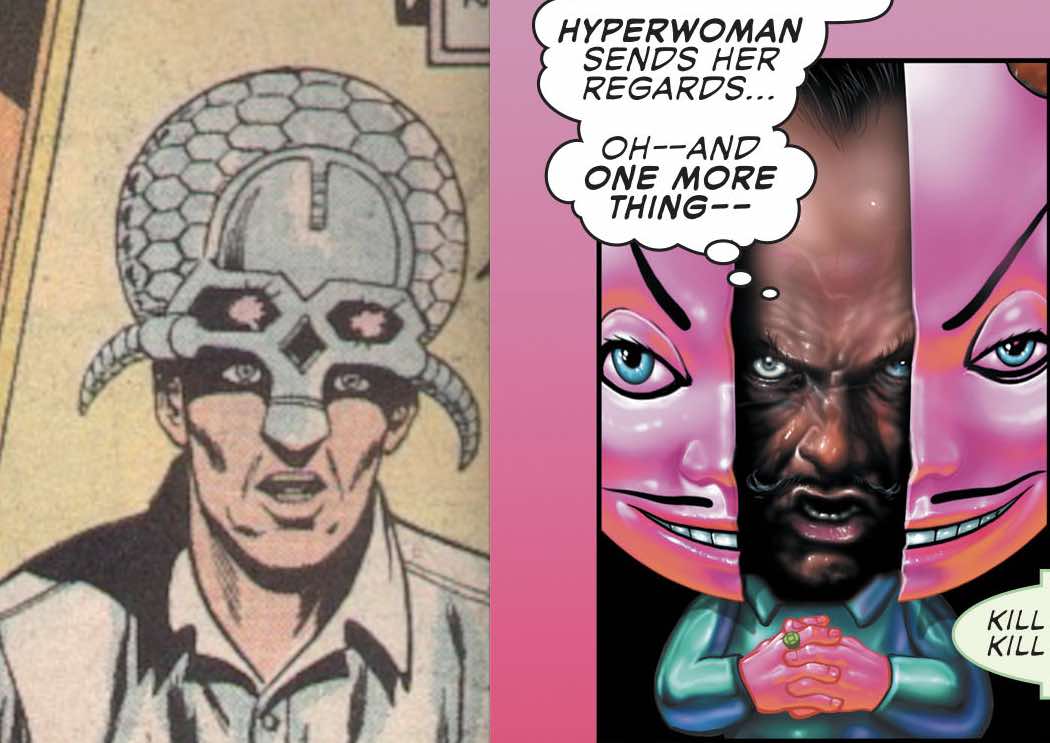
Who is the real villain here? Hyper-Woman was a Silver Age character ruined by adultification. Morrison dismisses the Young Guardians (his colleagues, until now) as “knowing everything, understanding nothing” (Season 1 #7). The chattering online fans (“i h8 u!” “terf!”) represent the Ultrawar of everyone against everyone else. Hammond is their leading voice, but he’s just a pawn. The artwork seems to pin down the answer. The latest Quing of the Nomad Empire  – a mispronunciation of “king”… “Long live the Quing!” (Season Two #4) – is depicted as an infectious virus – the perfect symbol for the Coronavirus era. From his first appearance he’s looked like a particular type of virus called a bacteriophage, but now we see him land on Hammond’s overdeveloped cranium and infect him, leaving him babbling gibberish like a virus-infected cell (perhaps bacterium). Check it out:

This story is the encounter between Hal – good old fashioned superhero comics… a vacation – and those corporate interests, but he doesn’t crush them, kill them, or eliminate them. He makes them a deal. Morrison’s message is that Hal’s style of superhero is the real, pure thing. They’re the kind of heroes that people are really looking for. Not itchy-looking brutes like Draatha (who goes down hard after bragging of his superiority) or the World of Warcraft downgrades of Fekk and Samandra (who becomes a franchise in comics, movies, and games). Superheroes. That’s the Cosmic Grail that they had and lost. They lost it because of change for change’s sake. And Hal makes them a deal. They can just have it back and profit off it forever. And all he has to do to consecrate the deal is to summon up his will and say the oath, and let it sound all over the Multiverse. Love and will. And when he’s done saying his oath, the war is over.

If they accept this, Morrison is saying of the creative conglomerates, if they let the superheroes be superheroes, they will have what they want, taking the golden lamp (a wonderful and moreover profitable source of new stories) into the over-space. Maybe Morrison’s right. And maybe they will.

In the epilogue, the Young Guardians confess that Hal was right. They were wrong to want to end his tenure. Letting Athmoora grow and advance seems to be compatible with what Hal asked – it can still be a place for vacation. Hal asks the Young Guardians – Morrison speaking of the new new crop of DC writers – “the next generation of artificial Guardians will learn from your [the 2016-2020 writers] experiences, right?” Morrison’s hoping, but also preaching.

And then it ends where it began. Asked to stay around, Hal beams himself off in a goodbye that is temporary for Hal Jordan. But this isn’t just the last page of The Green Lantern, but perhaps, of Grant Morrison’s DC work. Until if and when our paths cross again.

Sunday, March 7, 2021

The Green Lantern: Last Chapter

 The End?

With one issue and less than two weeks until the end of Grant Morrison’s 28-issue The Green Lantern, it’s clear that we’re headed for a climactic finish, quite a bit like the final two issues of Batman, R.I.P., where the hero is facing a carefully-prepared trap made just for him. It’s not just a tank of piranhas or some walls squeezing in or a vat of acid. This finale is not just about one particular gizmo or one particular scenario. This will be an existential crisis, with multiple enemies. And it’s big enough that we can’t see the broad edges around him: What will he face? Who is behind it? And is it unrelated that the Guardians have just told him that his time as a Green Lantern is basically up after this mission, and that the very way he has always operated is anathema to them? Hal Jordan is facing total doom. After all, he’s already escaped death multiple times in this run, and not just by dodging death, but actually coming back from it. The stakes in the finale are not comic book death but the total destruction of Hal Jordan.

If you’ve ever read or watched anything about the superhero genre, what I’ve just said may not move you. You know what to expect. He’ll pull victory out of nowhere. He’ll will a power ring to do something it’s never done before. He’ll defeat six entire corps of enemies with a wooden spoon. We’ve seen Morrison’s JLA give the whole human population super powers. We’ve seen Morrison’s Batman climb out of a grave. The hero wins at the end. That’s how this works, right?

Maybe. But in fact, Hal was killed out of DC Comics once before and it lasted for quite a while. And in fact, the April solicitations for DC hint that we may not be seeing any Hal comics in the coming era. When Trilla Tru says, in #11, “You okay, Jordan? It’s like you’re saying goodbye,” in fact maybe he is.

The Money Plot: Mass Consumption, Mass Destruction


There’s another thread to this story, one bigger than just Hal Jordan, that goes back to Morrison’s works early in the last decade. There’s a meta-story, as with most good DC events from the better writers over the past thirty-six years. Morrison has assiduously laid out a theme in which the bright, happy superheroes really are in trouble. There really is a threat to them, and Morrison believes it. There is a sharp turnaround from Final Crisis and Superman Beyond in which the irreducible optimism of Superman – as a fictional character – overpowers any threat on the printed page or off of it. Beginning with Action and Multiversity, Morrison depicts a real threat off the page to optimistic superheroes, one in which depressing stories prove more marketable, and we may really see these market forces in the real world put an end to the like of Hal Jordan.

I commented in my last post about TGL Morrison’s theme of this meta-enemy they associate with “mass production, mass consumption, mass destruction” of the DC superhero franchise, but I’m returning to it here because it’s hard to say anything about the run – at least since TGL Season One #9 – without putting this theme front and center. What I mentioned about this theme in my last post comes up so centrally from the first page of TGL Season Two #11 (“worthless toys… and those towers of shining glass”), and I gave the whole series a re-read looking for how this abstract theme interacts with the specific plot of TGL, to see how the former drives the latter.

First, Morrison takes many, many of the most light-hearted characters from the most light-hearted era of Silver Age comics and turns their stories dark, making some of them into psychopaths, and others into victims. The Hyperman family is the most prominent example of happy, sappy heroes turned into killers, but we also see the death of Vartox and the ghosts of the Superman, Wonder Woman, and Batman of the “perfect universe” Earth-15. We see the now-wicked Powerlord (once Power-Boy) pledge allegiance to a “Great Lah!”, a reference that confounded me until I finally, with head-slapping clarity, realized that “Lah” is “Hal” spelled backwards. We later learn that the Qwa-Man’s name is Qwa-Lah.


The meta-message is hammered home in TGL Season Two #4 when the Golden Giants of Neo-Pangaea declare that a court is in session, overseen by judges in the colors magenta, yellow, azure, and black. That’s a strange set of colors, isn’t it? Not four colors you’d likely see come up in any combination except that those are the four colors of printing – magenta, yellow, cyan, and black. These judges order Hal to submit and be destroyed and he escaped them back in #4, but their kind, the Nomad Empire, is back now, and as we’ve been warned, Hal’s going to face a worse version of them in #12. The specific reference to printer’s ink colors tells us that Morrison’s not referring to an abstract sci fi entity but something in the real world – the publishers of the comic book themselves.

Another meta-message made clear in #11 is when we, and Hal, find out that the new Young Guardians will surprisingly be leaving and be replaced soon, right after they were born and after a short reign. Hal notes, “But they’ve barely been here! You mean they changed everything and we’ll be left with the consequences?” I think here Morrison is commenting on many of the lead writers at DC in the 2015-2020 era. And throughout this run, Morrison has used the Antimatter Universe as a comment on the dark themes of the Dark Multiverse, the Joker Who Laughs. In the Hal Jordan storyline, antimatter has meant opposite and evil since the first mention of Qward in 1960. In TGL, the light-hearted Power-Boy who turns into the dark Powerlord now worships Lah – Hal spelled backwards, a representative of the evil antimatter world. Morrison has created a central plot line in this run about money, but it is about what money in the real world is doing to the comics industry.

This begins in Season One #10 when Hal says, “Some profiteers kick a hole in the antimatter border.” An Illegal antimatter mining operation blows a planet to pieces, and destroys many of the happy, positive Silver Age heroes while turning others of them evil. This is not the offhand creation of a plot device to make the story go. I suggest that this is a comment on writers (recall the printer’s ink) mining dark themes, which is lucrative (higher sales) but destructive (e.g., Vartox is killed, Hyperman and Hyperwoman become psychopathic killers). The central plot of Season Two is a critique of the direction of DC’s output over the past few years, a critique earlier seen pointedly during the Green Lantern: Blackstars interlude with the Depressoverse spawning a Batmanson whose evil, laughing Bat-family was “infectious now.”

But Morrison’s first invocation of this theme was in 2012, with Superdoomsday. The language that Morrison used then was “maximum cross-spectrum, wide-platform appeal.” This sardonic celebration of business values is echoed in TGL Season Two #2: “all-out opportunism” and the toy plot of #4, then picked up again in #11, in Samandra’s vision of “wild trolls chained to moving belts building worthless toys… and those towers of shining glass.” If the Dark Multiverse inspired Morrison to parody it as the Depressoverse, it was a development confirming the direction they saw coming well before DC: Metal began in 2017.

Moore of the Same?

In my 2018 analysis of Final Crisis, I expounded at length upon the many elements of Alan Moore’s work echoed and commented upon in FC. There, Morrison took a very different trajectory from Moore’s pessimism, particularly 1986’s Whatever Happened to the Man of Tomorrow? Now, in 2021, we see a few elements from Moore’s late-1980s work arise again.

Strikingly, Moore’s unpublished Twilight of the Superheroes had as its pivotal event a royal wedding between two “houses” of superhero, particularly involving the son of Superman to a powerful princess, Mary Marvel Jr. In TGL Season Two, the pivotal political event was a royal wedding between Hyperboy – the son of a Superman knock-off – and a powerful princess. In Moore’s story, this event would make the two families so powerful that other parties planned to start a war to prevent it. In TGL, the groom-to-be’s identity as the son of a Superman surrogate is parallel, and there is also a sense that the marriage will guarantee the power of the two families, in both cases a Superman Family to be feared, and a fear in turn, by Hyperwoman, that revelation of Hyperman’s criminal activities would cancel the wedding, and so she has to kill Hal Jordan before he can arrest Hyperman. As it turns out, the trial and conviction of Hyperman and the arrest of Hyperwoman fail to halt the wedding, which falls apart on its own. In Morrison’s story, the “success” of the dark family is doomed of its own sterility, with Hyperboy rejecting and insulting his “Shadow-Princess” bride-to-be at the altar and the two of them vowing war against one another. Mining the darkness of antimatter – or in comics – is not to be successful in the long run after all.


To return to the potent influence of WHTTMOT, the entire arc of Season Two has led us there. In Moore’s story, light-hearted Superman characters like Bizarro, Toyman, and the Prankster become homicidal. In Morrison’s, light-hearted Superman characters like Hyperman and Power-Boy become homicidal. At that point in WHTTMOT, Superman asks, “If the nuisances from my past are coming back as killers… what happens when the killers come back?” He is soon answered by the arrival of an array of his killer villains. Hal, at the end of #11, is stunned to see that the Nomad Empire, at Hyperwoman’s request, has gathered a collection of his more serious foes, including the Shark (deadly), Black Hand (virtually synonymous with death). The final attack on Superman in WHTTMOT is led by a Brainiac-possessed Luthor, featuring a weird composite of their heads, and lo, the leader of this final attack on Hal is led by Hector Hammond, with a weird superimposition of Sinestro over his head. Coincidence?

Chiaroscuro

Earlier in Season Two, we saw Hal in a seemingly fatal jam, falling from the sky at the end of #3,  when his bird-sidekicks caught him in midair. By issue #11, they have already grown to maturity and seem to leave him, and Hal is notably saddened. A family of birds referring to their guardian as “Unca Hal” – this is a lighthearted echo of Huey, Louis, and Dewey. They’ve saved him in the past. But for now, they have left him. This is the light…

…and subsequently, the dark: Hal has found himself in the most dire of circumstances. His bosses want to end his time as a Green Lantern. His foes have planned his annihilation. The entire setup on Athmoora is modeled on the darkness of Game of Thrones, from the comically parallel issue title “Contest of Crowns” to the map of multiple kingdoms and Hector Hammond saying, “Hyperwoman sends her regards” paraphrasing a key line in Game of Thrones, “The Lannisters send their regards.” In both stories it is a threat. Like Batman in Batman, R.I.P., Hal is in a trap made just for him, with a new villain asking his old villains to participate. Like Superman in WHTTMOT, this is to be Hal’s final fate.

Or will it? We know the pattern in which the hero pulls out the win at the end. We might suspect that Hal’s bird nephews will bring the light aspect of comics to him and save him once again. This is the R.I.P. ending. But how will Morrison’s view of real world “mass consumption… mass destruction” play into this? And we already know that this series ending will not be followed by another series with Hal right away. Maybe according to Morrison’s final GL issue, maybe according to the plans of the writers who take over next, this really is a grim fate awaiting Hal Jordan.

Monday, February 8, 2021

The Green Lantern, Before the End

If The Green Lantern is to be Grant Morrison’s last work writing a monthly title for DC, the final two issues should be a grand gesture, long remembered. With twenty-five of the issues behind us, what can we say of Morrison’s love letter to Hal Jordan? Where has this journey led and how will it finish?

In some regard, Morrison’s earlier runs with Batman and Superman (on Action) are two of a kind, with this Green Lantern run as the third in a set. These are not just runs that start with a story, followed by another story, then another, until there’s a last one. Morrison builds a structure. His Batman run had, primarily, three arcs, with a Big Bad lurking in the shadows until late in each run. His Action run, the shortest, had just one such season, with one primary Big Bad, Vyndktvx. Morrison’s run, thus far, organized around three distinct titles of 12, 3, and 12 issues, has had one clear Big Bad in the first, but the third has not, so far, suggested any one central villain lurking.

All of these plot lines have rosters of villains backing up the main one; sometimes they are underlings of the boss, and sometimes they are parallel, lesser, but unrelated threats. The Batman stories had Doctor Hurt and Talia as the central villains, but Ra’s al Ghul, the Joker, and Darkseid’s Hyper-Adapter and several others played major roles. In Action, Vyndktvx was the central villain, but Super-Doomsday was pivotal, the muscle in some respect, to Vyndktvx’s brains. And in The Green Lantern’s first twelve issues, the Qwa-Man, Hal’s antimatter double, is something like that for Commander Mu.

The structure even for Season One (the first twelve issues, not formally named as a season) was more complex than “seasons” of Morrison’s other runs. It appeared, near the end of issue 6, as though Commander Mu’s plan had reached fruition, and he had just about built the machine at the center of his master plot, hinted as far back as issue 1, and then… he was killed, by Alanna, no less. Furthermore, Hal and the universe as a whole were at death’s door along with him. But then, late in #12, we found out that Mu had not died (and perhaps could not die), and the plan suddenly went forward just exactly twice as far into the story as when it had seemed to have been halted the first time. And just as before, Hal was faced with imminent death. Just as before, creating, and giving to Mu, the miracle machine (Geh-Jedollah, the very same ultimate wishing machine from Final Crisis) seemed to be the only way for Hal to save his own life. And then, once again, Hal feigned compliance but at the end of the three-issue mini-season, Green Lantern Blackstars, it turned out that Hal had a massive ruse going, letting the Blackstars win in a different universe. Belzebeth believed that she would be able to fight back, but, once again, Mu had turned out to have escaped death and perhaps to be beyond death. Even fifteen issues in, the run had turned out to be a sort of Möbius Strip of repeated subplots. Has Mu won? Has Hal? Yes, no, yes, no, yes, no, yes.

For Hal, too, being on the verge of death, and actually dying, has occurred three times so far: around the midpoint of each season, and then at the end of the first. Everything is cycling; the run is not only a flashback to each of the major themes of Hal Jordan’s publication history, but a repetition of them. Old girlfriends come up early in each season. The Qwa-Man and Zundernell come up in both seasons. Marriage comes up near the end of each season. Each season has a buddy team up with a Silver Age JLA member important to Hal’s lore: first, Green Arrow; then, the Flash.

And, of course, as with Morrison’s Batman run, this run features plenty of alternate Green Lanterns; what the League of Heroes and other imitation Batmen were in that run, the Green Lantern Corps and Green Lanterns of other Earths in the Multiverse (no pair being more memorable than Batman Green Lantern and Hippie Green Lantern) are in this one. Hal succeeds where Superman and the JLA fail in Season One, manipulates and bests Superman in GL Blackstars, fights and ultimately bests the Superman surrogate Hyperman in Season Two. Repetition is everywhere, until even Hal, in Season Two #2 (two twos like Harvey Dent is behind it) says, “Feels like I’m trapped in my own history.” Morrison’s Green Lantern run is a carousel ride, repeating Hal’s history while it also repeats itself. Girlfriends, Silver Age -style sci fi plots with aliens, coming back to Earth, going back to space, buddy team-ups, the anti-universe, death, weird doppelgängers, his Guardian bosses, betrayal, defeat, victory. It all repeats, then repeats again. Morrison’s GL run is a microcosm of Hal’s publication history, but it’s also a microcosm of itself, loops upon loops.

And what is the story of Hal Jordan? Limitless talent, limitless self confidence, limitlessly prone to screwing everything up and then getting it all back again. He works as a pilot and is on the hot seat. He works for the Guardians and is on the hot seat. His knack for disobeying authority makes him the ultimate inside agent to bring down the Blackstars from the inside. He faces death and survives. He even dies and comes back. He wins over the lady and then blows it. His real romance as Green Lantern is with the power ring, personified as Pengowirr in Season One. His big scary enemy, the (yellow!) Zundernell, he shrinks down into a harmless joke. He’s a little bit comfortable in absolutely every situation and at home nowhere. In Season Two, the big universe-ending Crisis on Infinite Earths gets remixed and turns into another riff. Morrison didn’t invent any of this – it all goes back to the dawn of the Silver Age. Morrison simply refines it and repeats it. And this is the perfect time to pause and consider the story before its final arc because in the last story line, a proposal to Carol Ferris just might break the loop couldn’t do that because, as Carol said, “In the end maybe but it’s not – it’s not the end… not yet.”

This isn’t just the story of Hal Jordan. It’s also a work – potentially his last DC work, potentially a touchstone work – by Grant Morrison, and it may be following one long, slow-developing story that is taking perhaps the medium and perhaps the author on a path towards disenchantment.

After Final Crisis, Morrison’s three high-profile series have been Action, Multiversity, and The Green Lantern. FC and Superman Beyond delivered a message of optimism about the medium, that Superman was bigger than the writers, bigger than any of us, and the story of Superman drew so much power from its optimism that it was destined to go on forever. But in the three subsequent runs, we see this optimism undercut by metatextual messages in the stories as Morrison works in subplots that are about the superhero medium and the superhero as merchandise. In Action, perhaps the most ominous foe faced by Superman is Superdoomsday, “a brand” with “maximum cross-spectrum, wide-platform appeal, a violent, troubled, faceless anti-hero... a global marketing icon.” In Multiversity, The Empty Hand, symbolizing the economic pressures on the publishers and The Gentry, symbolizing the market and market forces that pervert the heroes, often, into something darker and more sensational, reinforce the message that marketing and branding would lead to something violent and troubled. And while I didn’t see it at first, I feel sure that it is significant that the agents of The Empty Hand, seemingly sweet and benign but dark and possessed were the Little League of Earth-42. Above all others, these are the versions of the DC characters aimed directly at the youngest, most innocent readers. And is there a common thread here? Yes, definitely: The Little League first met darkness when Superdoomsday from Earth-45 arrived and killed their Superman. And by the time we see them in Multiversity Guidebook, they are evil, possessed, red-eyed agents of marketing as perverted into darkness.


And now, in The Green Lantern, two subplots echoed and built upon this pessimism. First, the darkly satirical metatexual opening to GL Blackstars #2 amplifies the grim tone of Heroes in Crisis, the Dark Multiverse, and other works, with a Depressoverse, culminating with a clearly Batman Who Laughs -inspired Batmanson who is infectious, making the real Batman, the paragon of conviction in the DC Universe, “give in.” Later, quite parallel to the Little Leaguers, the team-up with the Flash in TGL Season Two #4 introduces Hal and Barry and Olivia Reynolds to an enemy world of toys. The world itself is a toy, smelling of “canned plastic” and ultimately, Olivia’s career expertise in toys allows her to defeat them, but not before we see how dark these toys are in a very modern way, “beta-testing” the heroes, play until they break, and when the lead toy, Quing, is broken, how unsympathetically he is replaced with one of the others as the new Quing.

In all of this, we see the underlying optimism – an affirmation of the superhero medium – turn to a darker metatextual comment with marketing as the enemy that may corrupt superheroes for once and for all. And it may not be coincidental that this message has picked up pace now as Morrison is, perhaps, moving on.

And so, a run that is full of repetition is going to stop repeating soon, because the end is coming. The big finale (#11 and #12) will take place on Athmoora, a world first shown in two panels of GL #16 back in 1962. Morrison places Hal on Athmoora in Season One #9, where Hal visits just for the fun of the adventure of brawling in combat where his ring is weakened. That is one of astonishingly many times in the run that Hal has voluntarily forsaken the security of his ring, confident in his ability to face danger in any circumstance. Now he returns to that danger again. If we have just two issues left of new Morrison monthlies to enjoy, I will be enjoying them and looking forward to seeing on what directions he takes Hal and us in his finale.

Saturday, March 16, 2019

Green Lantern 2-5


1972's Starbreaker and his Daughter, Belzebeth
Take a writer. Take an established character. The run that results is going to reflect both of them, who the two of them have traditionally been. And then there are creative choices, where the writer chooses among possibilities. The Grant Morrison Batman of 2006 was not the Grant Morrison Batman of Arkham Asylum or Gothic and Morrison's Hal Jordan of 2009 is one out of maybe several choices he might have made. If it's a recipe, it's a stew, with lots of tasty things thrown in. So far, it's been a feast.

The Legend

Hal Jordan to some extent fits a template that Batman or Superman can fit but Animal Man cannot: He is an alpha character. Most superheroes seem super in the world of their own stories, but some of them are on a higher level. Superman at his best is the best and most famous and accomplished being in the history of the Universe. Batman at his best is unbeatable. Hal Jordan at his best is the most confident and capable hero who's ever wielded a power ring – the champion not just of his planet and time, but all planets and all times, capable of transcending fear and doubt in an absolute way.

Other writers have weakened Hal, making him a troublemaker, hapless at love, a drifter who can't hold a steady job, the predictable stiff who can't be as interesting as John Stewart or Guy Gardner, and even a drunk driver and psychotic killer.

Morrison can put Hal into heroic situations and ignore those weaknesses in his past, but instead, he's opening them up, acknowledging them, redeeming them. The heroic situations are many, to be sure, and provide pleasure after pleasure. It begins in #1 with Hal doing nothing but observe in amusement as the meganthrope destroys himself. Since then, he's gone on a tear of victory after victory. He doesn't fail, can't fail. He wins on the field of action, he enters every situation with unfailing confidence. Morrison is making Hal supreme in ways we've never seen before, superb as a detective, student of the cultures and civilizations of the 3600 space sectors, and even in the interrogation room.

But we also see Hal moving past the ghosts of his past. He dismisses his career failures as unimportant. He isn't, as the 1960 formulation of Hal went, utterly without fear, but, as he tells Countess Beelzebeth, "you have to know fear to overcome it, own it. Turn it into something you can use." He has been possessed by a demon, and having moved past that, has no inner demons. Geoff Johns, in Green Lantern: Rebirth explained Hal's greatest failings away, made them not really his fault. Morrison goes further, redeeming Hal totally. It's not just that he's not to blame. He's even better now because of his earlier defeats.

I missed posting single-issue responses, so I did not have time to dwell on, as I would have, the seeming anomalies along the way where Hal's rectitude was brought into question – most strikingly when we saw him execute a prisoner from Dhor at the end of #3. As we now know, this was part of a ruse, taking Hal's extremely-well-established trope of being in trouble with the Guardians and using it as a way for him to infiltrate the Blackstars. The haunting foreshadowing at the end of #1 about a traitor in the Green Lantern ranks turned out to be Hal, carrying out that ruse. Specfically, Morrison is creating one instance in which Hal, purportedly a traitor, is really acting from a position of good and within the system. Symbolically, Morrison is redeeming a history of bad behavior by Hal. He is a winner and none of the past charges stick.

The triumphs, then, in The Green Lantern are absolute ones, and follow a time-tested formula of showing the hero besting not only his ordinary enemies, but even extraordinary ones, and surpassing his fellow heroes. Thus, when Earth is shrunken and stolen (one may recall that Metropolis was shrunken and stolen at a comparable moment in Morrison's Action run), Morrison took Hal's rescue to new (and blasphemous) heights, with Hal Jordan putting what looked like the Christian God under arrest – a (symbolic) superfeat for the ages. Less of an affront to a major world religion but perhaps more significant in Morrison's worldview, the same issue also shows Hal as triumphant in wrestling Earth from the false god while Earth's other top-tier superheroes (including Superman, Batman, Wonder Woman and – particularly relevant to the GL Corp – John Stewart) were helpless to save the planet. Then, as yet another token of Jordan's supremacy, we see him put the entire population of Earth under arrest (whatever that means). In a tie-in to our times, Morrison serves up social commentary by implying that the population of the world, bent by mind control to accept their capture, didn't rightly know what they were choosing and "drunk in charge of an planet… jeopardizing their own lives and future generations" needed to be set straight by Hal – there's a deliberate parable there for political events in recent years.

The Mythology

While Hal is the single dominant figure in the story, the cast is not small. Tapping Hal's publication history, Morrison has gone broader than one might have imagined. Yes, Hal's up and down personal life (once represented by an unstable professional career, later leading to mass murder and death) has been mentioned, as well as other traits such as loose liaisons with romantic partners. And yes, we have seen quite an imaginative use of the vast GL Corps, freely borrowing from the imaginative output of earlier writers (Rot Lop Fan, the sightless, acoustic-based F-Sharp Bell created by Alan Moore) as well as offering some new GLs and twists on some old ones. But broader still, Morrison has drawn upon the sci-fi Silver Age as a whole, with villains from Dhor (introduced with Kanjar Ro in JLA #3). A particular emphasis has been paid to the legacy of Starbreaker, a JLA super-foe from JLA #96-98, a cosmic vampire who vastly outpowered Superman, Hal, and Barry before pausing to feast upon the Earth. Starbreaker's original cover art was used as the inspiration for Morrison's Mandrakk. (On a personal note, that story was a bit before my time, but I found the cover so cool that it was, I think, the very first older issue of a comic that I ever bought from a used comic store just because it looked interesting.) Here, Starbreaker's daughter, Countess Belzebeth (named for the Old Testament's Baalzebub with a feminine suffix tacked on) seeks revenge with a particularly bitter memory, Hal anticipates, for the way Green Arrow shot her father with a silver arrow in JLA #98.

At the close of #5, we see Adam Strange, the latest example that, for all of the expanse of Green Lantern history to choose from, it's clear that Morrison has some favorites, with a lot of focus on characters from the 1959–1965 era from which Hal himself originated.

Cop Shows

Contributing some drama, and quite a bit of humor, sometimes in the same panel, Morrison has imbued this run with the superficial qualities of a trope-heavy TV cop show. Morrison's fine ear for dialogue has resulted in some hilarious uses of these clichés, perhaps best when the false God, threatened with arrest, tells Hal, "Thos shalt ne'er make thine acusation stick." It's probably not a coincidence, either, that Hal works with GL Tagort in issue #4, and a British TV cop from Morrison's own Glasgow was named Taggart.

The Big Bad

Morrison's Batman run was as pure an example as you could imagine of an extended story with one central villain behind it. While the Joker, the al-Ghuls, and some minor figures popped up from time to time, the great majority of Batman's troubles there were due to a massive plan emanating from Doctor Hurt. To different extents, some of his other runs have also built up to a pivotal encounter between his heroes and one, profoundly menacing villain, someone worthy of demonstrating the ability of any hero who could defeat them.

In Morrison's run, Controller Mu is referenced at the end of the first issue. Mu is working on multiple threats at once. In order to construct the "ultimate asset," an ultimate will-powered weapon, requires obtaining five different components, of which a Luck Dial was second and Evil Star's starband the third. Component one was already in their grasp, an antimatter being that was apparently alive and formidable: They obtained it from a moth world, as seen in flashback in #4. It killed several pirates before they subdued it, then ambushed Green Lanterns Maxim Tox and Chriselon. This is apparently what they vivisect for its heart at the end of issue #1, an Antimatter Lantern that curious resembles Hal.

If they only have three of the five, we have to expect something big. Hal gave the Darkstars his ring, which seems likely to contribute, but since it was a ruse from the beginning, it is unlikely that he and the Guardians are knowingly (literally) handing them a victory. Either this ring is spiked somehow or they have a sure way to stop Controller Mu from getting/after getting the fifth component.

Whatever that ultimate weapon is, it suggests Morrison's use of this idea in Final Crisis, realized into an ultimate wishing machine (itself originating in a Sixties LSH story). Will-powered weapons are one of the roots of superhero comics (and certainly, centuries of stories before that) and Morrison seems sure to make a grand use of this idea before the run is done.

Multihero

There's a point in superhero comics where the creators really have fun with the hero by putting them in multiple, unusual situations, showing the hero's flexibility. There might be a hundred stories where Superman or Batman were cast as some sort of wild variant on what they normally are – a pirate, a cowboy, a magician, a movie star. Return of Bruce Wayne encapsulated that into a single work. But while that's old hat for Superman and Batman, Morrison is doing something we haven't seen much of with Hal in that position, showing him not only as a tough cop (the focus of the series), but in quicker, temporary roles as a noir figure (undercover in #4) and in a wildly un-Green-Lantern-like goth scenario on the planet of the vampires. Seeing a couple of these makes it seem likely that we'll see more, and I couldn't pretend to guess which ways that will go. Pirate Hal? Cowboy Hal?

Pending

Clearly, there's a design here for a story that will take a year or more to come around to where Morrison is planning. Hal ends #5 in a cliffhanger where he has to kill Adam Strange in order to continue his ruse. The teasers at the end of issue #1 are largely untapped, so there's a vast Multiversal storyline still ahead. We will see Controller Mu build his power and offer an ultimate challenge for Hal. There's a traitor within the Green Lantern ranks. And the free will of Hal vs. the authority of the Guardians remains a tension that could turn into something bigger. The Guardians have told Hal that if his undercover mission goes bad, they will disavow him. What could be a more ultimate challenge than to have the source of his powers revoked, and need to escape unjust persecution?

A decade back, Geoff Johns wrote a Hal run of 75 issues (plus lots of extras) that was truly for the ages. Now his friend Grant Morrison is on a mission to write Hal a new, defining epic. If it remains self-contained – no big crossovers like Darkest Night – it may not capture fan attention on the level of a Batman or JLA run or Johns' GL, but it has begun as compelling and well-balanced as any of Morrison's earlier big runs. I'll be sitting back and enjoying.