Showing posts with label green lantern. Show all posts

Tuesday, November 16, 2021

Jon Kent: Man of Tomorrow?

They married 58 years after they first met. Superman and Lois Lane certainly had a long courtship, so it’s not surprising that they took another 19 years before having their first child.

For decades and decades, the status quo of Superman and Lois Lane turned so slowly you might have thought it was going backwards, and in fact, sometimes it did go backwards. They had fake weddings, imaginary story weddings, weddings on alternate Earths. In one line of stories, Superman had a son whom we saw and a wife who seemed to be Lois but whose back was always to the camera. They had a son on the last page of a famous imaginary story, an adopted son who was written out of history, had Jon Kent in a reality that was written out of history, and there were so many stories whose reality was considered to be imaginary or not, or hinted to be imaginary or not that even a DC editor couldn’t possibly keep track of which stories were asserted when to be real.

For over half a century, writers made Superman into the ultimate bachelor wary of commitment, and even now that he’s definitely married with a son, if you wanted to collect the issues where revealing his identity to Lois, the engagement, marriage, and birth occurred, you’d end up with a curiously thick stack where those events happened, then were altered or revised. However, if you want a quick summary of the lifetime that never actually unfolded in a single version of continuity, there’s an 11-panel spread in Action Comics #976 that gives you the latest story of how Clark and Lois met, married, and had a child. Then the way that their son grew up in space, on an alternate Earth, and in the future is another story or two.

Then, suddenly, in four years, Jon Kent was born, grew up, and became Superman, sort of replacing Chris Kent, sort of replacing Connor Kent, sort of replacing both teenage and then adult Clark Kent.

I establish all of this curious timeline to set the context for today’s big news regarding Jon Kent’s one-panel kiss, which has been and will be variously portrayed as either the biggest cultural change in comics or no big deal at all, and for those seeing a cultural earthquake in it, will be variously portrayed as a very good thing or a very bad thing.

And given the shifting pace of change over Superman’s 83 years, I see it as a very precarious thing. What happens now has an undeniable tendency to unhappen or rehappen. Just as DC was for decades extremely reluctant to allow Clark to commit to Lois, DC is now extremely reluctant to allow anything to happen without a high chance of unhappening. And they have, I believe, creatively painted themselves into a corner. One way or another they have to change their ways, and I’m not sure that decision makers inside the company see that yet.

When the news about Jon Kent’s orientation broke last month, I thought of Sam Zhao as a cautionary tale. Do you remember the name Sam Zhao? Does anyone?

In 2012, the New 52 version of Earth 2 introduced an old-yet-new version of Alan Scott, young and in his prime like the original was back in 1940. Very soon, we learned that Alan Scott was a gay man with a partner and fiancé named Sam Zhao, who promptly died (one issue after his introduction!), then was resurrected as a sort of elemental spirit. Sam Zhao’s last appearance was in 2015, Sam having lost, in rapid fashion, his life, his planet (literally destroyed), and then their entire plane of reality. The 2012 Alan Scott was erased. The previous Alan Scott (it becomes tedious even to enumerate all the previous Alan Scotts, who were variously discontinued, killed, resurrected, renamed, banished to Valhalla, and so on) then became a sort of symbol for the destructive retcons of the DC Multiverse, with Dr. Manhattan’s erasure of Alan Scott’s life as Green Lantern becoming retroactively the single symbolic act of creating the pre-Doomsday Clock timeline. Dr. Manhattan brought that timeline back. But then even Doomsday Clock didn’t happen, and even the timeline after Doomsday Clock has now unhappened, and that was only 2019! Then for good measure, the current version of Alan Scott (who closely resembles the post-Infinite Crisis Alan Scott) earlier this year came out as gay like it was new (because in a sense it was). Sam Zhao and his version of Alan Scott are buried deep behind multiple numbers of destroyed past realities, like a sheet on a bulletin board papered over by newer announcements many times. And so I say, beware to Jon Kent, or to Jon Kent’s creators.

Sam Zhao was [that specific] Alan Scott’s Lois Lane, but Lois Lane remained Superman’s love interest for decades and Sam Zhao appeared alive on only three pages of one issue. And in various ways, Sam Zhao is a Lois Lane for our times, while Jon Kent is a [2012] Alan Scott for our times. DC’s creators want to do something momentous and meaningful with Jon Kent as they did with Alan Scott, but the persistence in sticking out creative decisions is a proclivity or capacity that DC has perhaps lost.

Let’s look at the timelines again. DC took 77 years from the introduction of Superman to the introduction of Jon Kent as his then-infant son, but only 6 years from the introduction of Jon Kent to his succession as the Earth’s primary Superman (and, making more headlines, as a bisexual young man). That’s a remarkable acceleration, and in the new, accelerated DC, a “Lois Lane” might only survive three pages. Sam Zhao’s entire planet was destroyed within two years, and his timeline gone soon after that. To turn this pragmatic, let us identify, finally, what caused this acceleration, from Superman revealing his identity to Lois back in 1991, through Superman’s death, resurrection, their marriage, and all the many reboots that made Lois and Clark’s marriage and Chris Kent and Sam Zhao come and go – big events drive sales.

This is the corner into which DC has painted itself. They, and many readers, celebrate the ascension of Jon Kent, and his identity, and what that means for representing so much of humanity on the stage of DC’s historical flagship property. This is the gesture made halfheartedly nine years ago with the immediately-doomed Sam Zhao. This gesture is at odds with the reality (or metareality) within DC since about 2006, that accelerated and increasingly accelerating change is a booster shot needed for keeping the readership reading. If DC now shuffles Jon Kent off to the limbo where Chris Kent, Sam Zhao, and the 1978 marriage of Earth Two Superman and Lois dwell, they retract a major statement of representation. If they lock Jon Kent in as he is today, they lose the creative strategy that has defined the last 15 or so years of DC, to reinvent constantly. One of these has to go.

There is, perhaps, another way. To consider yet another major DC brand’s invention and reinvention, the main Flash in DC Comics was Barry Allen for thirty years, but then changed hands four times in three years, when in 2006’s Infinite Crisis Wally gave way to a brief interlude with Jay Garrick, then Bart Allen, then Bart to Wally, and Wally back to Barry. But then Barry stuck around for a while. Let’s forget for a moment that along the way, Wally switched dimensions, Bart died and was resurrected (along with his friend Connor Kent, who is another character coming and going through a wildly-revolving door), and then “Wally” was reintroduced as a boy with the same name but another race, came back to our reality, became a tormented and possibly homicidal cinder of his former self, but then became a healthy and happy superhero and the main Flash again… Yes, there is another way, a return to stable timelines and realities, but as the case of the Flashes demonstrates, DC has neither the proclivity nor capacity to take it.

Let us add one more undeniably true observation of pragmatics: Nobody planned any of this mad scramble of timelines and characters and lives and deaths. A writer may have a year or two planned, but that writer moves on, and the juice that has kept sales up necessitates 180° turns when the next writer comes along. This isn’t any one writer’s or editor’s decision. Continuity has become a blender set to “liquify” and perhaps nothing can survive it for long, though every now and a second 180° turn undoes a previous one and we end up, for a while, back where we were, and so Alan Scott is re-introduced to us as gay – twice.

Jon Kent’s orientation is too important of a statement for DC to erase the way they annihilated Sam Zhao, but the blender’s slicing and dicing blades haven’t stopped for anyone. Jon Kent’s timeline or reality or status will change, and there’ll be 180° turns – plus ça change, plus c'est la même chose. In 2031, DC Comics will most likely still have a Jon Kent, and he’ll most likely “still” be LGBTQ, but will he be in the main Superman title? Will his life be rebooted back to conception and birth and start up from scratch again? Will he, like Alan Scott, come out twice? And will anyone, in 2031, be able to tell you who Jay Nakamura was?

Monday, March 15, 2021

The Green Lantern Season Two #12

On the last page, the hero flies off. We may not see him again anytime soon. He doesn’t know where his path will take him. Yes, that’s a statement about Hal Jordan, but it’s also a statement (give or take pronouns?) about Grant Morrison, and not an accidental one. Morrison, who identified with and championed Batman so intimately a decade ago fully took the Hal Jordan character to heart and for as long as this run has lasted, it’s been a statement that Jordan is Morrison’s champion, and that he is worth of being ours. And so, Morrison’s send-off is Hal’s send-off. For now.

For such a landmark issue, The Green Lantern Season Two #12 is remarkably formulaic for much of its story. Someone powerful faces off against Hal and Hal tells them, in essence, Fight with me or lose. He’s always right about that and he knows that he’s right about that. Earlier, I compared this upcoming ending to the end of Morrison’s Batman run, but Batman was beaten low, unconscious, out of his mind. Hal really never stops smirking at any point in this issue. He doesn’t negotiate with enemies; he threatens them, and along the way, he belittles them; he informs them that he has absolute control over the outcome of the conflict. “The ‘Golden Ones’ – I figured you’d show up eventually. You shouldn’t have… and you’ll wish you hadn’t.” Hal wins over his allies and takes down his enemies in sequence: Draatha, the supervillain surrogates, a brainwashed and transformed Fekk and Samandra, Hector Hammond, and finally the Golden Giants – and by extension, offscreen, Hyperwoman. Each time, Hal states the outcome in advance. Fekk and Samandra join him. The Golden Giants accept a deal. The others go down in a fight. Hal barely, at any point, seems worried. Ultimately, he wins with whatever weapon he uses against whatever other weapon. If his enemy has a massive space fleet and Hal has a sharp rock, Hal will win. Hal wins because he’s a winner and this is his story. This isn’t a clinic on combat techniques. It isn’t really about the way the Intelligence Engine (the issue’s title) works or how it selectively interferes with the power ring. It’s a parable about the comics industry and the hero genre itself. Everybody represents a larger class. The fighting always goes Hal’s way. The real story is in the talking.

As we’ve seen with other Morrison works, many supporting characters are drawn from DC lore that hasn’t been thought of as in-continuity in quite some time, but Morrison changes the original conceptions profoundly. I came into this run expecting that, perhaps, we would see many such characters from Hal’s past, but we rather saw many characters from throughout the Silver Age, but not specifically from Green Lantern, Volume 2 (1960-). The Hyper-Family debuted as heroes in Superboy. The Golden Giants debuted as antagonists in Flash. These characters look like their original versions but, like Doctor Hurt with respect to the unnamed doctor from which he originated, are profoundly corrupted: Hyperman and Hyperwoman turned from happy, smiling superheroes into psychopaths while the Golden Giants turned from primitive brutes into tyrants. Athmoora, from an Abin Sur scene in an early Hal story, is also rooted, stylistically in the past, but Morrison doesn’t change it so much as he makes it dirtier and grittier. In the 1962 original, Athmoora was a planet in the present that remained stuck in a medieval past, with knights fighting in swordplay – but not too busy to stop and explain to Abin Sur that alien invaders had stolen their “I-Factor” which trapped them in a less developed state rather than progressing.

The irony is that Hal Jordan was created as a representation of futuristic technology – a test pilot only years after the sound barrier had first been broken – but TGL Season Two is a parable about past and present. And it’s necessary to tease apart how these different takes on the past interrelate. We have the Golden Giants rooted in prehistory (25 million years ago, Flash #120 says) but they represent nothing from the past so much as a timeless greed. Athmoora, literally in the present but living in the style of hundreds of years ago, represents the style of superhero comics produced in the Silver Age but representing something that Morrison values today. Characters like Vartox (destroyed) and Hyper-Man (now evil) represent those Silver Age value corrupted and diminished. This is similar to how Morrison depicted the downfall of Earth-20’s Society of Super-Heroes, with everything going wrong as soon as the Atom killed a man. The Silver Age bit performers, the Golden Giants, and Athmoora’s warriors are the players representing the past but what of the present?

Every now and then a Morrison story has a line that doesn’t seem to fit – something jarring, out of character, or otherwise defying the expected logic – and, not seeing the reason for them, I read on, but there’s usually a very good explanation for them in the end. And in #12, that line is Hector Hammond saying, “I was an ordinary person once. Ordinary like you. Like all of us.” And then later, “I get to kill a superhero. Admit it! Wouldn’t you want to kill a superhero?” And the simple question is: Who is “you”? To whom is Hector Hammond narrating? And the answer is, us. Some of us, at least. And it’s Hal talking back to those who want to see his style of superhero destroyed when he asks Hector, in rage, “You did all this just to kick over my sandcastle?”

That’s Hal, the erstwhile man of the future, now a man of the past in certain ways, talking back to those – fans and creators – who want to see Athmoora destroyed. For what is Athmoora? The answer is way back in Season One #9. On Athmoora, the ring sassily says to Hal, “I don’t know why we come here” and Hal answers, “Don’t know about you. I came for a vacation.” And that, 18 issues back, is the simple answer to the simple pleasure that Morrison is standing up for in this parable. Why the hell does anyone pick a comic book up, anyway? Hal came for a vacation. An escape. Didn’t you?

The Young Guardians (recent DC writers), the Golden Giants of the Nomad Empire (the corporate control of creativity and “change for no sake other than change itself”), and Hector Hammond (the creators and fans who have nothing but disdain for this sort of comic) are ready to kick over the sandcastle, end the vacation, end the escape, and move on for no sake other than change itself. This is why Morrison showed Earth-15 with its dead Superman, Batman, and Wonder Woman. This is the Depressoverse. This is the ugly revamp of Fekk and Samandra into gaudy video game characters (they drop terminology from World of Warcraft).


Who is the real villain here? Hyper-Woman was a Silver Age character ruined by adultification. Morrison dismisses the Young Guardians (his colleagues, until now) as “knowing everything, understanding nothing” (Season 1 #7). The chattering online fans (“i h8 u!” “terf!”) represent the Ultrawar of everyone against everyone else. Hammond is their leading voice, but he’s just a pawn. The artwork seems to pin down the answer. The latest Quing of the Nomad Empire  – a mispronunciation of “king”… “Long live the Quing!” (Season Two #4) – is depicted as an infectious virus – the perfect symbol for the Coronavirus era. From his first appearance he’s looked like a particular type of virus called a bacteriophage, but now we see him land on Hammond’s overdeveloped cranium and infect him, leaving him babbling gibberish like a virus-infected cell (perhaps bacterium). Check it out:

This story is the encounter between Hal – good old fashioned superhero comics… a vacation – and those corporate interests, but he doesn’t crush them, kill them, or eliminate them. He makes them a deal. Morrison’s message is that Hal’s style of superhero is the real, pure thing. They’re the kind of heroes that people are really looking for. Not itchy-looking brutes like Draatha (who goes down hard after bragging of his superiority) or the World of Warcraft downgrades of Fekk and Samandra (who becomes a franchise in comics, movies, and games). Superheroes. That’s the Cosmic Grail that they had and lost. They lost it because of change for change’s sake. And Hal makes them a deal. They can just have it back and profit off it forever. And all he has to do to consecrate the deal is to summon up his will and say the oath, and let it sound all over the Multiverse. Love and will. And when he’s done saying his oath, the war is over.

If they accept this, Morrison is saying of the creative conglomerates, if they let the superheroes be superheroes, they will have what they want, taking the golden lamp (a wonderful and moreover profitable source of new stories) into the over-space. Maybe Morrison’s right. And maybe they will.

In the epilogue, the Young Guardians confess that Hal was right. They were wrong to want to end his tenure. Letting Athmoora grow and advance seems to be compatible with what Hal asked – it can still be a place for vacation. Hal asks the Young Guardians – Morrison speaking of the new new crop of DC writers – “the next generation of artificial Guardians will learn from your [the 2016-2020 writers] experiences, right?” Morrison’s hoping, but also preaching.

And then it ends where it began. Asked to stay around, Hal beams himself off in a goodbye that is temporary for Hal Jordan. But this isn’t just the last page of The Green Lantern, but perhaps, of Grant Morrison’s DC work. Until if and when our paths cross again.

Sunday, March 7, 2021

The Green Lantern: Last Chapter

 The End?

With one issue and less than two weeks until the end of Grant Morrison’s 28-issue The Green Lantern, it’s clear that we’re headed for a climactic finish, quite a bit like the final two issues of Batman, R.I.P., where the hero is facing a carefully-prepared trap made just for him. It’s not just a tank of piranhas or some walls squeezing in or a vat of acid. This finale is not just about one particular gizmo or one particular scenario. This will be an existential crisis, with multiple enemies. And it’s big enough that we can’t see the broad edges around him: What will he face? Who is behind it? And is it unrelated that the Guardians have just told him that his time as a Green Lantern is basically up after this mission, and that the very way he has always operated is anathema to them? Hal Jordan is facing total doom. After all, he’s already escaped death multiple times in this run, and not just by dodging death, but actually coming back from it. The stakes in the finale are not comic book death but the total destruction of Hal Jordan.

If you’ve ever read or watched anything about the superhero genre, what I’ve just said may not move you. You know what to expect. He’ll pull victory out of nowhere. He’ll will a power ring to do something it’s never done before. He’ll defeat six entire corps of enemies with a wooden spoon. We’ve seen Morrison’s JLA give the whole human population super powers. We’ve seen Morrison’s Batman climb out of a grave. The hero wins at the end. That’s how this works, right?

Maybe. But in fact, Hal was killed out of DC Comics once before and it lasted for quite a while. And in fact, the April solicitations for DC hint that we may not be seeing any Hal comics in the coming era. When Trilla Tru says, in #11, “You okay, Jordan? It’s like you’re saying goodbye,” in fact maybe he is.

The Money Plot: Mass Consumption, Mass Destruction


There’s another thread to this story, one bigger than just Hal Jordan, that goes back to Morrison’s works early in the last decade. There’s a meta-story, as with most good DC events from the better writers over the past thirty-six years. Morrison has assiduously laid out a theme in which the bright, happy superheroes really are in trouble. There really is a threat to them, and Morrison believes it. There is a sharp turnaround from Final Crisis and Superman Beyond in which the irreducible optimism of Superman – as a fictional character – overpowers any threat on the printed page or off of it. Beginning with Action and Multiversity, Morrison depicts a real threat off the page to optimistic superheroes, one in which depressing stories prove more marketable, and we may really see these market forces in the real world put an end to the like of Hal Jordan.

I commented in my last post about TGL Morrison’s theme of this meta-enemy they associate with “mass production, mass consumption, mass destruction” of the DC superhero franchise, but I’m returning to it here because it’s hard to say anything about the run – at least since TGL Season One #9 – without putting this theme front and center. What I mentioned about this theme in my last post comes up so centrally from the first page of TGL Season Two #11 (“worthless toys… and those towers of shining glass”), and I gave the whole series a re-read looking for how this abstract theme interacts with the specific plot of TGL, to see how the former drives the latter.

First, Morrison takes many, many of the most light-hearted characters from the most light-hearted era of Silver Age comics and turns their stories dark, making some of them into psychopaths, and others into victims. The Hyperman family is the most prominent example of happy, sappy heroes turned into killers, but we also see the death of Vartox and the ghosts of the Superman, Wonder Woman, and Batman of the “perfect universe” Earth-15. We see the now-wicked Powerlord (once Power-Boy) pledge allegiance to a “Great Lah!”, a reference that confounded me until I finally, with head-slapping clarity, realized that “Lah” is “Hal” spelled backwards. We later learn that the Qwa-Man’s name is Qwa-Lah.


The meta-message is hammered home in TGL Season Two #4 when the Golden Giants of Neo-Pangaea declare that a court is in session, overseen by judges in the colors magenta, yellow, azure, and black. That’s a strange set of colors, isn’t it? Not four colors you’d likely see come up in any combination except that those are the four colors of printing – magenta, yellow, cyan, and black. These judges order Hal to submit and be destroyed and he escaped them back in #4, but their kind, the Nomad Empire, is back now, and as we’ve been warned, Hal’s going to face a worse version of them in #12. The specific reference to printer’s ink colors tells us that Morrison’s not referring to an abstract sci fi entity but something in the real world – the publishers of the comic book themselves.

Another meta-message made clear in #11 is when we, and Hal, find out that the new Young Guardians will surprisingly be leaving and be replaced soon, right after they were born and after a short reign. Hal notes, “But they’ve barely been here! You mean they changed everything and we’ll be left with the consequences?” I think here Morrison is commenting on many of the lead writers at DC in the 2015-2020 era. And throughout this run, Morrison has used the Antimatter Universe as a comment on the dark themes of the Dark Multiverse, the Joker Who Laughs. In the Hal Jordan storyline, antimatter has meant opposite and evil since the first mention of Qward in 1960. In TGL, the light-hearted Power-Boy who turns into the dark Powerlord now worships Lah – Hal spelled backwards, a representative of the evil antimatter world. Morrison has created a central plot line in this run about money, but it is about what money in the real world is doing to the comics industry.

This begins in Season One #10 when Hal says, “Some profiteers kick a hole in the antimatter border.” An Illegal antimatter mining operation blows a planet to pieces, and destroys many of the happy, positive Silver Age heroes while turning others of them evil. This is not the offhand creation of a plot device to make the story go. I suggest that this is a comment on writers (recall the printer’s ink) mining dark themes, which is lucrative (higher sales) but destructive (e.g., Vartox is killed, Hyperman and Hyperwoman become psychopathic killers). The central plot of Season Two is a critique of the direction of DC’s output over the past few years, a critique earlier seen pointedly during the Green Lantern: Blackstars interlude with the Depressoverse spawning a Batmanson whose evil, laughing Bat-family was “infectious now.”

But Morrison’s first invocation of this theme was in 2012, with Superdoomsday. The language that Morrison used then was “maximum cross-spectrum, wide-platform appeal.” This sardonic celebration of business values is echoed in TGL Season Two #2: “all-out opportunism” and the toy plot of #4, then picked up again in #11, in Samandra’s vision of “wild trolls chained to moving belts building worthless toys… and those towers of shining glass.” If the Dark Multiverse inspired Morrison to parody it as the Depressoverse, it was a development confirming the direction they saw coming well before DC: Metal began in 2017.

Moore of the Same?

In my 2018 analysis of Final Crisis, I expounded at length upon the many elements of Alan Moore’s work echoed and commented upon in FC. There, Morrison took a very different trajectory from Moore’s pessimism, particularly 1986’s Whatever Happened to the Man of Tomorrow? Now, in 2021, we see a few elements from Moore’s late-1980s work arise again.

Strikingly, Moore’s unpublished Twilight of the Superheroes had as its pivotal event a royal wedding between two “houses” of superhero, particularly involving the son of Superman to a powerful princess, Mary Marvel Jr. In TGL Season Two, the pivotal political event was a royal wedding between Hyperboy – the son of a Superman knock-off – and a powerful princess. In Moore’s story, this event would make the two families so powerful that other parties planned to start a war to prevent it. In TGL, the groom-to-be’s identity as the son of a Superman surrogate is parallel, and there is also a sense that the marriage will guarantee the power of the two families, in both cases a Superman Family to be feared, and a fear in turn, by Hyperwoman, that revelation of Hyperman’s criminal activities would cancel the wedding, and so she has to kill Hal Jordan before he can arrest Hyperman. As it turns out, the trial and conviction of Hyperman and the arrest of Hyperwoman fail to halt the wedding, which falls apart on its own. In Morrison’s story, the “success” of the dark family is doomed of its own sterility, with Hyperboy rejecting and insulting his “Shadow-Princess” bride-to-be at the altar and the two of them vowing war against one another. Mining the darkness of antimatter – or in comics – is not to be successful in the long run after all.


To return to the potent influence of WHTTMOT, the entire arc of Season Two has led us there. In Moore’s story, light-hearted Superman characters like Bizarro, Toyman, and the Prankster become homicidal. In Morrison’s, light-hearted Superman characters like Hyperman and Power-Boy become homicidal. At that point in WHTTMOT, Superman asks, “If the nuisances from my past are coming back as killers… what happens when the killers come back?” He is soon answered by the arrival of an array of his killer villains. Hal, at the end of #11, is stunned to see that the Nomad Empire, at Hyperwoman’s request, has gathered a collection of his more serious foes, including the Shark (deadly), Black Hand (virtually synonymous with death). The final attack on Superman in WHTTMOT is led by a Brainiac-possessed Luthor, featuring a weird composite of their heads, and lo, the leader of this final attack on Hal is led by Hector Hammond, with a weird superimposition of Sinestro over his head. Coincidence?

Chiaroscuro

Earlier in Season Two, we saw Hal in a seemingly fatal jam, falling from the sky at the end of #3,  when his bird-sidekicks caught him in midair. By issue #11, they have already grown to maturity and seem to leave him, and Hal is notably saddened. A family of birds referring to their guardian as “Unca Hal” – this is a lighthearted echo of Huey, Louis, and Dewey. They’ve saved him in the past. But for now, they have left him. This is the light…

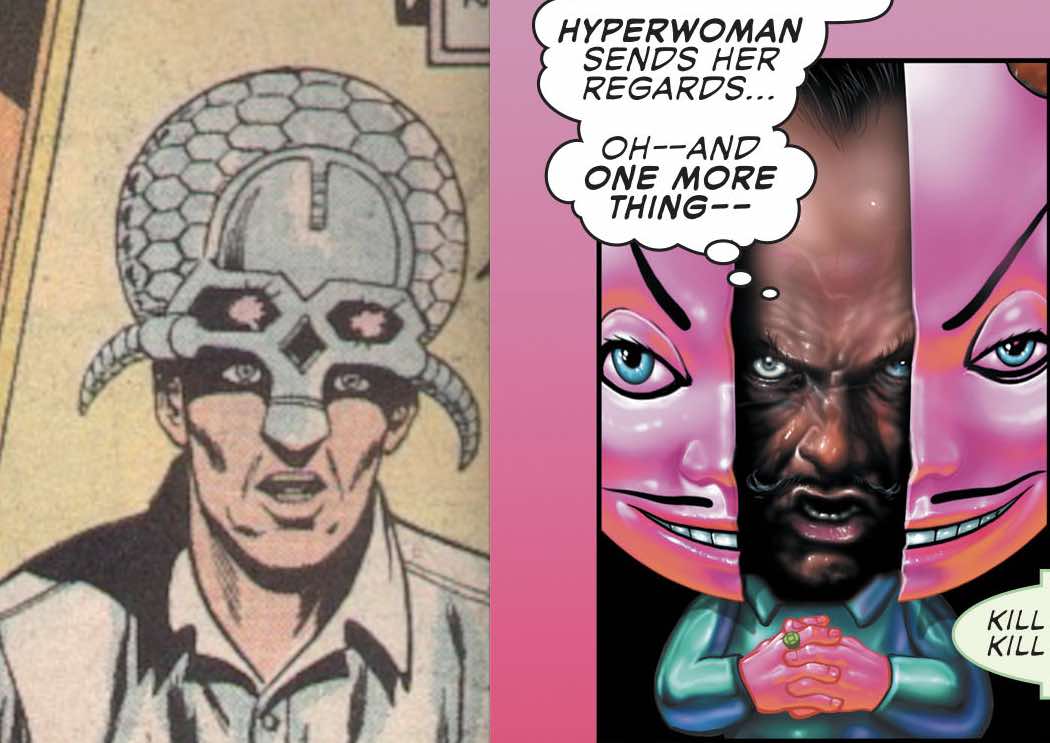
…and subsequently, the dark: Hal has found himself in the most dire of circumstances. His bosses want to end his time as a Green Lantern. His foes have planned his annihilation. The entire setup on Athmoora is modeled on the darkness of Game of Thrones, from the comically parallel issue title “Contest of Crowns” to the map of multiple kingdoms and Hector Hammond saying, “Hyperwoman sends her regards” paraphrasing a key line in Game of Thrones, “The Lannisters send their regards.” In both stories it is a threat. Like Batman in Batman, R.I.P., Hal is in a trap made just for him, with a new villain asking his old villains to participate. Like Superman in WHTTMOT, this is to be Hal’s final fate.

Or will it? We know the pattern in which the hero pulls out the win at the end. We might suspect that Hal’s bird nephews will bring the light aspect of comics to him and save him once again. This is the R.I.P. ending. But how will Morrison’s view of real world “mass consumption… mass destruction” play into this? And we already know that this series ending will not be followed by another series with Hal right away. Maybe according to Morrison’s final GL issue, maybe according to the plans of the writers who take over next, this really is a grim fate awaiting Hal Jordan.

Monday, February 8, 2021

The Green Lantern, Before the End

If The Green Lantern is to be Grant Morrison’s last work writing a monthly title for DC, the final two issues should be a grand gesture, long remembered. With twenty-five of the issues behind us, what can we say of Morrison’s love letter to Hal Jordan? Where has this journey led and how will it finish?

In some regard, Morrison’s earlier runs with Batman and Superman (on Action) are two of a kind, with this Green Lantern run as the third in a set. These are not just runs that start with a story, followed by another story, then another, until there’s a last one. Morrison builds a structure. His Batman run had, primarily, three arcs, with a Big Bad lurking in the shadows until late in each run. His Action run, the shortest, had just one such season, with one primary Big Bad, Vyndktvx. Morrison’s run, thus far, organized around three distinct titles of 12, 3, and 12 issues, has had one clear Big Bad in the first, but the third has not, so far, suggested any one central villain lurking.

All of these plot lines have rosters of villains backing up the main one; sometimes they are underlings of the boss, and sometimes they are parallel, lesser, but unrelated threats. The Batman stories had Doctor Hurt and Talia as the central villains, but Ra’s al Ghul, the Joker, and Darkseid’s Hyper-Adapter and several others played major roles. In Action, Vyndktvx was the central villain, but Super-Doomsday was pivotal, the muscle in some respect, to Vyndktvx’s brains. And in The Green Lantern’s first twelve issues, the Qwa-Man, Hal’s antimatter double, is something like that for Commander Mu.

The structure even for Season One (the first twelve issues, not formally named as a season) was more complex than “seasons” of Morrison’s other runs. It appeared, near the end of issue 6, as though Commander Mu’s plan had reached fruition, and he had just about built the machine at the center of his master plot, hinted as far back as issue 1, and then… he was killed, by Alanna, no less. Furthermore, Hal and the universe as a whole were at death’s door along with him. But then, late in #12, we found out that Mu had not died (and perhaps could not die), and the plan suddenly went forward just exactly twice as far into the story as when it had seemed to have been halted the first time. And just as before, Hal was faced with imminent death. Just as before, creating, and giving to Mu, the miracle machine (Geh-Jedollah, the very same ultimate wishing machine from Final Crisis) seemed to be the only way for Hal to save his own life. And then, once again, Hal feigned compliance but at the end of the three-issue mini-season, Green Lantern Blackstars, it turned out that Hal had a massive ruse going, letting the Blackstars win in a different universe. Belzebeth believed that she would be able to fight back, but, once again, Mu had turned out to have escaped death and perhaps to be beyond death. Even fifteen issues in, the run had turned out to be a sort of Möbius Strip of repeated subplots. Has Mu won? Has Hal? Yes, no, yes, no, yes, no, yes.

For Hal, too, being on the verge of death, and actually dying, has occurred three times so far: around the midpoint of each season, and then at the end of the first. Everything is cycling; the run is not only a flashback to each of the major themes of Hal Jordan’s publication history, but a repetition of them. Old girlfriends come up early in each season. The Qwa-Man and Zundernell come up in both seasons. Marriage comes up near the end of each season. Each season has a buddy team up with a Silver Age JLA member important to Hal’s lore: first, Green Arrow; then, the Flash.

And, of course, as with Morrison’s Batman run, this run features plenty of alternate Green Lanterns; what the League of Heroes and other imitation Batmen were in that run, the Green Lantern Corps and Green Lanterns of other Earths in the Multiverse (no pair being more memorable than Batman Green Lantern and Hippie Green Lantern) are in this one. Hal succeeds where Superman and the JLA fail in Season One, manipulates and bests Superman in GL Blackstars, fights and ultimately bests the Superman surrogate Hyperman in Season Two. Repetition is everywhere, until even Hal, in Season Two #2 (two twos like Harvey Dent is behind it) says, “Feels like I’m trapped in my own history.” Morrison’s Green Lantern run is a carousel ride, repeating Hal’s history while it also repeats itself. Girlfriends, Silver Age -style sci fi plots with aliens, coming back to Earth, going back to space, buddy team-ups, the anti-universe, death, weird doppelgängers, his Guardian bosses, betrayal, defeat, victory. It all repeats, then repeats again. Morrison’s GL run is a microcosm of Hal’s publication history, but it’s also a microcosm of itself, loops upon loops.

And what is the story of Hal Jordan? Limitless talent, limitless self confidence, limitlessly prone to screwing everything up and then getting it all back again. He works as a pilot and is on the hot seat. He works for the Guardians and is on the hot seat. His knack for disobeying authority makes him the ultimate inside agent to bring down the Blackstars from the inside. He faces death and survives. He even dies and comes back. He wins over the lady and then blows it. His real romance as Green Lantern is with the power ring, personified as Pengowirr in Season One. His big scary enemy, the (yellow!) Zundernell, he shrinks down into a harmless joke. He’s a little bit comfortable in absolutely every situation and at home nowhere. In Season Two, the big universe-ending Crisis on Infinite Earths gets remixed and turns into another riff. Morrison didn’t invent any of this – it all goes back to the dawn of the Silver Age. Morrison simply refines it and repeats it. And this is the perfect time to pause and consider the story before its final arc because in the last story line, a proposal to Carol Ferris just might break the loop couldn’t do that because, as Carol said, “In the end maybe but it’s not – it’s not the end… not yet.”

This isn’t just the story of Hal Jordan. It’s also a work – potentially his last DC work, potentially a touchstone work – by Grant Morrison, and it may be following one long, slow-developing story that is taking perhaps the medium and perhaps the author on a path towards disenchantment.

After Final Crisis, Morrison’s three high-profile series have been Action, Multiversity, and The Green Lantern. FC and Superman Beyond delivered a message of optimism about the medium, that Superman was bigger than the writers, bigger than any of us, and the story of Superman drew so much power from its optimism that it was destined to go on forever. But in the three subsequent runs, we see this optimism undercut by metatextual messages in the stories as Morrison works in subplots that are about the superhero medium and the superhero as merchandise. In Action, perhaps the most ominous foe faced by Superman is Superdoomsday, “a brand” with “maximum cross-spectrum, wide-platform appeal, a violent, troubled, faceless anti-hero... a global marketing icon.” In Multiversity, The Empty Hand, symbolizing the economic pressures on the publishers and The Gentry, symbolizing the market and market forces that pervert the heroes, often, into something darker and more sensational, reinforce the message that marketing and branding would lead to something violent and troubled. And while I didn’t see it at first, I feel sure that it is significant that the agents of The Empty Hand, seemingly sweet and benign but dark and possessed were the Little League of Earth-42. Above all others, these are the versions of the DC characters aimed directly at the youngest, most innocent readers. And is there a common thread here? Yes, definitely: The Little League first met darkness when Superdoomsday from Earth-45 arrived and killed their Superman. And by the time we see them in Multiversity Guidebook, they are evil, possessed, red-eyed agents of marketing as perverted into darkness.


And now, in The Green Lantern, two subplots echoed and built upon this pessimism. First, the darkly satirical metatexual opening to GL Blackstars #2 amplifies the grim tone of Heroes in Crisis, the Dark Multiverse, and other works, with a Depressoverse, culminating with a clearly Batman Who Laughs -inspired Batmanson who is infectious, making the real Batman, the paragon of conviction in the DC Universe, “give in.” Later, quite parallel to the Little Leaguers, the team-up with the Flash in TGL Season Two #4 introduces Hal and Barry and Olivia Reynolds to an enemy world of toys. The world itself is a toy, smelling of “canned plastic” and ultimately, Olivia’s career expertise in toys allows her to defeat them, but not before we see how dark these toys are in a very modern way, “beta-testing” the heroes, play until they break, and when the lead toy, Quing, is broken, how unsympathetically he is replaced with one of the others as the new Quing.

In all of this, we see the underlying optimism – an affirmation of the superhero medium – turn to a darker metatextual comment with marketing as the enemy that may corrupt superheroes for once and for all. And it may not be coincidental that this message has picked up pace now as Morrison is, perhaps, moving on.

And so, a run that is full of repetition is going to stop repeating soon, because the end is coming. The big finale (#11 and #12) will take place on Athmoora, a world first shown in two panels of GL #16 back in 1962. Morrison places Hal on Athmoora in Season One #9, where Hal visits just for the fun of the adventure of brawling in combat where his ring is weakened. That is one of astonishingly many times in the run that Hal has voluntarily forsaken the security of his ring, confident in his ability to face danger in any circumstance. Now he returns to that danger again. If we have just two issues left of new Morrison monthlies to enjoy, I will be enjoying them and looking forward to seeing on what directions he takes Hal and us in his finale.

Saturday, March 16, 2019

Green Lantern 2-5


1972's Starbreaker and his Daughter, Belzebeth
Take a writer. Take an established character. The run that results is going to reflect both of them, who the two of them have traditionally been. And then there are creative choices, where the writer chooses among possibilities. The Grant Morrison Batman of 2006 was not the Grant Morrison Batman of Arkham Asylum or Gothic and Morrison's Hal Jordan of 2009 is one out of maybe several choices he might have made. If it's a recipe, it's a stew, with lots of tasty things thrown in. So far, it's been a feast.

The Legend

Hal Jordan to some extent fits a template that Batman or Superman can fit but Animal Man cannot: He is an alpha character. Most superheroes seem super in the world of their own stories, but some of them are on a higher level. Superman at his best is the best and most famous and accomplished being in the history of the Universe. Batman at his best is unbeatable. Hal Jordan at his best is the most confident and capable hero who's ever wielded a power ring – the champion not just of his planet and time, but all planets and all times, capable of transcending fear and doubt in an absolute way.

Other writers have weakened Hal, making him a troublemaker, hapless at love, a drifter who can't hold a steady job, the predictable stiff who can't be as interesting as John Stewart or Guy Gardner, and even a drunk driver and psychotic killer.

Morrison can put Hal into heroic situations and ignore those weaknesses in his past, but instead, he's opening them up, acknowledging them, redeeming them. The heroic situations are many, to be sure, and provide pleasure after pleasure. It begins in #1 with Hal doing nothing but observe in amusement as the meganthrope destroys himself. Since then, he's gone on a tear of victory after victory. He doesn't fail, can't fail. He wins on the field of action, he enters every situation with unfailing confidence. Morrison is making Hal supreme in ways we've never seen before, superb as a detective, student of the cultures and civilizations of the 3600 space sectors, and even in the interrogation room.

But we also see Hal moving past the ghosts of his past. He dismisses his career failures as unimportant. He isn't, as the 1960 formulation of Hal went, utterly without fear, but, as he tells Countess Beelzebeth, "you have to know fear to overcome it, own it. Turn it into something you can use." He has been possessed by a demon, and having moved past that, has no inner demons. Geoff Johns, in Green Lantern: Rebirth explained Hal's greatest failings away, made them not really his fault. Morrison goes further, redeeming Hal totally. It's not just that he's not to blame. He's even better now because of his earlier defeats.

I missed posting single-issue responses, so I did not have time to dwell on, as I would have, the seeming anomalies along the way where Hal's rectitude was brought into question – most strikingly when we saw him execute a prisoner from Dhor at the end of #3. As we now know, this was part of a ruse, taking Hal's extremely-well-established trope of being in trouble with the Guardians and using it as a way for him to infiltrate the Blackstars. The haunting foreshadowing at the end of #1 about a traitor in the Green Lantern ranks turned out to be Hal, carrying out that ruse. Specfically, Morrison is creating one instance in which Hal, purportedly a traitor, is really acting from a position of good and within the system. Symbolically, Morrison is redeeming a history of bad behavior by Hal. He is a winner and none of the past charges stick.

The triumphs, then, in The Green Lantern are absolute ones, and follow a time-tested formula of showing the hero besting not only his ordinary enemies, but even extraordinary ones, and surpassing his fellow heroes. Thus, when Earth is shrunken and stolen (one may recall that Metropolis was shrunken and stolen at a comparable moment in Morrison's Action run), Morrison took Hal's rescue to new (and blasphemous) heights, with Hal Jordan putting what looked like the Christian God under arrest – a (symbolic) superfeat for the ages. Less of an affront to a major world religion but perhaps more significant in Morrison's worldview, the same issue also shows Hal as triumphant in wrestling Earth from the false god while Earth's other top-tier superheroes (including Superman, Batman, Wonder Woman and – particularly relevant to the GL Corp – John Stewart) were helpless to save the planet. Then, as yet another token of Jordan's supremacy, we see him put the entire population of Earth under arrest (whatever that means). In a tie-in to our times, Morrison serves up social commentary by implying that the population of the world, bent by mind control to accept their capture, didn't rightly know what they were choosing and "drunk in charge of an planet… jeopardizing their own lives and future generations" needed to be set straight by Hal – there's a deliberate parable there for political events in recent years.

The Mythology

While Hal is the single dominant figure in the story, the cast is not small. Tapping Hal's publication history, Morrison has gone broader than one might have imagined. Yes, Hal's up and down personal life (once represented by an unstable professional career, later leading to mass murder and death) has been mentioned, as well as other traits such as loose liaisons with romantic partners. And yes, we have seen quite an imaginative use of the vast GL Corps, freely borrowing from the imaginative output of earlier writers (Rot Lop Fan, the sightless, acoustic-based F-Sharp Bell created by Alan Moore) as well as offering some new GLs and twists on some old ones. But broader still, Morrison has drawn upon the sci-fi Silver Age as a whole, with villains from Dhor (introduced with Kanjar Ro in JLA #3). A particular emphasis has been paid to the legacy of Starbreaker, a JLA super-foe from JLA #96-98, a cosmic vampire who vastly outpowered Superman, Hal, and Barry before pausing to feast upon the Earth. Starbreaker's original cover art was used as the inspiration for Morrison's Mandrakk. (On a personal note, that story was a bit before my time, but I found the cover so cool that it was, I think, the very first older issue of a comic that I ever bought from a used comic store just because it looked interesting.) Here, Starbreaker's daughter, Countess Belzebeth (named for the Old Testament's Baalzebub with a feminine suffix tacked on) seeks revenge with a particularly bitter memory, Hal anticipates, for the way Green Arrow shot her father with a silver arrow in JLA #98.

At the close of #5, we see Adam Strange, the latest example that, for all of the expanse of Green Lantern history to choose from, it's clear that Morrison has some favorites, with a lot of focus on characters from the 1959–1965 era from which Hal himself originated.

Cop Shows

Contributing some drama, and quite a bit of humor, sometimes in the same panel, Morrison has imbued this run with the superficial qualities of a trope-heavy TV cop show. Morrison's fine ear for dialogue has resulted in some hilarious uses of these clichés, perhaps best when the false God, threatened with arrest, tells Hal, "Thos shalt ne'er make thine acusation stick." It's probably not a coincidence, either, that Hal works with GL Tagort in issue #4, and a British TV cop from Morrison's own Glasgow was named Taggart.

The Big Bad

Morrison's Batman run was as pure an example as you could imagine of an extended story with one central villain behind it. While the Joker, the al-Ghuls, and some minor figures popped up from time to time, the great majority of Batman's troubles there were due to a massive plan emanating from Doctor Hurt. To different extents, some of his other runs have also built up to a pivotal encounter between his heroes and one, profoundly menacing villain, someone worthy of demonstrating the ability of any hero who could defeat them.

In Morrison's run, Controller Mu is referenced at the end of the first issue. Mu is working on multiple threats at once. In order to construct the "ultimate asset," an ultimate will-powered weapon, requires obtaining five different components, of which a Luck Dial was second and Evil Star's starband the third. Component one was already in their grasp, an antimatter being that was apparently alive and formidable: They obtained it from a moth world, as seen in flashback in #4. It killed several pirates before they subdued it, then ambushed Green Lanterns Maxim Tox and Chriselon. This is apparently what they vivisect for its heart at the end of issue #1, an Antimatter Lantern that curious resembles Hal.

If they only have three of the five, we have to expect something big. Hal gave the Darkstars his ring, which seems likely to contribute, but since it was a ruse from the beginning, it is unlikely that he and the Guardians are knowingly (literally) handing them a victory. Either this ring is spiked somehow or they have a sure way to stop Controller Mu from getting/after getting the fifth component.

Whatever that ultimate weapon is, it suggests Morrison's use of this idea in Final Crisis, realized into an ultimate wishing machine (itself originating in a Sixties LSH story). Will-powered weapons are one of the roots of superhero comics (and certainly, centuries of stories before that) and Morrison seems sure to make a grand use of this idea before the run is done.

Multihero

There's a point in superhero comics where the creators really have fun with the hero by putting them in multiple, unusual situations, showing the hero's flexibility. There might be a hundred stories where Superman or Batman were cast as some sort of wild variant on what they normally are – a pirate, a cowboy, a magician, a movie star. Return of Bruce Wayne encapsulated that into a single work. But while that's old hat for Superman and Batman, Morrison is doing something we haven't seen much of with Hal in that position, showing him not only as a tough cop (the focus of the series), but in quicker, temporary roles as a noir figure (undercover in #4) and in a wildly un-Green-Lantern-like goth scenario on the planet of the vampires. Seeing a couple of these makes it seem likely that we'll see more, and I couldn't pretend to guess which ways that will go. Pirate Hal? Cowboy Hal?

Pending

Clearly, there's a design here for a story that will take a year or more to come around to where Morrison is planning. Hal ends #5 in a cliffhanger where he has to kill Adam Strange in order to continue his ruse. The teasers at the end of issue #1 are largely untapped, so there's a vast Multiversal storyline still ahead. We will see Controller Mu build his power and offer an ultimate challenge for Hal. There's a traitor within the Green Lantern ranks. And the free will of Hal vs. the authority of the Guardians remains a tension that could turn into something bigger. The Guardians have told Hal that if his undercover mission goes bad, they will disavow him. What could be a more ultimate challenge than to have the source of his powers revoked, and need to escape unjust persecution?

A decade back, Geoff Johns wrote a Hal run of 75 issues (plus lots of extras) that was truly for the ages. Now his friend Grant Morrison is on a mission to write Hal a new, defining epic. If it remains self-contained – no big crossovers like Darkest Night – it may not capture fan attention on the level of a Batman or JLA run or Johns' GL, but it has begun as compelling and well-balanced as any of Morrison's earlier big runs. I'll be sitting back and enjoying.

Wednesday, November 14, 2018

Green Lantern 1

"Nobody panic. Chill. I've got this." Hal Jordan makes everything (besides holding down a steady job and a healthy relationship) look easy. And in many ways, so does Grant Morrison. What seems, on most pages, like a light-hearted comic to breeze through in a few minutes carries a lot of history behind it, with some foreshadowing and a bit of brutality.

The first panels of the run begin with a bit of numerology. Maxim Tox (seen for the first, and, apparently, last time) is a Green Lantern of Sector 2018, which is not so coincidentally our current year AD. So watch his story carefully, for therein lies a parable. As soon as he begins his fight to the finish against an arachno-pirate, Rokk and Sorban, gamblers from the planet Ventura, make a wager on the fight. Though Maxim Tox (= maximum toxicity, or toxic platitudes?) takes an initial setback (losing his ring finger) in stride, with three Green Lanterns backing him up, he does not survive the issue. Floozle Flem, a sentient GL virus infects the spider villain, making him beg for mercy, and setting up Tox with an "in Soviet Russia" joke ("You catch Floozle Flem!"). With characteristic and unbeatably succinct wit, Morrison has the crystal GL Chriselon respond to Tox's high-spirited rhetorical question with a curt "Yes." while a chicken-looking GL, Trilla-Tru, celebrates victory with a chicken-sounding "buck buck-AW!" In the very short time that we get to know Tox, we find out that he's a member of his home planet's nobility and all that Morrison, a non-noble Brit, brings along with it, and then Tox dies.

So, in just a few pages, and before the title character makes his first appearance, we find out so much about the direction of the series. First, Rokk and Sorban troubled Superman and Batman back in the Silver Age, making two real appearances before seeming to appear for the second Superman-Flash race back in Flash #175 (1967), though it was really a pair of other villains in disguise. So, we know that Silver Age lore (from the time that Morrison was 7 years old) is in play. The crystal Green Lantern, Chriselon, is apparently the successor to Silver Age Chaselon, from the same sector of 1416; Chaselon debuted in GL #9 (1961) and was later written into Final Crisis (with the single line, "Cease and desist!"), but later killed by Black Lanterns. We also see hubris and comedy suddenly give way to tragedy, which suggests that what starts off as easy victories for our hero(es) are apt to take a much darker turn. Finally, we see that another Silver Age creation, the Luck Lords who debuted to bedevil the LSH in Adventure Comics #343 (1966) are providing the substance of a larger threat that will carry well past this issue, as a Luck Dial allows the villains to beat and the other three fun GLs. Right there, we have the makings of a pretty good idea of how the multi-issue story arc will go: Hal Jordan's extraordinary skill and confidence will be put to the test – more than he knows – by characters who can manipulate the very rules of time and chance. Along the way, we're going to see some fun and some skillful use of Morrison's gift of creating wonderfully new, and sometimes disposable, side characters. And it will get dark, but who are we kidding: This is Hal Jordan – Hal Jordan! – of course he's going to win.

As Hal appears for the first time, staring at the skies before a quick date with "Eve" we are promptly shown where in Hal Jordan lore Morrison wants to take us. This is not 1960s test pilot Hal or early 1970s social justice Hal (and Ollie). This is late 1970s/early 1980s hitchhiking Hal, who is only magnificent when he's in costume, and fails at one job after another as he travels America like a beatnik from On the Road without the fun. Except that Hal, full of self doubt, is nowhere to be seen here. This Hal accepts his career setbacks as collateral damage. When reminded of his job failures, he shrugs it off with a smile. If this Hal is going to prove complex, it will not be due to anguish. But note carefully the recent items on his resume – a gas station named "52 Pick Up" (a reference to playing cards, games of chance), selling toys (befitting a superhero icon), and selling insurance (what makes everything right when bad luck turns against you). So when there's bad luck, a superhero comes and makes everything right. There are no accidents in these details.

Along the way, Morrison shows us the defining traits of Hal, and they're the same ones I highlighted in my review of Final Crisis: It's not Hal Jordan if he's not in hot water with the Guardians. When the issue begins, he's already had his lantern revoked for upgrades… a detail that is likely to be explained more later. Then, after saving Chriselon's life, the Guardians summon him to New Oa and it is revealed that the Guardians know that there is a traitor-to-be within the ranks of the GLs and they know who it will be… a mystery pending future issues, but who is it? Hal himself? Hal is also supremely self-confident, and when another GL, Chriselon thinks that he will die, Hal tells him that he won't, and Hal is right. Chriselon also tells us that three extremely dangerous space criminals are on the loose, and Hal, never concerned, goes to confront them alone. (The crashed ship with a dying GL inside, as Hal notes, is a deja vu to Hal's origin, but this time, the dying GL lives!) And part of his supreme confidence comes from his supreme skill: Nabbing the criminals is almost effortless. In fact, he has a laugh at their expense: When the criminal makes himself larger, and tries to threaten Hal, Hal's response is to say that he will "Laugh my ass off, probably." He's cool enough to say that and cool enough not even to chuckle when his estimate is right, and the criminal's leg bones shatter painfully under his own weight. And this shows us a trait of Hal that not all writers have asserted: This Hal is smart. He understands physics, and engineering, and mathematics, and he knows when a Luck Dial is fake, when a bunch of attackers is a colony creature with one brain, and when a "bum"'s reaction to guacamole pegs him as a Horminth Collective from Cluster World 3. (And I'm reminded that Morrison's response to Frank Miller's All Star Batman included the comment that Green Lantern is smarter than Miller wrote him.) Morrison's Hal Jordan is Hal Jordan at his best. He is easily worth more than three other Green Lanterns, and he knows it. He doesn't do scared, he doesn't rattle, he laughs off the "trouble" of his vagabond life and the cycle of disapproval and begrudging respect that the Guardians show him. He is the epitome of Tom Wolfe's The Right Stuff: An American male at the top of his game, with skill and confidence amplified to the extreme and intertwined to an extent as pure and intense as the unadulterated green of a green laser. This Hal is as good at what he does as Miller's Batman is good at what he does. Don't expect to see a complicated man in anguish, struggling with life's challenges. Hal is ready to beat and smirk his way through any such challenges, give or take a gigantic space armada or two.

A challenge worthy of him, however, is looming. We know that the villains of this story arc are trying to assemble five powerful artifacts and they already have two. We know that they are seeking to acquire control over reality itself, changing the predestined facts in the Book of Oa, and inevitably changing the rules of luck in their favor. And in a grotesque surprise, we see that they have a Yellow Lantern version of Hal, somehow related to the weaponers from Qward, and are harvesting the heart from its dead corpse. This subtly evokes the world of Sinestro, and it's as inevitable that Sinestro eventually show up in this run as Luthor and the Joker did in Morrison's runs on Superman and Batman. The only one missing for now is Carol Ferris.

But Morrison's plans are big. A final teaser page shows us Hal's verdant buddy Green Arrow and the Green Lantern of Earth-20 (a befanged version of Abin Sur). It looks already like the plan here is for a series that will run a couple of years, and the challenge for Morrison is how to make his Hal as purely skilled and confident as he's communicating here and for Hal's challenge still to be challenging.

Monday, January 22, 2018

Final Crisis Retro Review Part II: The Darkseid Plot

Overview

The simplest superhero stories have this plot: There is a villain on the loose, and only the superhero is able to stop them. The villain evades capture long enough to keep things interesting, then eventually loses. Slightly more complicated is this: The villains get organized, and start by attacking the heroes first, to try to clear their path to victory. After some initial success, the villains still lose.

Final Crisis shows a world in which the villains win – really win – and take control of the world: Not just the most powerful villains, but the worst ones, dedicated not to mere wealth, but to absolute power and absolute evil. As in many older superhero stories, the villains begin by subduing the superheroes.

It's a vision we've seen before. Most literally, Grant Morrison had a subplot about Darkseid conquering the world in his JLA story "Rock of Ages." There are few literary works more compelling than George Orwell's "1984," in which the politics of control meld with science fiction and subject the Earth's population to control over thoughts as well as over their physical bodies. Orwell's novel had its own forebears including the historical example of the Nazi domination of Europe and Stalinist domination of Russia and Eastern Europe.

Darkseid was, from Kirby's original work, deliberately patterned on Hitler. Final Crisis shows what happens when Darkseid wins, making Darkseid's Apokoliptan regime an analogue for Nazi Germany and the Darkseid-occupied Earth an analogue for Nazi-occupied Europe. A few weakened and isolated superheroes and other characters fight back, serving as an analogue for, say, the French Resistance, until finally the A-list superheroes retake the field and wipe Darkseid's rule away in a matter of minutes; here, those superheroes serve much the same role that the U.S., U.K., and Canada played in liberating Western Europe.

In FC, the bad guys do more than conquer half the world; they get virtually everything, and it is nearly to the point of destroying all reality. There is resistance remaining led by some scattered superhero groups under Mister Terrific, Alan Scott and Black Canary, by various governmental agencies, by a few survivors in Japan led by Shilo Norman and Sonny Sumo, and a couple of upstart supervillains. None of them stand much of a chance. Then, one at a time, DC's biggest heroes face off against Darkseid and take him down like a quintet of bowling balls hitting one pin.

The Darkseid plot of Final Crisis is, essentially, a very common, simple story with all of the variables set to their maximum values: The worst villains do the worst things and inflict the worst damage before the best heroes set things right with the best tools in the best way. This is a superhero-vs-supervillain story refined to its purest essence.

Themes

There are several interesting motifs common to past Morrison stories and his major influences shape the Darkseid plot:

• A time loop: Darkseid dies sometime around 2008 but falls into the past and is reborn on Earth for Seven Soldiers around 2005.
• A second time loop: Darkseid fires a bullet in FC #7 that goes into the past, exploding in Orion's brain in FC #1, then burying itself under the sidewalk 50 years in the past. John Stewart gives it to Batman, who uses it to shoot Darkseid in FC #6.
• A third time loop: Kamandi tells Anthro that people in the future will need the symbols he got from Metron. Thereby, Anthro writes them on a cave wall, and those symbols are ultimately passed on to save the day in the Final Crisis.
• A fourth time loop: Batman appears in the cave way back in Anthro's time, bringing with him superhero emblems that he turns into cave art, to put the superhero idea into humanity
• A fifth (!) time loop: Brainiac Five gives Superman knowledge of the Miracle Machine, which was based on the diagram on Metron's costume all the way back in FC #1. Superman takes that into the LSH's past, his own present, and uses it to save the future.
• Sneak attack: After the September 11 attacks, several Morrison stories feature villains making a sneak attack that circumvents defenses rather than a full frontal attack that tries to overwhelm the superheroes by force. Darkseid builds an organization that establishes his presence on Earth, recruiting allies and planting spies, before covertly taking out key threats and finally assaulting Earth's freedom in one, swift blow.
• A scattered team: In Seven Soldiers, the heroes are never present in the same place at the same time. This is also true in the victory of the biggest heroes at the end of FC, with Batman, the two Flashes, Superman, Wonder Woman, and Green Lantern making their attacks in that order.
• References to unheralded stories from the Silver Age, including The Human Flame (1959), the Miracle Machine (1968), Superman making the entire world's population safe while a catastrophe is resolved comes from "The Man Who Murdered the Earth!" (1972), Libra (1974), the Flash winning a race for his life with Superman as the finish line (1977, more details below) and the Manhunters as a corps of pre-Green Lantern servants of the Guardians (1977), now re-imagined as Alpha Lanterns.

As the ultimate DC superhero–supervillain story, the Darkseid plot it gives us start-to-finish, alpha-to-omega, big-picture views of superhero history organized in multiple fashions:

• Publication history: FC has multiple categories of hero, representing different eras of comic books, including ordinary detectives like Dan Turpin, Golden Age heroes who came and went, government agents like Checkmate, Kirby's gods, second-tier superheroes, and the first-tier superheroes. Their success in opposing Darkseid correlates closely with their prominence in DC history. So, Batman strikes a crucial blow whereas the vastly powerful but never highly popular Martian Manhunter dies.
• Sources of superpowers: Extra significance is given to magic words, magic signs, and will-powered machines. While many comics accept these old ideas with no fanfare, FC presents the ideas over and over as though they are incredible and new.
• Past to future: FC spans human history from Anthro to Kamandi, and they are used as bookends who bracket the larger story, and briefly meet.

The Attack

Darkseid's attack is multipronged:

Preparation
• Glorious Godfrey is an African-American televangelist undermining public sentiment.
• Mokkari and Simyan are creating genetically engineered versions of soldiers based on tigers.
• Granny Goodness possesses an Alpha Lantern, Kraken.
• Desaad possesses Mary Marvel.
• Mad Hatter technology is used to build mind-control helmets.
• The Dark Side Club, as shown as the evil force in Seven Soldiers Mister Miracle subplot, is kidnapping children and subjecting them to the Anti-Life Equation.
• Libra recruits supervillains as a prophet converting them to a religion of crime.

Initial Strike
• Orion is killed by a gunshot from the future.
• Libra kills Martian Manhunter to impress supervillains.
• John Stewart is attacked as he investigates Orion's murder scene.
• Hal Jordan is implanted with a suppressor chip to hide Granny's presence.
• Hal Jordan is framed for Orion's death.
• Batman is subdued and captured by Granny / Kraken.
• Lois Lane is injured critically, forcing Superman to remain at her bedside.

Takeover
• The Anti-Life Equation is broadcast globally, turning most people into slaves.
• Mary Marvel attacks Wonder Woman, infecting her with Morticoccus.
• Armies of Justifiers and other Darkseid slaves try to finish his conquest.

The Long Story

As I noted in my Kirby Fourth World retro review, a lingering mystery regarding the entire body of work is: Why Earth? With such a cosmic scope, why would gods trouble themselves so much with one planet? Morrison gives us a long story in which this makes sense, a literally biblical, literally cinematic story sketched in extremely broad strokes, in which Earth has always had the potential to produce the gods who will surpass the Fourth World's evil gods.

Metron arrives in his chair before Anthro, the first boy, and plays a role synthesized from many different myths: This is Early Man receiving technology from the aliens (2001: A Space Odyssey); this is Prometheus receiving fire from the gods; this is the angel telling shepherds that the savior will be born.

Metron says, "Have no fear. Here is knowledge." That line closely echoes the New Testament's angel visiting shepherds, "Do not be afraid; for behold, I proclaim to you good news of great joy that will be for all the people." (Luke 2:8-20). Metron gives Anthro fire and two symbols. The symbol on Metron's forehead is a vaccine against the Anti-Life Equation. The symbol on Metron's chest is a diagram for the Miracle Machine and we see it directly in the design when Brainiac Five shows it to Superman in the 31st Century. Fire is to Anthro's people precisely what the idea of tools is to the primitive men in 2001 and they promptly use it to win a battle while Metron's other knowledge plays a role, like the spacecraft in 2001 in the distant future.

Kamandi speaks across time to Anthro, telling him that they need the symbols. Thereafter, humans on Earth have the promise of future greatness. Darkseid's final battle for domination of the universe therefore takes place on Earth, and his forces show an awareness of this when Granny asks, on Oa, if the central power battery is the gift that Metron gave humanity. Ultimately, we see heroes born on Earth, plus Superman who was raised there, as the humans raised above gods who are the ultimate winners.

Liberation

The timeline isn't very precise, but Darkseid's forces control the Earth for "a few weeks" and then, from a position of absolute victory, he's taken down and out in what must be a matter of mere minutes by DC's A-list superheroes, who not only defeat him, but also erase him and his deleterious effects on the world completely. There are essentially five DC superheroes who are winners in this story while all the rest – the Hawks, the Atoms, Green Arrow – are B-listers who make a good show but don't quite measure up. Of the Big Five, four smack down Darkseid while the fifth eliminates Mandrakk. Those five, the top tier of DC superheroes are:

Superman, Batman, Wonder Woman, the Flash, and Green Lantern.

It's a little more complicated that that because we have, in the end, multiple Supermen, two Flashes, and multiple Green Lanterns. But if we see each hero as a "brand," those are the five brands that come out on top, the winners.

Contained within FC's main plot are subplots for each of the Big Five. The obvious intent here is to give each of them a plot that is very refined as a sort of pure, refined version of the character's stories over the years. These are highly personalized subplots: We don't see, for example, Wonder Woman on trial and the Flash pulling something out of a utility belt. Morrison puts the Big Five into cliched versions of their most stereotypical stories because these are, ultimately, what made those characters so endearing and so popular. The plots are as follows:

• Wonder Woman is made captive, which renders her helpless. When she is freed, she turns the tide, in turn making the villain her captive. "It was Wonder Woman who bound Darkseid's body. With her lasso of truth, she chained the god of evil. And no one was hurt." What a beautiful line, particularly the final note, for a character associated as much with love and peace as with being a warrior. What that line communicates, poetically, is that Darkseid's hypnotic grip over 3 billion people was commanded to end by Wonder Woman with her lasso – a peaceful solution that nobody else could have brought about. We also see her comforting children both before and after the main action of the story. Though she spends most of the story as one of Darkseid's Furies, her star turn as one of the heroes saving the day is inspired.

• Batman is also made captive, and is put into a slow-acting death trap, from which he escapes to rain hell from inside the villain's own headquarters. Mokkari and Simyan attempt to clone Batman and make an army of Batman warrior, but Batman uses his own memories as a weapon, punishing the Lump, who is psychically transferring Batman's thoughts to the clones, and causing the clones to perish spontaneously. Batman psychically convinces the Lump to set Batman free, and then Batman uses Mokkari's abandoned gun to confront Darkseid. Pulling the almost ridiculously right thing out of his utility belt at exactly the right time, Batman uses the bullet that killed Orion to shoot Darkseid. The purest historical example of this ridiculous rightness of Batman's accessing a gadget might have been in the movie Batman (1966) when Adam West deals with a shark by pulling a can of Bat Shark Repellent out of his utility belt. As elaborated upon in Morrison's issues of Batman, Batman shooting Darkseid literally changes the entire nature of heroes facing evil. We can contrast this Fifth World event with the Fourth World confrontation between Mister Miracle and Boss Dark Side, in which Darkseid shoots Shilo Norman in the head, calling that his "first and last lesson in cosmic Realpolitik." In Batman's version, it's Darkseid getting shot (after, quite pleasingly, Batman cuts Darkseid off with, "Do I make myself clear?") and Batman gets his revenge for the month he'd spent in the Evil Factory. "Gotcha."

• As revealed on the last page of DC Universe #0, Barry Allen returns from the dead and his passage through sci fi / spiritual realms gives him knowledge regarding Darkseid's plan. Allen has to outrace death, and lead the Black Racer to a time and a place where death personified claims Darkseid instead of himself – killing two birds with one stone. Of course, it's no surprise that the Flash prevail by winning a race. In the execution (pun intended), this may be a conscious or subconscious reference by Morrison to a Silver Age story in Flash #249 in which a deadly super-powerful disembodied fist is following Flash, keeping pace with him, and will inevitably kill him when he tires and it catches him. Allen leads the fist to Metropolis, runs (vibrating at super speed) right through Clark Kent, and allows the fist to punch Superman harmlessly, and thus ending the threat. The tactics are very similar to the race that ends in Final Crisis #7, also running right by/through Superman and (look closely) through Darkseid so that the Black Racer continues the death of Darkseid set in motion by Batman's gunshot in the previous issue. Flash's race is also one of community, having been begun with Jay Garrick, continued with Wally West, having a break so that Barry can reunite with Iris, and is his reintroduction to the Justice League as Superman sees the red blur and comments, "Barry Allen?" A particularly nice ambiguous line is when the Flashes' arrival is announced with, "And then it seemed as if the sun had risen in the West." (as if the son had risen in [Wally] West). As with all other aspects of Final Crisis, the Flashes' race is not a twisty or arbitrary plot but simple, even clichè, and even predictable. When one reader posted on a message board that they wondered, after Final Crisis #2, what was coming next, I responded, "I know what's coming. The Black Racer's win-loss record in races is 9,378,621 to 0 but it's about to be 9,378,621 to 1 because now he's racing Barry #^!#!$& Allen." All of these superhero subplots, in isolation, were equally predictable if you knew that Morrison was giving us them at their most typical and finest.

• Going back to his original conception, three hallmarks of Hal Jordan are (1) Perpetually getting into trouble, (2) Fearlessness to the point of flippancy, (3) Winning effortlessly against impossible odds. While gods are dying, civilization is disintegrating, and Hal himself is framed for murder, Hal Jordan reacts to the Final Crisis like it's not even a big deal, telling Wonder Woman after his arrest, "I'll be fine." While even the other A-listers are battered, chased, enslaved, and besieged, Hal comfortably walks through the paces of his arrest and trial, knocks down one of the evil gods with a non-power-ring punch as the first significant win by any of the heroes, holds out his palm to get his power ring returned to him like a kid getting candy on Halloween, and shows up on Earth in time to strike the final winning blow. Hal's turnaround on Oa is so quick, so absolute, so effortless, I called it my second-favorite scene of the decade. As I note there, Hal manages to beat Kraken despite being the only person in the room who doesn't have a power ring and wins the same matchup that Batman had lost in FC #2. Hal's plan for what his strike force will do to Darkseid when they get to Earth is "kick his ass." He doesn't even need everyone's help, just "anyone who wants to." He's the god of confidence, cowboy cool reimagined as a flying spaceman. He doesn't believe merely that the Final Crisis is winnable, but that it isn't even going to be that hard. Ultimately, Hal and the Green Lanterns show up in time to defeat Mandrakk, not Darkseid, but as far as Hal is concerned, and as far as we get to see, he might have been able to win everything all by himself.
  
• Superman is the Alpha Hero on the A-list. His devotion to others is his vulnerability, so he is made hostage at the bedside of his injured wife, Lois Lane. After triumphing on two massive side adventures, Superman appears late in Final Crisis #6, after John Stewart and Supergirl note that the heroes need "more firepower" in the form of her "big cousin." When Superman does appear, enraged by what he sees, his flight to Darkseid's command center leaves heroes and villains falling in his wake. Without pausing at the door, he smashes his way in with one punch – his only use of direct force in the FC title itself – and for the duration of the story does no more than utilize his voice and his craftsmanship as a super scientist. His dialogue articulates the appropriate tone of horror in response to Darkseid's madness; then, when the slain Darkseid lingers as a malevolent ghoul intending to use the Miracle Machine against him, Superman dissipates Darkseid like a puff of smoke by singing a super-loud musical note. The construction of the Miracle Machine is Superman's greatest contribution to dealing with Darkseid, giving him one wish to fix the damage, a wish which was ultimately, "only the best for all of us." As important as Superman was to the Darkseid plot, he is absolutely central to the heroes winning in the Monitor plot, which is the topic for my next FC post.

Simplicity, Complicated

The Darkseid plot of Final Crisis has as its backbone one of the simplest superhero story ideas: Bad guys attack the superheroes, succeed initially, victimize innocent people, and then the superheroes turn things around. Morrison amplifies those simple things in scope and extent, and twists and tangles it up with five or so time loops, but he never deviates far from the formula. Along the way, he tells the story of pulp detectives, many different eras of costumed adventurer, and the basis of superheroes' superpowers. We see that some heroes are more potent than others, and that the worst evil, Darkseid, is greater than most heroes, but not equal to the top tier of DC's pantheon

Most of the seven issues of FC narrate the Darkseid plot, and it's not hard to imagine a relatively clean edit that eliminated the Monitor plot and left simply the Darkseid plot. That would have been a pretty good event. I think almost every reader, with a little effort, "got" the Darkseid plot. A standalone Darkseid plot without the Monitor plot might have been better received by many readers, for whom the Monitor plot was perceived as a confused and unnecessary add-on. A version of FC like that would have been a fine story, but it would have been something very much less than Morrison's intention. It would have been a very big story, but not the Final Crisis.


In my next FC post, I'll break down the Monitor plot. I don't think the majority of readers really "got" it. Some very thoughtful readers have posted many insights, but they don't agree that much on what the Monitor plot meant; there is no clear and detailed consensus. But I believe this: There is a reading of the Monitor plot that is extremely clear regarding Morrison's intentions. It is not a random add-on to the Darkseid plot. It is not a vague message about stories and readers and writers: It is a wonderful and unforgettable and essential storyline. It is a story to make you smile and cry and a story to love. It has an exceedingly specific point. It is for a very specific reason and a very good reason that Mandrakk appears right after Darkseid is defeated. I think that any reader who becomes aware of this reason will never forget it and will enjoy Final Crisis much more than they did before they were aware of it.  And that's my cliffhanger. Coming very soon (Doomsday Clock #3 will get my attention in the interim): My breakdown of the Monitor plot.

ADDENDUM: I thought I might add this to the Monitor post, but it may best belong here: The Element X that Superman obtains from Metron's chair comes from Forever People #7. It is not necessarily the Worlogog, although the art makes it look, ambiguously, similar.